Hiroshima okonomiyaki
Okonomimura Audio Guide
Three floors of small okonomiyaki restaurants, partition to partition, born from fourteen postwar street stalls evicted from the square opposite. Behind every griddle is a city that had to earn a living among the ruins.
- 60 min of audio
- Postwar food culture
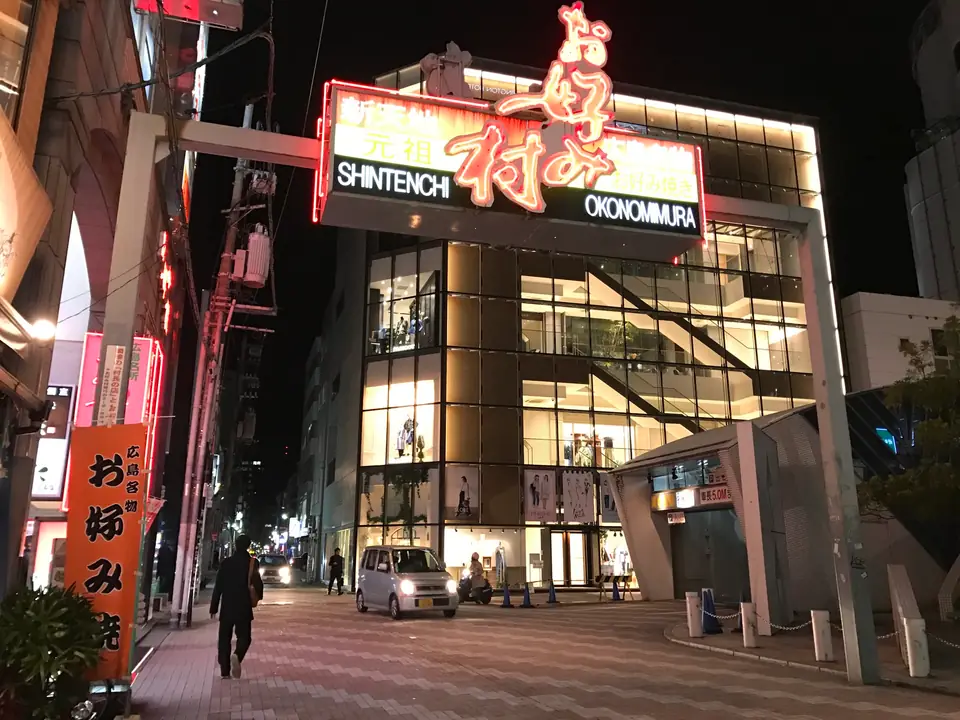
Okonomimura, the “okonomiyaki village”, occupies the 2nd to 4th floors of Shintenchi Plaza, a seven-storey concrete building completed in January 1992 opposite the old Nishi-Shintenchi square, today Alice Garden. Its roots are the street food stalls that appeared around 1950 on Chūō-dōri; in 1965, evicted from the squares, the 14 stalls that found no other place struck a deal with the city and founded the village. With the 1992 building they went from 14 to 27 restaurants.
It was named by a phrase of the writer Kida Minoru on seeing the row of stalls: “This looks like an okonomiyaki village”. It was no casual remark: Kida had studied with Marcel Mauss at the Sorbonne and in 1948 had won a prize with a chronicle of village life in Tokyo, where he lived some 20 years in an abandoned temple. On the ground floor, a stone jizō remembers the children killed by the bomb.
Highlights
- Alice Garden — the square opposite, from which the stalls were evicted in 1965
- Stone jizō — 1.7 m raised in 1992 for the children killed by the bomb
- Griddle counter — eaten straight off the iron, with the cook in front
- Momotarō — a restaurant that still cooks on the griddle of the street stalls
- Sauce war — Sunfoods here, Otafuku in the rival building two doors away
The story of Okonomimura begins in the street. Around 1950, shortly after the war, a cluster of food stalls appeared on Chūō-dōri, okonomiyaki and ramen among them. In 1957 they moved to two squares, Nishi-Shintenchi and Higashi-Shintenchi, where close to 50 stalls came to operate, and in 1965 the squares were landscaped as a park and the stalls were evicted. Some, such as Micchan, Rei-chan, Zen-san and Henkutsuya, looked for premises on their own; the other 14 founded Okonomimura in December 1965. The sources do not fully agree on the dates, and some place the eviction and the first building in 1963.
The village was conceived by Furuta Shōzaburō, of the Chii-chan stall, its first “mayor”, and Sumida Kazuya, of the local food wholesaler Sumida, who in 1967 raised on the present site a two-storey prefabricated building of 260 square metres for 14 restaurants. That building entered the school-trip routes and Okonomimura became a tourist attraction, with 70% of customers from outside the prefecture. In November 1990, because of the building’s deterioration, the fire department’s instructions and the approach of the 1994 Asian Games, it closed and moved to temporary premises, until the 1992 building. How many restaurants it has today depends on whom one asks: the figures range from 23 to more than 25.
The audio guide covers Okonomimura in four stops, from the square opposite to the griddle counter on the 2nd floor, with documented narration checked against historical sources.
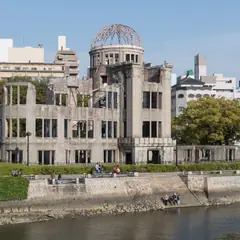
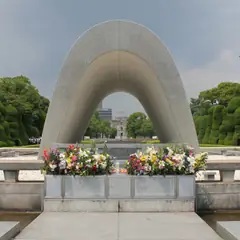
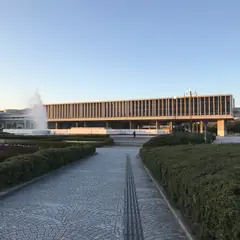
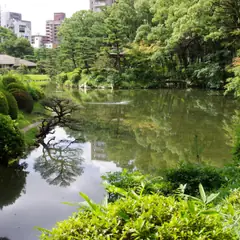
The reconstruction that these griddles fed has its counterpoint in the Atomic Bomb Dome, the ruin the city decided to keep, and in the Peace Memorial Museum, about 800 metres as the crow flies. A little over a kilometre away lies the Shukkeien Garden, whose restoration began in 1949, in the same years when food stalls filled the streets.
The square the stalls were thrown out of
Alice Garden
Summary of this stop
Opposite the building opens Alice Garden, the old Nishi-Shintenchi square. Its value lies in what is missing: from 1957 the street okonomiyaki stalls lined up here, with names such as Momotarō, Chii-chan, Henkutsuya or Rei-chan, cooking on iron griddles and serving until very late.
In August 1965 the square was still full of stalls, and neighbours helped one another with batter and vegetables. In October the city banned its use and expelled them all, and from that eviction the village was born. What life was like at one of those stalls, from the charcoal briquettes to the arguments over the sauce recipe, is the scene the narration reconstructs in the square.
A stone jizō for a sister
Ground-floor stone jizō
Summary of this stop
Beside the entrance, at street level, stands the Shintenchi Jizō-son, a 1.7-metre stone jizō with its pedestal. It was erected in early 1992, the story goes, by Sumida Kazuya, the wholesaler who had built the 1967 building and the present one, in memory of the children killed by the atomic bomb. He died in November of that same year, at 71.
For almost everyone passing on the way to okonomiyaki it is one more statue on an entertainment street. Behind it lies a family story, that of a farewell at Hiroshima station before the war, which the narration tells before the jizō with the delicacy it calls for.
Signs ending in “-chan”: widows, daughters and a mayor
2nd-floor restaurant corridors
Summary of this stop
In the corridors of the 2nd floor one understands why this is called a “village”: small restaurants separated by a single partition, each with its own name and its noren curtain, like a row of kitchen-houses. One of them is called Chii-chan, like the stall of Furuta Shōzaburō, the first “mayor” of 1965.
Many signs end in “-chan”. The most repeated tradition says they come from women who lost their husbands in the war or in the bomb and opened a stall to earn a living; another version holds that they were so returning soldiers could find their families. The story of some specific signs fits neither, and the narration explains why before the signboards.
The griddle that comes from the stalls
Momotarō griddle counter
Summary of this stop
Almost all the seats are at a counter that is one large iron griddle: the cook works in front of the customer and the food is eaten straight off the iron with a spatula. On the 2nd floor, Momotarō, run by two women, still cooks on the griddle from the street-stall era, and Shin-chan has been operating since then and has been open for some 60 years.
The sauce has its sides too. All the restaurants in Okonomimura use Sunfoods as the official one, while two doors away Okonomi Kyōwakoku Hiroshima-mura has Otafuku, and its opening was experienced as a “sauce war”; between the two buildings is Honke Sonchō no Mise, which belongs to neither. What that inherited griddle says about postwar Hiroshima is what the tour closes with, as the iron sizzles.