Garden of the Asano lords
Shukkeien Garden Audio Guide
An Inland Sea in miniature, with islands, bridges and hills, made to be contemplated at leisure. In 1945 it was refuge, firebreak and grave, and what looks intact today is a mix of survivors and reconstruction.
- 60 min of audio
- Miniature landscape
Shukkeien Garden began to be built in 1620, a year after Asano Nagaakira received the domain of Hiroshima, as a villa with a garden beside the Kyōbashi river, commissioned from his chief counsellor and tea master Ueda Sōko. After the great fire of 1758, the seventh lord, Asano Shigeakira, brought in 1783 the Kyoto gardener Shimizu Shichirōemon, who remade it almost from scratch; from that reform comes the form seen today, with the Takuei-chi pond and its granite bridge of 1786.
In 1940, five years before the bomb, the State designated it a National Place of Scenic Beauty. On 6 August 1945, some 1.35 kilometres from the hypocentre and designated as an evacuation site, it filled with the wounded; many died there almost without treatment and were buried inside the garden itself. Of the whole only the Kokō-kyō bridge was left standing, along with three trees that are still alive today.
Highlights
- Kokō-kyō bridge — the 1786 granite arch, the only structure in the garden that withstood the bomb
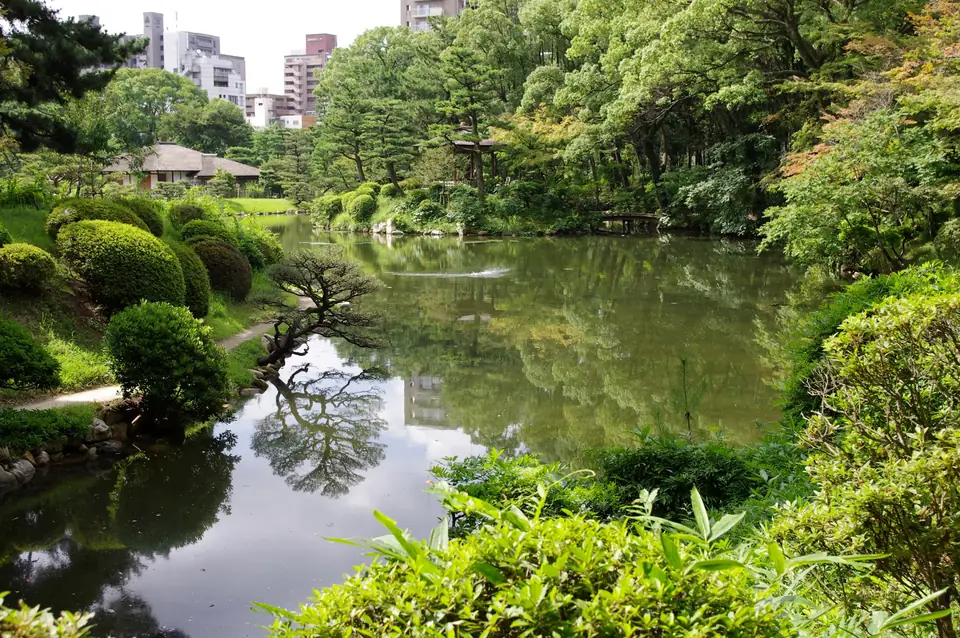
- Takuei-chi pond — about 8,000 m² with 14 islands imitating the Seto Inland Sea
- Great surviving ginkgo — about 17 m tall and more than 200 years old
- Memorial by the river — where the remains of 64 victims appeared in 1987
- Yūnenjō rice paddies — where the lord planted rice, with a festival every June
The story of Shukkeien Garden is that of a landscape that has been made twice and saved once. It was begun in 1620 by Ueda Sōko, a tea master, for Asano Nagaakira, and remade from 1783 by the gardener Shimizu Shichirōemon for Asano Shigeakira; how much of the original layout remains and when that great reform ended are questions on which the sources differ. In the 19th century it was the setting of an imperial visit: with the Imperial Headquarters moved to Hiroshima, Emperor Meiji came on 6 November 1894 and watched an exhibition bout held in his presence. At the end of 1939 the Asano family offered it to the prefecture, which accepted it in 1940.
Even its name has a history. It was officially called Sensui yashiki from its construction and Sentei from the Meiji era until the war; Shukkeien, “garden of reduced landscapes”, has only been its official name since the postwar years, although it already appears in a text of 1713. One version attributes it to Ueda Sōko having “reduced” the landscape of West Lake in Hangzhou, and another to the preface of a poem by Hayashi Razan for the second Asano lord. Restoration began in 1949, the garden reopened in 1951 and the works ended in 1974.
The audio guide covers the garden in five stops, from the entrance plaque to the lord’s rice paddies, with documented narration checked against historical sources.
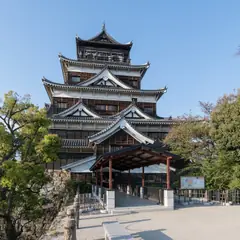
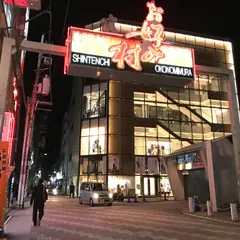
The Asano ruled the domain from Hiroshima Castle, where in 1894 the Imperial Headquarters was installed that brought Emperor Meiji to this garden. A little over a kilometre as the crow flies, Okonomimura tells another side of the city’s reconstruction, that of the postwar food stalls.
The 1945 photo beside the gate
Garden entrance
Summary of this stop
Beside the entrance, the municipal atomic bomb plaque number 18 shows a photo from October 1945 taken by Matsumoto Eiichi: this same garden turned into a devastated field, some 1.35 kilometres from the hypocentre. The contrast with what is seen on crossing the gate is the first key to the place.
It was then the Asano villa, and it had a museum of its own. In 1913 the family opened inside the Kankokan, a Western-style museum with its collection of paintings, armour and tea utensils, free on even-numbered days and with some 3,500 visitors a month. The bomb destroyed it, and on its site, to the southwest of the garden, the Hiroshima Prefectural Art Museum stands today. What name the garden bore when that photo was taken is one of the details with which the narration opens the visit.
The garden without trees to spot intruders
Seifūkan Pavilion
Summary of this stop
In front of the Seifūkan pavilion, the largest building in the garden, raised in 1964 with a bell-headed window on its east side and home to the seasonal tea ceremonies, it is understood that this garden has had two lives. The first was that of Ueda Sōko, who laid it out outside the castle grounds, some 600 metres to the east, when daimyo gardens usually lay inside the walls for security. That is why its first design had very few trees, grass-covered hills and gravel around the tea pavilion: an intruder would have been seen at once. Of that plan remains the island of Chōzenkyo, with its thatched-roof pavilion.
The second life came after the great Hōreki fire of 1758, with the Kyoto gardener who remade the whole from 1783. From that period comes a tradition about the stone bridge and a lord demanding about its curve, which circulates in two versions and which the narration tells in front of the pavilion.
The only arch that withstood the bomb
Kokō-kyō Bridge
Summary of this stop
The Kokō-kyō bridge, completed in 1786, is a granite arch 27.4 metres long and 2.1 wide that splits the pond in two, and on 6 August 1945 it was the only structure in the garden that the bomb did not destroy. From its top the Takuei-chi pond is overlooked, some 8,000 square metres, with 3 crane islands and 11 tortoise islands, seven on each side of the bridge, representing the islands of the Seto Inland Sea. In the background rises the Geiki-hō hill, about 10 metres high, imitating Mount Fuji.
The water comes from the Kyōbashi river, brackish because of its closeness to the mouth, and that is why freshwater carp and sea mullet swim together in the pond. Those same waters were, on the morning after the bomb, the setting of an episode recorded in survivors’ accounts, which the narration tells over the arch with the respect it deserves.
The 64 buried beside the river
Riverside victims' memorial
Summary of this stop
At the edge of the garden beside the river stands the victims’ memorial. The garden was designated as an evacuation site in case of bombing, and on 6 August 1945 it filled with the wounded; many died there almost without treatment and were buried inside the grounds. That afternoon, on the bank, the wounded Jesuits LaSalle, Schiffer, Kleinsorge and Cieslik took refuge, in the place that Western accounts call “Asano Park”, and there a whirlwind uprooted large trees and raised over the water a waterspout some 100 metres high.
The memorial occupies the exact spot of a forgotten grave. In 1945 Matsumoto Eiichi, a photographer for the Asahi Shimbun, photographed a sign marking bodies buried at the foot of a tree killed by the bomb; from that photo an excavation was made in 1987 and the remains of 64 people appeared. On this same bank, a Methodist pastor took part that day in a rescue by boat and a fight against the fire with water from the ponds, a documented story that the narration gathers here.
The lord who planted rice here
Yūnenjō rice paddies and Kōsaiho tea garden
Summary of this stop
In the east zone, four small rice paddies, those of the Yūnenjō, and the Kōsaiho tea garden keep an Asano custom: the feudal lord harvested tea and planted rice inside his own garden. Today it is repeated every year, with the tea harvest festival at the end of April and the rice planting festival in mid-June.
The garden surrounding those paddies was rebuilt piece by piece after the war, and its pavilions, such as the Seifūkan of 1964 and the Meigetsutei of 1974, are reconstructions. But three trees, a ginkgo, a muku and a black pine, are registered by the city as survivors of the bomb at 1,370 metres from the hypocentre. The ginkgo is about 17 metres tall and about 4 in girth, and its age is calculated at more than 200 years. What is said of whoever rests a hand on its trunk is the popular belief with which the tour ends.