Historic monument
Kowloon Walled City Park Audio Guide
Beneath the ponds and pavilions of a 1995 garden lies the densest city the planet has known: some 33,000 people on 2.6 hectares, towers held down by the planes of Kai Tak and a limbo that three governments left ungoverned.
- 45 min of audio
- Jiangnan garden
In 1847 the Qing administration raised a walled garrison town here, with six watchtowers and four gates, to watch over Hong Kong Island, occupied by the British in 1841. The 1898 convention left it out of the New Territories lease, in 1899 British troops expelled the mandarins and soldiers, and that vacuum of authority ended up shaping a semi-lawless enclave that was demolished between 1993 and 1994.
Of the fortress and the vertical city that replaced it, only the 1847 Yamen, with the English word ALMSHOUSE carved above its door, and the granite foundations of the South Gate remain standing. The rest is a classical Jiangnan-style garden whose paths still bear the names of the streets of the 1950s, such as Guangming Lane, the street of light, lit by opium lamps.
Highlights
- 1847 Yamen — the only surviving building, with ALMSHOUSE above the door and two Qing cannons of 1802
- Remains of the South Gate — granite foundations and the plaques that gave the park its official name
- Bronze model and screen wall — the city of 33,000 residents in cross-section
- Paths with street names — Longjin Road and Guangming Lane, as they were called in the 1950s
- Sets from Twilight of the Warriors: Walled In — a free exhibition since May 2025
In the Kowloon City district, about 800 metres from the old Kai Tak airport, a classical garden of ponds, pavilions and rocks seems to have nothing to hide. It hides an entire city. On this site a Qing fortress was raised in 1847, and on the fortress grew in the 20th century a compact block of some 350 buildings that an official survey in 1987 filled with about 33,000 people: the highest density in the world at the time. The demolition finished in April 1994, and the 31,000-square-metre park that occupies its place today was inaugurated by Governor Chris Patten on 22 December 1995.
The history of the Kowloon Walled City does not fit inside the garden, but it shows up everywhere. Outside its walls, near the Lung Tsun pier, the Qing authorities beheaded in 1891 the pirates who had raided the steamer Namoa, according to documented tradition, before a crowd and a camera. In January 1948, the demolition of fifty-odd refugee huts inside the compound ended, days later, with the British consulate general in Canton in flames. What to see at Kowloon Walled City Park is, to a large extent, learning to read what is missing: the wall, the towers, the walkways. The audio guide, documented and checked against historical sources, covers the park in five stops and gives back to every corner the city that lay beneath.
About three kilometres away, the Temple Street Night Market keeps the popular Kowloon of stalls and fortune-tellers, and in Central the former police station of Tai Kwun tells of the colonial order from which this enclave stood apart.
The vertical city, reduced to a model
Bronze model of the walled city
Summary of this stop
Beside the south entrance, a bronze model reproduces one of the city’s buildings before the demolition, and a screen wall shows it in cross-section. It is the best way to understand what was here: about 33,000 inhabitants according to the 1987 survey, on a site of about 2.6 hectares, at roughly 1,255,000 people per square kilometre. The population figures, however, were never unanimous: the censuses of 1971 and 1981 gave considerably fewer, and other informal estimates spoke of 41,000 or even 50,000 residents.
Among those roughly 350 buildings a network of stairways and elevated walkways was woven that allowed crossing the city from north to south without touching the ground, and the postmen traced their own delivery route by leaping from rooftop to rooftop. The end was announced on 14 January 1987, in a joint declaration by the British and Chinese governments; there followed some 2.7 billion Hong Kong dollars in compensation, forced evictions until July 1992 and a demolition that began on 23 March 1993.
The cross-sections that today allow a peek into the interior of the labyrinth have specific authors: a Japanese team of architects, engineers and urban planners that walked through the already-emptied city, corridor by corridor, until the eve of the bulldozers’ arrival. Who led it and how Japan followed that demolition is told in front of the model itself.
A South Gate that actually faces southeast
Remnants of the South Gate of Kowloon Walled City
Summary of this stop
Beside the Yamen esplanade, the granite foundations of the old main entrance emerge just as they were found, along with the flagstone paving and the drainage ditch at the foot of the inner wall. This is where it all began: between 25 November 1846 and 31 May 1847 the Qing administration raised a garrison town of some 6.5 acres to reinforce coastal defence facing Hong Kong Island. The so-called South Gate, the main entrance for more than a century and a monument declared in 1996 together with the Yamen, actually opened towards the southeast, probably for feng shui and topographical reasons.
The wall no longer exists. During the Japanese occupation, between 1941 and 1945, that wall, 15 feet wide, 13 high and about 2,200 feet long, was pulled down, and its granite went into the extension of the Kai Tak airfield. From then on the walled city had no wall, and today only the excavated foundations reveal its perimeter.
At this very point, during the demolition, two granite plaques appeared that changed the name of the park. The excavations of the Antiquities and Monuments Office, guided by former residents, unearthed the inscriptions “南門” and “九龍寨城”. The park was going to take the popular name, 九龍城寨, but ended up adopting the character order of the plaques, the official one of the late Qing. What that simple change of order reveals is one of the findings the narration reserves for in front of the stone.
ALMSHOUSE: the last building of the limbo
Former Yamen Building of Kowloon Walled City
Summary of this stop
In the front courtyard, flanked by two Qing cannons cast in 1802, the seventh year of the Jiaqing reign, stands the Yamen: a grey-brick building of three halls and courtyards, seat of the commodore of the Dapeng brigade and of the Kowloon assistant military inspectorate, and the only survivor of the entire city. Above its main door the word ALMSHOUSE is still carved in English, a reminder of when the Anglican Church turned it into a home for the elderly after the Qing left. Inside, stone tablets are preserved, among them a register of the troops’ shifts and pay engraved in 1886.
The limbo this building embodies was born of a treaty. The 1898 convention leased the New Territories to Britain for 99 years, but left the walled city out, with its Qing officials and more than 500 soldiers. In 1899 British troops took it and expelled the mandarins and soldiers, although the sources do not agree on the exact date of the assault. The vacuum of authority that followed sowed the semi-lawless enclave of the 20th century, to which Hong Kong popular speech gave a three-character nickname, “三不管”, the “three that do not govern”.
The city already had a reputation as a place apart long before. In 1872, the Spanish consul in Hong Kong and the Peruvian consul in Macao fought a pistol duel over a gambling debt on the drill ground beside the walls, with the permission of the Qing officers. How the duel ended and which three governments hide behind the popular nickname are two of the stories the audio guide tells among the cannons.
Guangming Lane, the street of light
Mountain View Pavilion
Summary of this stop
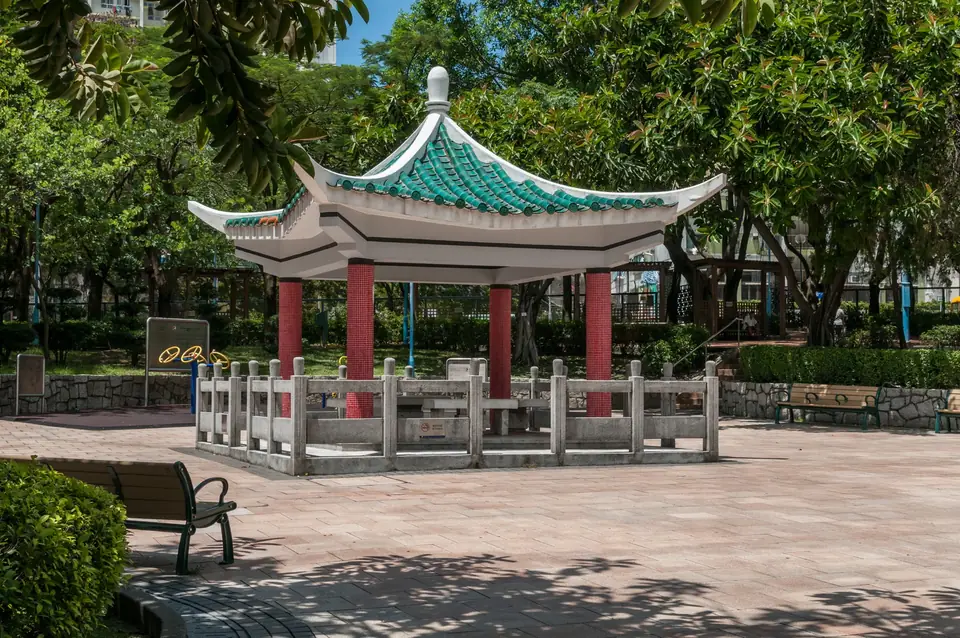
The signs on the park’s paths are not invented: Longjin Road, Longcheng Road, Xicheng Road and Guangming Lane preserve the names of the city’s streets in the 1950s. Guangming means “light”, and in that dark labyrinth it was so literally, because many addicts kept their opium lamps lit day and night. On this path stands the Mountain View Pavilion, a two-storey pavilion shaped like a moored boat, with a red rickshaw on display and limestone rocks piled in front that evoke waves.
The sky above the pavilion was not calm either. The city’s towers stopped at 13 or 14 floors because the planes landing at Kai Tak airport, some 800 metres to the south, passed right overhead, and the roar of the engines was part of the neighbourhood’s daily life.
In that city without patrols, dominated by the triads and opium, a young Englishwoman fresh from London’s Royal College of Music settled in the 1960s, according to documented tradition, with barely 10 dollars in her pocket. Who she was, what brought her to Hong Kong and what kind of light she brought to the street of light is the episode that accompanies this stop.
A Qing garden premiered in 1995
Guibi Rock
Summary of this stop
West of the Yamen esplanade, a circular gate framed by couplets leads to the pavilion of Kuixing, god of literature, and to Guibi Rock, a spiral stone from Lake Tai that symbolises Hong Kong’s return to China. The whole ensemble looks old and is not: the park, with eight landscape zones, was designed in the style of the Jiangnan gardens of the early Qing dynasty, and built by craftsmen brought from the mainland between May 1994 and August 1995, for 76 million Hong Kong dollars. In the northeast corner, the Chess Garden gathers four 3-by-5-metre Chinese chess boards made of pebbles and porcelain.
The verses that adorn the garden have their own history. In 2003, a committee of four poets reviewed the couplets of 18 public parks and found tonal-metre errors in 22 of them, spread over 9 parks; the one at the Walled City was the most affected. In 2004, 15 poems and couplets written in the 1990s, which had never been Qing pieces, were removed and replaced with new works.
Meanwhile, the demolished city has come back in the form of a set. Since 24 May 2025, and for three years, the park hosts a free exhibition of “Twilight of the Warriors: Walled In”, with a dentist’s surgery, a bone-setter, a fish-ball factory, a market and a rooftop where the roar of planes is projected. What it says about this place that the densest city in the world returns as a film set closes the tour.