Cantonese temple
Man Mo Temple Audio Guide
Beneath coils of incense that never stop smoking, the temple of the gods of literature and war was for decades the courthouse, the meeting point and the charity fund of Chinese Hong Kong, and people still come here to touch a brush or a sword to ask for grades, promotions or work.
- 30 min of audio
- Former Chinese court
The Hollywood Road site was leased on 24 June 1847 on one condition: that it house a school. It ended up as a temple, rebuilt on a larger scale in 1851 and completed around 1862 as three blocks separated by alleys, the Man Mo, the Lit Shing Kung and the Kung Sor, paid for by the merchants Loo Aqui and Tam Achoy. It has been managed by the Tung Wah Hospital since 1908.
In the Kung Sor, the meeting hall attached to the temple, the Chinese population settled their disputes before the gods: the parties wrote their promise and a curse on yellow paper, beheaded a rooster, let the blood drip onto the paper and burned it. That former arbitration hall is today the souvenir shop.
Highlights
- Shiwan ceramic ridge — 1893, a Cantonese opera stage with a pearl and dragon-fish
- Incense coils — hung from the ceiling, some carrying notes with wishes
- Altars of Man Cheong and Kwan Tai — the brush and the weapon that worshippers touch for luck
- Shen Wei Pu You plaque — granted by the Guangxu Emperor in 1879
- Kung Sor — the former arbitration hall, with its year engraved in a granite frame
On Hollywood Road, Man Mo Temple is recognised by its smell before its façade: the smoke of its great incense coils drifts out into the street. It is dedicated to Man Cheong, god of literature, and Kwan Tai, god of war, and its bell is inscribed with the 27th year of the Daoguang reign of the Qing dynasty, which corresponds to 1847. That is the date usually given for its founding, although the sources do not fully agree: 1847 is the year of the site lease and of the bell, the present building follows the reconstruction inaugurated in 1851, and the three-block complex was completed around 1862.
The history of Man Mo Temple goes far beyond worship. In the first decades of the British colony, the temple committee, made up of the leaders of the Chinese community, mediated in disputes and received Qing government officials passing through Hong Kong. Here the founders of the Tung Wah Hospital met; it received the temple by law in 1908 and, since the revision of 1958, also directs its income to schools, charity and medical services. What to see at Man Mo Temple, how its architecture is read and what its worshippers ask for today is told in four stops of an audio guide, documented and checked against historical sources, listened to while walking through the temple.
About 500 metres away, on the same Hollywood Road, Tai Kwun brought together the British police station, courthouse and prison. Across the harbour, the Tin Hau temple of the Temple Street Night Market is another neighbourhood temple around which Chinese life was organised, and on Lantau the Tian Tan Buddha takes devotion to a monumental scale.
A ceramic opera over a site promised to a school
Man Mo Temple
Summary of this stop
From the pavement, three green-brick buildings with gabled roofs can be seen in a row, separated by narrow alleys: the Man Mo temple, the Lit Shing Kung, dedicated to all the gods, and the Kung Sor, the former public meeting hall. They were paid for by two Chinese merchants, Loo Aqui and Tam Achoy, and the complex was completed little by little between 1847 and 1862. Two granite platforms flank the main door of the temple, which has three bays and two halls.
The origin has something of a broken promise. The site, Inland Lot 338, was leased on 24 June 1847 on condition that it be used as a school. When the work was finished it was used as a temple, and in March 1848 the Government began to charge rent on the lot. In 1851 it was rebuilt on a larger scale, up to its current size, with an inauguration that the Chinese community celebrated in May of that year.
The most striking feature of Man Mo Temple’s architecture is up above. The ridge of the main roof is made of Shiwan ceramic manufactured in 1893: a Cantonese opera stage frozen in figurines, with a pearl in the centre and two dragon-fish at the ends. What that miniature performance depicts, and why it is there, is revealed by listening to the narration from the street.
Oaths with rooster blood beneath the incense
Incense coils of the covered courtyard
Summary of this stop
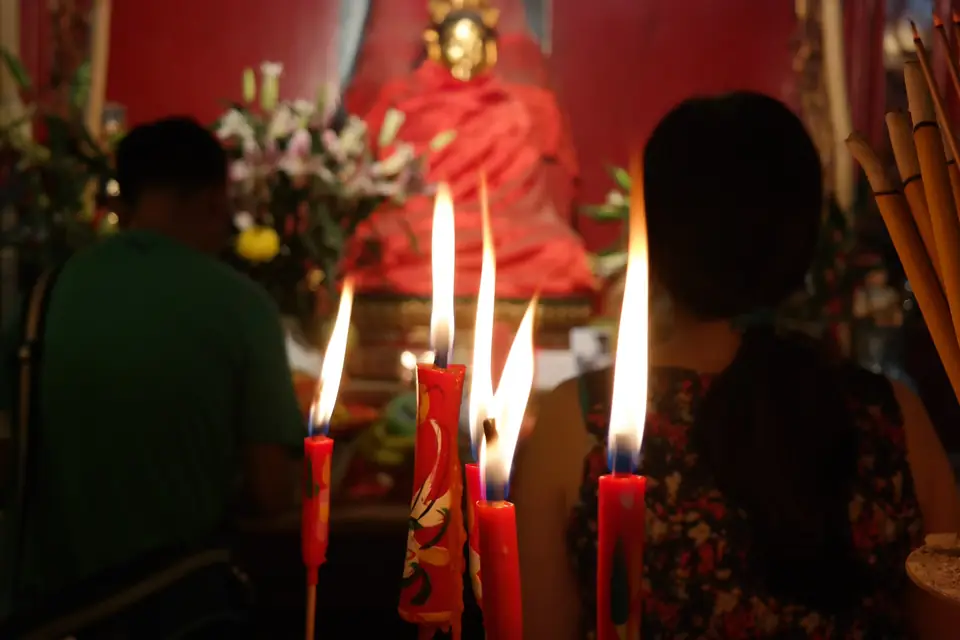
On entering, smoke envelops everything. Enormous incense coils hang from the ceiling, some with notes carrying worshippers’ wishes, and between the two halls a double-eaved xieshan-style roof, resting on four granite columns, covers the former courtyard. This place of worship was also, for years, a place of justice for the Chinese population.
Under the supervision of the Man Mo Temple Committee, plaintiff and defendant wrote their promise and a curse on yellow paper, beheaded a rooster, let its blood drip onto the paper and burned it before the gods, a procedure taken from the Qing dynasty legal system. Its legal scope is still debated: one version presents it as an oath recognised by the colonial courts and required to be held here; another, as an alternative route for disputes that British law did not resolve. It is said that in 1918 a court sent two great merchants at odds over a debt to the temple to swear with the rooster, and that neither would kneel first.
According to documented tradition, the temple committee worked almost like a parallel government, and in the middle of British territory it received the mandarins of the Chinese emperor. How the 1918 dispute ended, and who lost for refusing to kneel, is revealed beneath the coils.
The brush, the sword and the very specific wishes
Altars of Man Cheong and Kwan Tai
Summary of this stop
The rear hall, raised a few steps, holds the images of the two gods: Man Cheong, in a red robe with a brush, and Kwan Tai, in green garb with a long sword. Nearby are preserved two palanquins of 1862 and 1885, the sedan chairs in which the gods are carried in procession during the great celebrations. The Shen Wei Pu You plaque also hangs here, granted in 1879 by the Guangxu Emperor to the Tung Wah in gratitude for the funds raised for the great drought that struck mainland China between 1876 and 1878.
Local custom says to ask with the hands. Office workers seeking a promotion touch Man Cheong’s brush, merchants touch Kwan Tai’s weapon so business goes well, and students leave pencils and pencil cases on the altar before exams. At the 2015 Lunar New Year, a father lifted his 12-year-old daughter in his arms so she could touch the war god’s halberd and ask for good grades, and in 2026 social media renamed it “the temple for finding a job”.
The gods also have an official appointment: since 1957 the directors of the Tung Wah have held the Autumn Sacrificial Rites here every year, included in 2014 in Hong Kong’s Inventory of Intangible Cultural Heritage. What the ordinances of 1908 and 1958 say about the fate of the temple’s money completes the stop before the altars.
The hall of justice turned shop
Granite frame of the Kung Sor
Summary of this stop
The tour ends outside the main temple, in front of the Kung Sor. Its granite door frame preserves the year of construction engraved, and it was here that, in the early years of the colony, justice was dispensed to the Chinese population. Today it works as a souvenir shop, and in 1994 the Virtue Court, a modern structure for ancestor worship, was attached to the back of it.
The irony does not end there. The temple, raised on a site meant for a school, financed with its donations the Tung Wah Hospital’s first free school, opened in 1880 at the Chung Wah College, beside the temple itself.
In the neighbouring Lit Shing Kung a ritual of documented tradition survives: on the 26th of the first lunar month, according to belief, Kwun Yam, the goddess of mercy, opens her treasury and lends money to worshippers, who arrive from eleven o’clock the night before. What that divine loan consists of and how it is repaid before the end of the year closes the audio guide.