Night market
Temple Street Night Market Audio Guide
Hong Kong calls it “the poor man's nightclub”: a street of stalls allotted by lottery, bird fortune-tellers and Cantonese opera, split in two by the temple of a sea goddess that now stands inland.
- 60 min of audio
- Market and temple
Temple Street owes its name to the Tin Hau temple of Yau Ma Tei, moved here in 1876 after the typhoon that in 1874 destroyed the shrine the boat people kept at the water's edge. In 1887 the Government named the two stretches running out on each side Temple South Street and Temple North Street, and from the 1920s the banyan square opening in front of it hosted a night market with jugglers, magicians and storytellers.
Beneath the watches, jeans and cheap electronics that earned it the nickname “men's street”, the ground holds another story: in 1968 hawkers negotiated with the Government and the police 3-by-4-foot stalls allotted by lottery, and in 1975 the Urban Council marked out nearly 600. Beside it, the street's last bird fortune-teller still works with four white birds.
Highlights
- Jordan Road arch — 10.5 m high, inaugurated in 2010 as Hong Kong's first urban landmark arch
- Southern stretch of stalls — nearly 600 stalls marked out by the Urban Council in 1975
- Yung Shue Tau — the banyan square, chosen by Time in 2004 as the best place in Asia to play chess
- Tin Hau Temple — stone lions from the 1860s and a Shiwan ceramic ridge with the Yang generals
- Market Street — the last bird fortune-teller and the Cantonese opera and karaoke stalls
Every evening, in Yau Ma Tei, in the heart of the Kowloon peninsula, the roadway of Temple Street fills with awnings, light bulbs and folding tables. It is Hong Kong’s most famous night market, but its history begins far from the stalls: in a small shrine to the sea goddess Tin Hau that the boat people built around 1865 at the water’s edge, near today’s Pak Hoi Street. The typhoon of 1874 destroyed it; the temple moved to its present site in 1876 and, according to the official note, was finished in 1878, although other sources stretch the works to 1890. Today the sea is far away, and the street that bears its name is still split in two by it.
What to see on Temple Street is not limited to haggling. There is a banyan square where, from the 1920s, a market with jugglers, magicians and storytellers was set up; a group of five buildings that served as temple, neighbourhood arbitration hall and school, declared a monument on 22 May 2020; a 1950 café with wooden booths that appears in Days of Being Wild; and a flank where Cantonese opera is still sung and fortunes are consulted. Some sources even link the first vendors under the banyans with the arrival of population in Yau Ma Tei in the 1860s, and the exact date of the market’s origin remains open.
The temple’s history is not a quiet one either. In 1914 a colonial ordinance decided that its income would pass to the new Kwong Wah Hospital, despite the opposition of its trustees, and since 1928 it has been run by the Tung Wah Group of Hospitals. In 2015 a fire burned almost all the images in the City God temple, except that of the god himself, and in 2018 the festival of Tin Hau’s birthday was again celebrated on a grand scale after decades without. The audio guide, documented and checked against historical sources, covers the street in five stops, from the Jordan Road arch to the loudspeakers of Market Street, and tells what this bazaar of watches and jeans was before it became one.
About three kilometres away, Kowloon Walled City Park keeps the memory of the most extreme Kowloon, that of the lawless enclave. Across the harbour, which the Star Ferry crosses, Man Mo Temple on Hollywood Road is another neighbourhood temple around which Chinese life was organised.
A modern arch for a 19th-century name
Jordan Road arch
Summary of this stop
The tour starts at the southern end, under the entrance arch at the junction with Jordan Road. It is 10.5 metres high and 8.9 wide, cost 3 million Hong Kong dollars and was inaugurated on 18 December 2010 as the city’s first urban landmark arch. Looking north a couplet in Chinese characters appears, speaking of the temple’s splendour and the bustle of the street; at the other end, beside Kansu Street, a second arch closes the market.
The arch is new, but the name it announces is much older. In 1887 the colonial Government called the two stretches that ran out on each side of the Tin Hau temple “Temple South Street” and “Temple North Street”, and only later were they merged into a single Temple Street. What exactly the couplet says, and why this gateway points to a temple that cannot even be seen from here, is explained on setting out.
Six hundred stalls for men’s street
Rows of stalls on the southern stretch
Summary of this stop
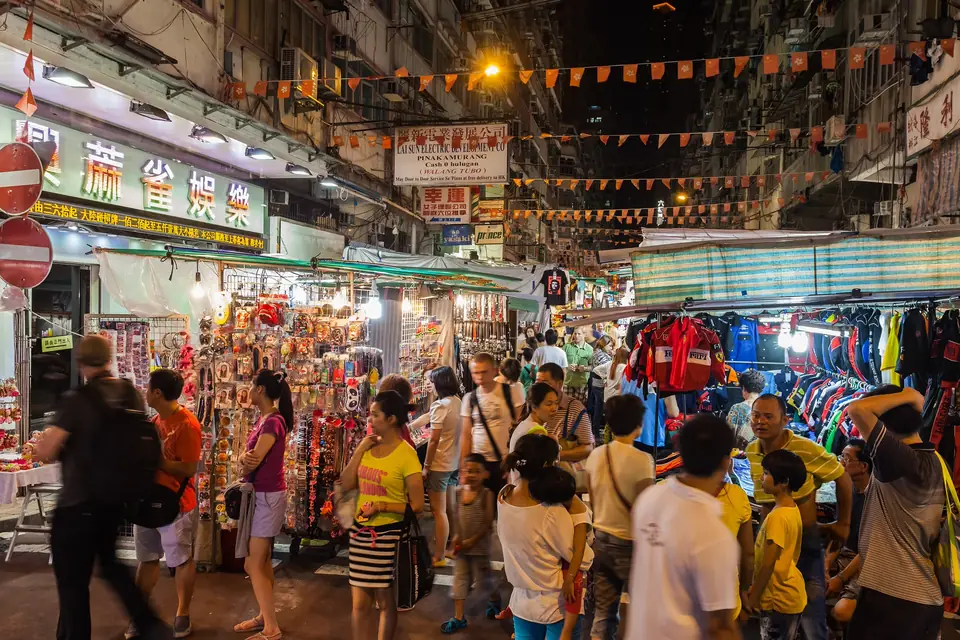
Between Kansu Street and Nanking Street, every evening, rows of awning-covered stalls line up on the roadway: menswear, watches, jeans, pens, cheap electronics and souvenirs. That inventory explains the street’s popular nickname, “男人街”, men’s street, which forbids nothing to anyone: it only describes what is sold. Its counterpart, women’s street, is on Tung Choi Street, in Mong Kok, a neighbourhood away.
The disorder is only apparent. In March 1975 the Urban Council declared Temple Street an authorised hawking area in two stretches, from Man Ming Lane to Public Square Street and from Kansu Street to Nanking Street, with nearly 600 marked-out stalls. It is often repeated that it was Hong Kong’s first street with that status, although twenty areas were designated that same day and some sources give priority to Tung Choi Street.
The present is leaner: in 2023 about 100 active vendors remained of the roughly 200 before. On 15 December of that year a food street of 32 stalls opened over a stretch of about a hundred metres, as part of the “Hong Kong Night Vibes” campaign. How a market that is losing vendors reinvents itself is the question that accompanies this stretch of the audio guide.
The square where the street was drawn by lottery
Public Square Street Rest Garden
Summary of this stop
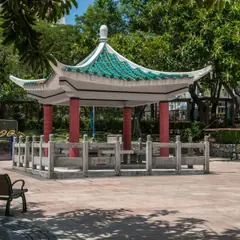
Halfway along, the street breaks off in front of Yung Shue Tau, “the head of the banyans”, today Public Square Street Rest Garden. Around 1870 this esplanade in front of the temple was where fishermen dried the hemp ropes of their boats, and the tung-oil and hemp-rope shops that set up around it gave the district its name: Yau Ma Tei, “the place of oil and hemp”. From the 1920s the wasteland became a dai dat dei-style night market, with stalls of household goods, clothing and food, and at nightfall jugglers, magicians and storytellers arrived.
In 1968 the square was the setting of a decisive conflict. The Government’s plan to build the Leung Hin Lee community centre next to it set more than 200 hawkers against their relocation; after mediation by the Yau Ma Tei neighbourhood association and the police, 3-by-4-foot stalls were laid out on Temple Street and Shanghai Street and allotted by lottery. The street walked in the previous stop was born, in large part, of that allocation.
Today, under the interlaced banyans, the dominant sound is the clack of retirees’ Chinese chess pieces. In November 2004 the Asian edition of Time magazine chose this place as the best in Asia to play chess. The street running in front, Public Square Street, carried for almost a century a translation error in its Chinese name; what it was and how it was corrected in the 1970s is part of what is heard here.
Lions from the lost shoreline
Yau Ma Tei Tin Hau Temple
Summary of this stop
In front of the porch of the Tin Hau temple appear the drum platforms on granite columns with carved bases and, up high, the Shiwan ceramic ridge added in a refurbishment of the 1910s. Its figures tell the story of the generals of the Yang family, legendary heroes of the Song dynasty; above, two dragons contend for a pearl among carp leaping the Dragon Gate, and at the ends rise the gods of the sun and the moon. Below, the two stone lions at the door are, according to the temple’s documented tradition, its oldest pieces: worshippers donated them in the 1860s for the shoreline shrine and they travelled inland with it.
The temple is only one of five adjoining buildings separated by alleys. Between 1894 and 1920 a communal hall, the Kung Sor, a temple of the earth god and two schools were added, so the complex served at once for worship, the arbitration of neighbourhood disputes and teaching. Today the row consists of the Kwun Yum temple, the Shing Wong temple, the Tin Hau temple, the She Tan hall and the Shu Yuen, and since 2020 it has been a declared monument as the largest surviving Tin Hau complex in Kowloon. What the door of the old school hides after the 2015 fire is one of the moments the audio guide reserves for the porch.
Fortune-telling birds and opera with a curfew
Singing stalls of Market Street
Summary of this stop
At one side of the temple, the street of the fortune-tellers keeps booths and awnings for palm reading, face reading and divination with caged birds. In the late 1950s there were more than ten booths with doors and windows in front of the temple devoted to consulting the gods; in 2023 only one bird-divination stall remained, that of Master Lam, over 60 and with more than twenty years in the trade, against the four or five of its heyday. He works with four white birds, Bak Yat, Bak Yi, Bak Saam and Bak Sei, who retire at the age of four.
On Market Street, next to the temple, the improvised stages with awning, loudspeakers and karaoke are still standing, where amateur singers perform Cantonese opera and old songs. Under the banyans no one sings any more, and here noise control forces closing earlier than the planned 7 to 10 p.m. hours.
This street even has a king of song: Wan Kwong, who arrived in Hong Kong in 1969, whom they call “the king of Temple Street songs”. He never performed on it. Why his crown was given to him by the loudspeakers of the cassette stalls, and what his 1970s lyrics had that kept radio from airing them, closes the tour.