Former police station and prison
Tai Kwun Audio Guide
In one block of Central, the police arrested, the judge sentenced and the prison locked up, wall to wall, from 1864. Ho Chi Minh, a tortured poet and a man sentenced to death who could see only a mango tree passed between its granite walls; today it is an arts courtyard.
- 75 min of audio
- Colonial heritage
The history of Tai Kwun begins in 1841, the same year the British occupied the island, with the magistrate's house and its cells: from there came Victoria Gaol, Hong Kong's first prison. In 1864 came the Central Police Station, with its neoclassical Barrack Block, and in 1914 the Central Magistracy, with neo-Greek columns. From 1864 police, court and prison shared one compound, enclosed by a wall of large granite blocks between Hollywood Road, Old Bailey Street, Chancery Lane and Arbuthnot Road.
The name was given by the neighbours: “Tai Kwun”, “the big station”, was the nickname the press was already using in the 1880s and which became official in 2018. That same year JC Contemporary and JC Cube opened, the Herzog & de Meuron volumes clad in 100% recycled cast aluminium, after neighbourhood opposition stopped a 160-metre tower shaped like a bamboo scaffold.
Highlights
- Headquarters Block — a 1919 red-brick façade with George V's GR monogram
- D Hall — the surviving half of a radial prison inspired by Philadelphia
- B Hall cells — in Victoria Prison, the jail of Ho Chi Minh and the poet Dai Wangshu
- JC Contemporary and JC Cube — recycled aluminium that imitates the blocks of the granite wall
- Central Magistracy — a holding cell with a staircase straight up to the dock of the courtroom
Between the slopes of Hollywood Road and Arbuthnot Road, in the heart of Central, a granite wall encloses the block where Hong Kong dispensed justice for more than a century. Here the magistrate’s house with its cells was built in 1841, the seed of Victoria Gaol, renamed Victoria Prison in 1899; here the Central Police Station was installed in 1864, moved from Wellington Street, and here the Central Magistracy opened in 1914, which sat in judgment until 1979. Arresting, trying, locking up and, from 1879, hanging: it all happened within a few metres.
What to see at Tai Kwun goes far beyond a colonial façade. The compound holds the police parade ground and its mango tree, the prison yard, the surviving half of a radial prison, uncooled cells and a courtroom with its holding cell underneath. Its architecture also tells recent history: the Japanese bombs of 1941, the collapse of the Married Inspectors’ Quarters in 2016, with the building empty, and the two new Herzog & de Meuron buildings that opened in 2018. For decades, moreover, officers ate beneath the stuffed head of a tiger that in 1915 had killed two officers in the New Territories.
The audio guide, documented and checked against historical sources, covers the compound in five stops, from the Parade Ground to the former courtroom, and leaves the listener on Arbuthnot Road with the feeling of having crossed police station, prison and court without stepping into the street.
About 500 metres along Hollywood Road, Man Mo Temple was for the Chinese population a sanctuary and arbitration hall. Colonial hierarchy could also be read on the slope of Victoria Peak, with its summit reserved for non-Chinese residents, and across the harbour Kowloon Walled City Park marks the site of what became a lawless enclave.
A nickname, a monogram and a mango tree that granted promotions
Parade Ground
Summary of this stop
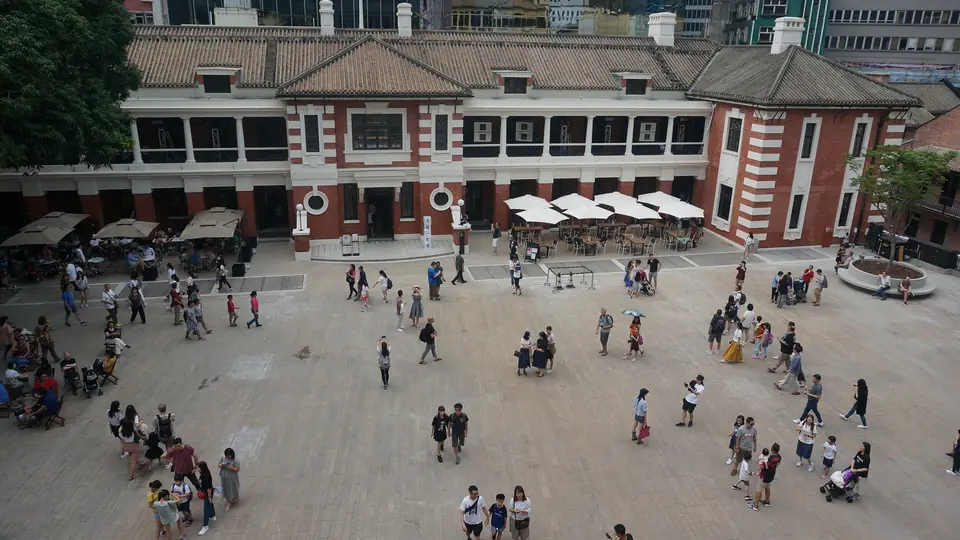
The Parade Ground, the old yard where the police fell in, is today the entrance square. It is presided over by the Headquarters Block, inaugurated in 1919: four storeys of red brick with granite and columns and, above the door, the letters “G” and “R”, George V’s monogram. On the afternoon of 15 December 1941, in the middle of the Battle of Hong Kong, a string of Japanese bombs struck the station and destroyed the ground floor and basement offices of this building, with casualties.
To one side stands the Barrack Block, built between 1862 and 1864 and extended with a fourth floor in 1905: the oldest police building in the complex, with arcaded galleries and Chinese tiles. And at the centre of the place’s memory is its name. “Tai Kwun”, “the big station”, was what police and neighbours called the compound; the press was already writing it in the 1880s, and in 2018 it became the official name of the centre.
Beside the old armoury grows a large mango tree. Among the officers it was said that whoever ate its fruit would be promoted, and since the tree yields little and only every two or three years, the mangoes usually ended up in the hands of the commanders. The rank-and-file had their own method of outwitting their bosses’ superstition, and how one of them told it, seventeen years of service at the station, is the story the audio guide saves for this yard.
The gallows yard and the prison that copied Philadelphia
Prison Yard
Summary of this stop
On passing into the Prison Yard, the courtyard of the old prison, the granite and brick walls, raised higher over the years, give the space a feeling of a pit. This is where the island’s first prison was born, and opposite rises D Hall, reinforced inside with arch-shaped steel plates. It is the surviving half of a radial-plan prison planned in 1858 on the model of the Eastern State Penitentiary in Philadelphia: the bombing of the Second World War took away the central watchtower and two wings.
From 1879, all executions by hanging in Hong Kong were carried out here, in the open space between B Hall and D Hall, covered with tarpaulins. In 1937 the gallows and the flogging frame, in use since 1868, were moved to the new Stanley Prison.
Everyday punishment also has its documented account. In the 19th-century Victoria Gaol, hard labour was graded in scales: iron balls, 45-pound stones, the treadwheel or a crank that had to be turned 12,500 times a day, so exhausting that an 1896 report noted that some prisoners preferred the lash. What happened in 1862 on Old Bailey Street, the street that still skirts the wall, is told in the yard itself.
Ho Chi Minh, Dai Wangshu and Man Kam-tong
B Hall cells
Summary of this stop
The B Hall cells, a hall from the early 20th century, can be visited inside: individual uncooled cells, with projections about prison life. The humid heat that builds up in them makes physical the stories of three prisoners who passed through Victoria Prison.
The first arrived in June 1931, arrested in Kowloon under the name Sung Man Cho. He was Ho Chi Minh, wanted by France, which had sentenced him to death in 1929. The English lawyer Francis Loseby held up his deportation to Indochina until the Privy Council in London dismissed the appeal by agreement on 21 July 1932, and in January 1933 the future leader of Vietnam left Hong Kong for Amoy disguised as a Mandarin lawyer, in clothes sewn by Loseby’s wife. The second was the poet Dai Wangshu, editor of the Sing Tao Daily supplement, locked up in 1942 by the Japanese occupation for about seven weeks, beaten and repeatedly tortured; on release he wrote “On the Prison Wall” and “With My Maimed Hand”.
The third, Man Kam-tong, was sentenced to death in 1973 at the age of 21 for killing a police officer in a bank robbery, and pardoned in 1997. He spent ten months in the detention centre before sentencing, and the only thing he saw of the world from the window was the mango tree in the yard. Who played the servant in Ho Chi Minh’s escape is one of the details the narration reveals inside the cell.
Aluminium cut to granite’s measure and a tower that was never built
Laundry Steps
Summary of this stop
Beneath the JC Cube, the Laundry Steps, a covered stairway used for screenings and events, link the two new buildings on the spot where the prison laundry stood. Above, JC Contemporary and JC Cube, the work of Herzog & de Meuron inaugurated on 25 May 2018, seem to float over the historic walls.
Their skin is the key: a lattice of 100% recycled cast aluminium pieces whose size imitates that of the granite blocks of the retaining wall that surrounds the whole compound. The new repeats, in another material, the measure of the old.
The project could have been very different. In 2007 the Hong Kong Jockey Club proposed building on the upper prison yard a 160-metre tower shaped like a bamboo scaffold. Neighbourhood opposition led in 2010 to a much lower design, with two buildings and a height limit of 80 metres. How the reading of the compound changes on learning what came close to rising here is what the audio guide poses at the foot of the stairway.
From the cell to the dock without setting foot in the street
Former Central Magistracy
Summary of this stop
The Central Magistracy, built between 1913 and 1914 in neo-Greek style, fits its columns into the steep Arbuthnot Road. It sat in judgment until its closure in 1979, and inside it keeps an old courtroom with a detail that sums up all of Tai Kwun: the holding cell is right underneath, and the accused climbed a staircase that came out directly in the dock.
That proximity between prison and court also had its unexpected side. Man Kam-tong watched the same fellow inmate of Victoria Prison escape twice: the first time in a police uniform that had been hung out to dry; the second, using the meal queue to climb a drainage channel and jump into the building next door. Where he ended up and how the second escape ended is the finale the audio guide keeps for the courtroom.