Viewpoint and colonial heritage
Victoria Peak Audio Guide
The 552-metre hill that serves as a balcony over the Hong Kong skyline was for decades a privilege handed out by altitude: a funicular with seats reserved for the governor, a law that kept the summit for non-Chinese residents and a summer villa of which only the gatekeeper's lodge remains.
- 90 min of audio
- 1888 funicular
Before the funicular, the summit was bare rock with a signal mast, and people were carried up in sedan chairs along the path that Governor Hercules Robinson ordered cut in 1860. In May 1888 the Peak Tram entered service, the first cable funicular in Asia, and the hillside filled with summer houses, a hotel, a chair-bearers' stand and the governors' residence, some 7.8 °C cooler than Central.
In 1904 the Peak District Reservation Ordinance set aside for non-Chinese residents all the land above 788 feet, about 240 metres, unless the Governor in Council granted permission. Today the area receives around seven million visitors a year, but the 552-metre summit is still closed to the public: it is occupied by radio antennas.
Highlights
- Peak Tram — Asia's first cable funicular (1888): 1,350 m of track rising from 28 to 396 m above sea level
- Peak Tower — Terry Farrell's tower (1997), its height capped at 428 m so as not to break the line of the hills
- Lugard Road — an almost level 2.4 km path at about 400 m, with a stretch carried on 87 concrete pillars
- Gate Lodge — the 1900–1902 gatekeeper's lodge, the last building standing from the governors' villa
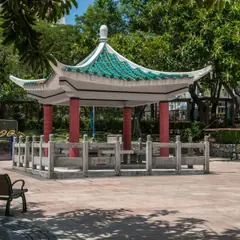
- Victoria Peak Garden — a pavilion on the granite platform of Mountain Lodge, below the closed summit
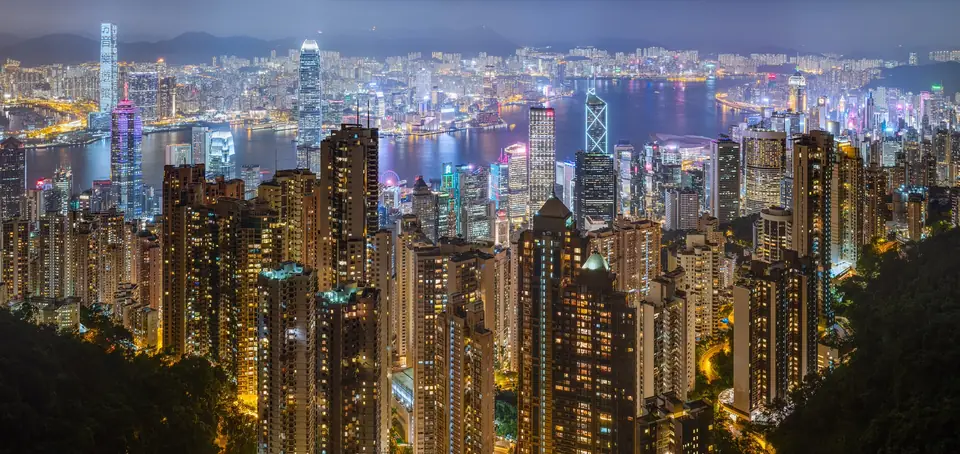
The most repeated postcard of Hong Kong is taken from here: the skyscrapers of Central at its feet, Victoria Harbour beyond, Two IFC and the ICC forming a gateway between the island and Kowloon, and Lamma and the islands to the southwest. What the photo does not tell is that this hillside was ordered by altitude for decades. In 1888 the Peak Tram put an end to the sedan chairs; in 1904 an ordinance reserved everything above 788 feet for non-Chinese residents; and beside the summit, now closed to the public, stood the governors’ summer villa.
What to see at Victoria Peak goes well beyond the viewpoint: the funicular’s upper terminus, the Victoria Gap saddle with its frying-pan-shaped tower, the hanging path of Lugard Road, the Gate Lodge and the garden raised over the foundations of the vanished villa. The history of Victoria Peak, its architecture and its Cantonese nicknames is spread across those points. The audio guide, documented and checked against historical sources, covers them in five stops and turns every metre of the climb into a chapter about who could live up here and who carried everyone else.
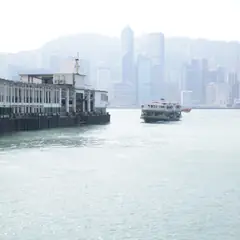
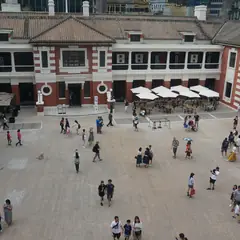
Down in the harbour, the Star Ferry has been crossing Victoria Harbour for more than a century, and in Central the former police station of Tai Kwun tells the other side of colonial order. The city’s other great viewpoint is on Lantau, on the terrace of the Tian Tan Buddha.
A funicular ordered by rank
Peak Tram Upper Terminus
Summary of this stop
The upper platform of the Peak Tram, under the Peak Tower, is the end of a 1,350-metre track that climbs from 28 to 396 metres above sea level. It was proposed in 1881 by the Scot Alexander Findlay Smith and entered service in May 1888 as Asia’s first cable funicular; the exact day and the number of passengers on opening day vary by source. In its first year it carried more than 150,000 passengers, almost 80% of the colony’s population. Beside the terminus stands a 1956 car, of the fourth generation, with the 1988 centenary sign.
The journey was not the same for everyone. Until 1926 the ticket was divided into three classes: senior officials and residents of the Peak, military and police, and servants and cargo. Between 1908 and 1949 the first two seats were reserved for the governor, marked with a bronze plaque, and no one could occupy them until two minutes before departure. On 11 December 1941, in the middle of the Battle of Hong Kong, an attack damaged the engine room; regular service returned on Christmas Day 1945 with a fragment of Japanese shell still lodged beneath the base plate of the traction drums.
On the way up, moreover, the skyscrapers seem to lean towards the mountain by up to about 30 degrees. The psychologist Chia-huei Tseng, of the University of Hong Kong, turned the funicular into a laboratory and in 2013 published the explanation in Psychological Science. What exactly fools the brain, and why the illusion does not vanish even when it is known to be false, is told on leaving the carriage.
Sedan chairs, a hotel on fire and a frying pan
Victoria Gap
Summary of this stop
The Victoria Gap esplanade was an interchange long before it filled with shops. The low stone building of the Peak Lookout was raised in 1901 as a chair-bearers’ stand: there residents stepped off the funicular and into the sedan chair to get home. Since 1947 it has been a restaurant. Opposite, the Peak Hotel, linked to Alexander Findlay Smith, burned down in 1938 and was never rebuilt; its site became a bus terminus and since 1993 has been occupied by the Peak Galleria shopping centre, which keeps the interchange on the ground floor.
Above it all rises Terry Farrell’s Peak Tower, completed in 1997 at 396 metres, 156 below the summit. Its concave crown, the “frying pan”, has its height capped at 428 metres above sea level so as not to break the line of the hills. It replaced the 1972 tower by Chung Wah Nan, demolished in 1993.
That earlier tower inherited a nickname that Hongkongers used for decades: 老襯亭, “the pavilion of the suckers”, where 老襯 is Cantonese for the naive person who gets fleeced. According to the historian Cheng Po-hung, the expression was born in the early fifties; other versions disagree about who the sucker was. The three possible answers, and which one points at the visitor, are revealed on the esplanade.
A balcony hung over the 788-foot law
Lugard Road
Summary of this stop
Lugard Road circles the summit at about 400 metres of altitude: 2.4 almost level kilometres with a direct view of the harbour. It was finished in March 1921 for 88,165 Hong Kong dollars, and its most exposed stretch flies over a reinforced-concrete deck resting on 87 pillars. Opening it meant removing rocks of up to 45 tonnes.
This path runs through a territory that was reserved by law. The Peak District Reservation Ordinance of 1904 set aside for non-Chinese residents all the land on the island above the 788-foot contour west of Middle Gap, including Victoria Peak, Mount Gough, Mount Kellett and Mount Cameron, unless the Governor in Council gave permission; resident Chinese servants were exempt. The government presented it as a health measure after the plague of 1894, while part of the historiography reads it as social and racial segregation. It was repealed in 1930, although some sources place the end of the prohibition in 1946–1947, with the repeal of another ordinance from 1918.
On this same road the Eurasian businessman Robert Ho Tung had a house, presented as the first non-European allowed to live in the district: in 1917 he bought Bishop’s Lodge, at number 26, for 20,830 Hong Kong dollars. How he came to live here, something the sources explain in different ways, and what became of the family’s holdings on the Peak is told on the pillars.
The gatekeeper’s lodge of a vanished palace
Gate Lodge
Summary of this stop
On Mount Austin Road, a small stone house passes almost unnoticed. It is the Gate Lodge, the gatekeeper’s house built between 1900 and 1902, and the only surviving building of the governors’ summer residence. The first house on the summit had been the signal station; in 1860 Hercules Robinson ordered a sedan-chair path cut from what is now Robinson Road to Victoria Gap and the summit.
The villa was born of a failure. In 1862 a military sanatorium opened on the plateau and 17 patients were sent there; they improved no more than elsewhere in the colony and the army abandoned it. In 1867 Governor Richard MacDonnell bought the building from the War Department and turned it into the first Mountain Lodge, his summer residence. It was made of wood: a typhoon destroyed it in 1874 and termites did the rest.
The second, a two-storey granite villa in the style of Scottish mansions designed by Palmer & Turner, was finished in 1902 for 97,000 Hong Kong dollars. No governor lived in it after the arrival of William Peel in 1930, it was damaged in the Second World War and demolished in 1946. Why such an expensive residence ended up empty is explained at the gatekeeper’s door.
A villa-less platform below the forbidden summit
Victoria Peak Garden
Summary of this stop
The pavilion of Victoria Peak Garden, a park opened in 1969, stands on the granite platform of the vanished Mountain Lodge and is the closest public point to the summit. In the northeast corner of the former grounds a boundary stone appears with the inscription “GOVERNORS RESIDENCE”: the markers were rediscovered in 1978. The Gate Lodge was declared a monument in 1995.
Above, the 552-metre summit is closed and occupied by antennas. On government maps it appears as 扯旗山, “flag-raising mountain”: a signal mast stood there that the typhoon of September 1874 left damaged. The origin of the name is disputed; tradition links it to the signals of the pirate Cheung Po Tsai, with no documentary proof, and other hypotheses point to the British flag of 1841 or to the masts on the summit. Before 1940, the night view from here, 旗山星火, headed the list of the eight views of Hong Kong.
And yet almost no Hongkonger uses that official name: in conversation people say 山頂, “the summit”, or 太平山. The reason, a double meaning in twentieth-century Cantonese that draws awkward smiles, closes the tour with humour.