Historic ferry
Star Ferry Audio Guide
A few minutes' crossing, a cheap ticket and more than a century of history: the green-and-white ferry founded by a stowaway turned baker crosses Victoria Harbour on double-ended boats that never turn around.
- 30 min of audio
- Victoria Harbour crossing
Since Dorabjee Naorojee launched the Kowloon Ferry Company in 1888, with a steamer called Morning Star loaded mostly with bread, the crossing between Kowloon and Hong Kong Island has not stopped, except during the Japanese occupation. The Star Ferry Company was born in 1898, and in 1957 the twin Streamline Moderne piers of Tsim Sha Tsui and Edinburgh Place were completed.
A five-cent rise in the first-class fare set off four nights of riots in Kowloon in 1966, and in 2006 some 150,000 people bid farewell to the Edinburgh Place pier before its demolition. Few crossings so short have weighed so heavily on a city's memory.
Highlights
- Tsim Sha Tsui pier — a 1957 Streamline Moderne design with no clock tower of its own beside the Clock Tower
- Mooring with a boathook — the same rope manoeuvre at every docking since the 19th century
- Double-ended ferries — a wheelhouse at each end, a fleet built from 1958 to 1965
- Reversible-backed benches — a design in use since 1904
- Central Pier 7 — a clock tower that recreates the one at the vanished Edinburgh Place
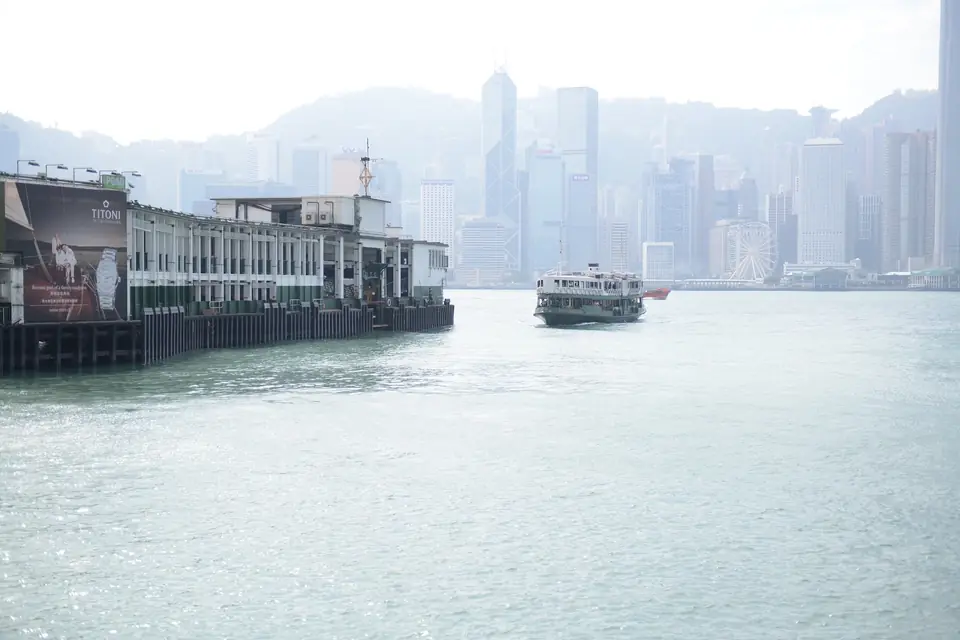
At the southern tip of Kowloon, a green-and-white ferry docks, one sailor throws a rope and another catches it with a long boathook. The scene lasts seconds and has repeated since the 19th century. The Star Ferry links Tsim Sha Tsui with Central, on Hong Kong Island, crossing Victoria Harbour in a few minutes, and in 2025 its 8 boats, with an average age of 63 years, carried 16,165,528 passengers. The exact date of its founding is still disputed: the company places the origin in 1880, other sources speak of the 1870s, and the launch of Dorabjee Naorojee’s Kowloon Ferry Company is dated to 1888.
The history of the Star Ferry is told on board and at the piers: a founder who arrived as a stowaway, a first pier wiped out by a typhoon, an evacuation under Japanese attack, a hunger strike that ended in a riot and a clock that wound up in a landfill. The audio guide, documented and checked against historical sources, covers the crossing in four stops, from the Tsim Sha Tsui Clock Tower to Central Pier 7, while the island’s wall of skyscrapers grows on the other side of the water.
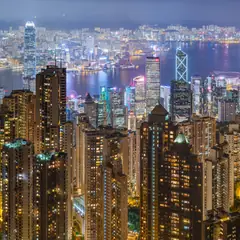
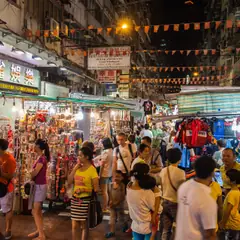
From the water the slope of Victoria Peak can be made out, which the funicular has climbed since 1888, and on landing at Tsim Sha Tsui the Temple Street Night Market lies less than two kilometres away.
A pier without a clock in the shadow of another tower
Tsim Sha Tsui Clock Tower
Summary of this stop
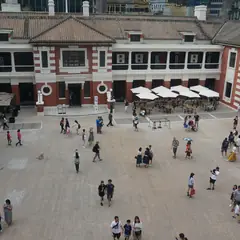
At the foot of the Tsim Sha Tsui Clock Tower, the one that belonged to the old Kowloon-Canton railway station, opens the Star Ferry pier: two two-level piers on timber piles, completed in 1957 in the Streamline Moderne style. Its twin at Edinburgh Place, on the island, was built at the same time and did have a clock tower. The Kowloon one did not need it: it had one next door.
This edge of the harbour has endured a great deal. The first Star Ferry pier at the Kowloon point, made of wood, opened on 1 April 1906, and on 18 September of that same year a typhoon wrecked it; the facility was moved further south, to its current site. In December 1941, during the Japanese attack, the ferries kept crossing until 10:00 on the 12th to evacuate refugees, soldiers and British authorities from the peninsula.
Afterwards, the crossing stood idle for three years and eight months, and in 1943 two boats of the fleet sank, one of them in the harbour itself. Which they were and where the other ended up is one of the stories the narration saves for this spot.
A rope, a boathook and a baker who arrived as a stowaway
Tsim Sha Tsui Star Ferry Pier
Summary of this stop
On the boarding pontoon, the mooring manoeuvre can be seen up close: the rope flies from the ferry and the pier sailor catches it with the boathook, just as in the early years of regular service. The sailors wear a navy-blue nautical-cut uniform, with a white cap and the company name in English and Chinese around the band. One from the seventies is part of the collection of the Victoria and Albert Museum in London, as an object tied to Hong Kong’s identity; here it is seen worn and in motion.
The names painted on the hulls, such as Morning Star, Night Star or Solar Star, refer back to the founder. Dorabjee Naorojee Mithaiwala arrived from Bombay in 1852 as a stowaway and worked as a cook. His bakery on Hollywood Road took off after an extraordinary episode in 1857, when the bread from the bakery supplying European households turned up poisoned with arsenic. In 1888 his steamer Morning Star crossed a harbour a mile and a half wide with its workers and a cargo that was, above all, bread; the other passengers paid one cent.
In May 1898 he sold all his boats to the Hongkong and Kowloon Wharf and Godown Company, linked to Catchick Paul Chater, and the Star Ferry Company was born, named after the boats that carried the word Star. Why he chose that name is another matter: it is attributed to a poem by Tennyson, but the poem is later than the first Morning Star. What exactly happened that day in 1857 at the rival bakery is told on the pontoon itself.
Benches that change direction without the boat turning
Reversible-backed benches
Summary of this stop
Once on deck, the boat is understood with the body. The ferries are double-ended, with a wheelhouse and propeller at both ends of the lower deck: they arrive and depart without turning around. They came out of the Hong Kong & Whampoa Dock shipyards between 1958 and 1965, and are still in service more than sixty years later.
The wooden-slat benches complete the logic of the design. Since 1904 they have had reversible backs: the passenger flips the backrest and sits facing the direction of travel without moving the bench. It is a minimal gesture repeated on every crossing.
This same crossing opens one of the best-known films shot in Hong Kong, The World of Suzie Wong (1960): the architect played by William Holden crosses to the island and meets a young woman, played by Nancy Kwan, who introduces herself under another name and vanishes into the crowd on docking. The boat used for the shoot was the Radiant Star. How that first meeting unfolds, with a handbag in between, is placed by the narration out on the water.
Five cents, a hunger strike and a clock that ended up in the landfill
Central Star Ferry Pier
Summary of this stop
The ferry lands at Central Pier 7, in use since November 2006, whose clock tower recreates the profile of the vanished Edinburgh Place pier. What is seen is a replica of a memory. On 4 April 1966, at the old Central terminal, the translator So Sau-chung began a solitary hunger strike against the 5-cent rise in the first-class fare, wearing a black jacket on which he had handwritten “Hail Elsie”, in support of councillor Elsie Elliot. His arrest set off four nights of riots in Kowloon, with one death, dozens of injuries and more than 1,800 arrests. The rise was approved anyway on 26 April.
Forty years later, on the night of 11 November 2006, some 150,000 people came to bid farewell to the Edinburgh Place pier. The last four ferries sailed at midnight and 1,800 passengers paid 88 Hong Kong dollars, 40 times the normal fare, for that final charity trip. The demolition is still disputed: the government maintained that the building was not protected, while architects and conservationists defended it as a rare example of Streamline Moderne and part of the collective memory.
The clock tower, whose chimes had sounded every quarter-hour since 1957 with a mechanism by Edward John Dent, the maker of Big Ben’s movement, was dismantled in December 2006 amid protests. Where its remains ended up, and why that loss awoke Hong Kong’s fight for its urban memory, closes the tour.