Royal palace still lived in
City Palace Audio Guide
The king who built it proclaimed himself a mere minister of a god, and his descendants still live inside: at the top of the tower, a flag of a quarter size gives away whether the maharaja is at home.
- 90 min of audio
- Rajput court still inhabited
Sawai Jai Singh II built the City Palace between 1729 and 1732, while laying out Jaipur itself, founded in 1727 to replace Amber as the capital because of the lack of water and the growth in population. Palace and city were born together, and the complex that is explored courtyard by courtyard, from the Mubarak Mahal pavilion to the seven-storey Chandra Mahal tower, is one of the few court complexes of a Hindu sovereign of the Mughal era preserved intact as a single historic ensemble.
What looks like a museum is still a home. Man Singh II was the last maharaja to rule from Chandra Mahal, but after the integration of the kingdom into the Indian Union in 1949 the royal family went on living in the palace, and still occupies part of the building. In 1959 the first rooms opened as a museum; beyond the cordons, the upper floors of the tower remain a private residence.
Highlights
- Gangajalis — two silver jars 1.6 metres tall cast from 14,000 coins, a Guinness record
- Chandra Mahal — a seven-storey tower and the quarter-size flag that announces the maharaja
- Pritam Niwas Chowk — four gates for four seasons: peacock, lotus, green and rose
- Sarvato Bhadra — coronation hall, still in use at Gangaur, Teej and Makar Sankranti
- Mubarak Mahal — a pavilion of 1900 carved like lace to receive foreign guests
The history of the City Palace of Jaipur begins on 29 November 1727, when Sawai Jai Singh II founded a new city to leave behind Amber, a capital that had run out of water and room to grow. Between 1729 and 1732, while the streets were being laid out, he built at its heart the palace-court from which he would govern. In 1735 the temple of Govind Dev Ji was built inside the compound, aligned with the north façade of Chandra Mahal so that the maharaja could see the deity as soon as he woke. It was not a devout whim: Jai Singh II proclaimed that the true sovereign of the kingdom was Govind Dev Ji, a form of Krishna, and that he was only his minister.
Who designed the city and the palace remains an open question. The official tourism portal and other sources name Vidyadhar Bhattacharya; the museum’s curator considers him a senior official who controlled the land and the works, and leaves the real planners anonymous. Nor is there agreement on the famous pink: the most repeated version attributes the painting of Jaipur to Ram Singh II in 1876 in honour of the Prince of Wales, while the curator, relying on Sachdev and Tillotson, maintains that the geru tone comes from the local masonry, which evoked Mughal sandstone, and that the façades were only touched up before illustrious visits.
Ram Singh II, who reigned between 1835 and 1880, left another mark as well: he was a photographer with his own studio in the palace, and the royal archive holds 6,050 photographs and 1,941 glass negatives, including portraits of the women of the zenana. His diary notes that on 1 January 1870 he photographed the Duke of Edinburgh. In 1959 part of the palace opened as a museum, today the Maharaja Sawai Man Singh II Museum, and the architecture of the City Palace is explored as a sequence of courtyards: that of Mubarak Mahal, that of Sarvato Bhadra, Pritam Niwas Chowk and, at the back, the Chandra Mahal tower. The audio guide follows that order, from the entrance gate to the house where the royal family still lives.
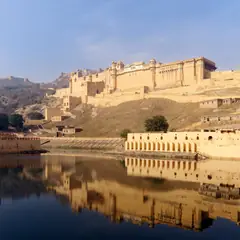
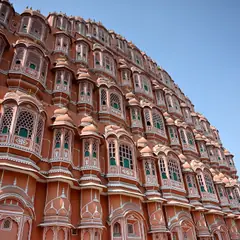
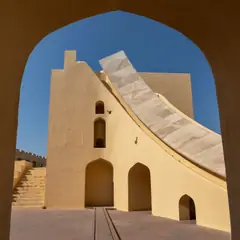
The court came down here from Amber Fort, and the same king built beside it the Jantar Mantar, his stone observatory; the palace’s zenana extends to the lattice façade of the Hawa Mahal.
Marble lace to dazzle outsiders
Mubarak Mahal
Summary of this stop
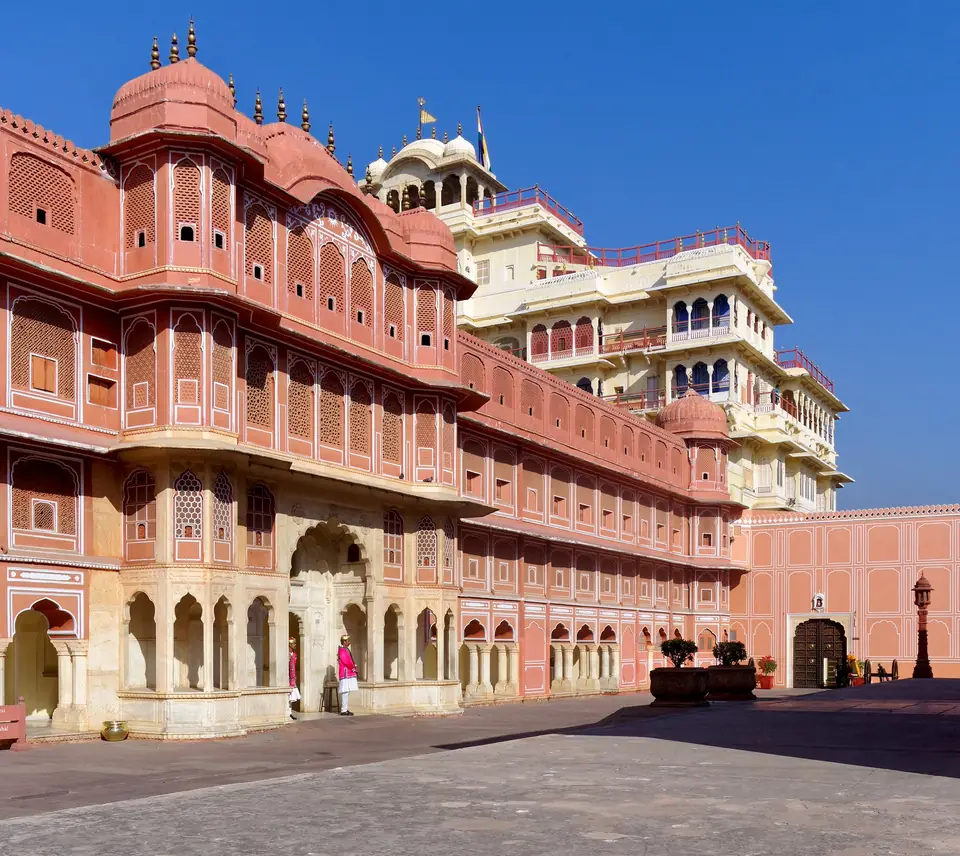
After the bustle of the old town, the entrance through Virendra Pol opens onto a flat, open courtyard. At its centre stands Mubarak Mahal, a freestanding pavilion with an identical façade on all four sides, a hanging balcony and carving in white marble and beige stone that looks like cut-out lace. It was built in 1900 to receive foreign guests and today houses the museum’s textile gallery, as well as offices and a library.
Its authorship is disputed: the museum and other sources attribute it to Lala Chiman Lal, a collaborator of Samuel Swinton Jacob, while some guidebooks present it as the work of Swinton Jacob himself for Madho Singh II. What is certain is its function: the first building the visitor sees was raised precisely to impress outsiders, almost two centuries after palace and city were born together.
Inside, among the textiles, is displayed a set of garments of Sawai Madho Singh I measuring 1.2 metres across. Legend says that this maharaja was a colossus of over two metres and about 215 kilos who ate ten kilos of milk, almonds and jalebis for breakfast, and his life of poisons, hired assassins and battles has made him a giant of epic. How far the clothes back up the myth is told right there, in front of the display case.
The stage that is never taken down
Rajendra Pol and its elephants
Summary of this stop
Between two marble elephants, the openwork gate of Rajendra Pol, the work of Chiman Lal around 1900 in the same style as Mubarak Mahal, leads into the courtyard of Sarvato Bhadra. The pavilion is square, single-storey, open on all four sides and painted with floral motifs in white and pink. It was the hall of private audiences and the stage of the maharajas’ coronations, kings who, from Jai Singh II onwards, presented themselves as mere ministers of Govind Dev Ji.
What is unusual is that the hall has not retired. At Gangaur and Teej the image of the goddess leaves from here in a palanquin, and at Makar Sankranti the paper kites of Sawai Ram Singh II are displayed in the centre while new ones are flown from the roof.
According to documented tradition, every spring, in the month of Chaitra, the image of Gauri leaves the women’s wing in the Gangaur sawari, with a cannon on a carriage, decorated chariots, camels and kachhi ghodi and kalbeliya dancers. The procession crosses the Tripolia gate and Tripolia Bazaar as far as Chhoti Chaupar and enters a bazaar that for that reason is called Gangauri Bazaar. What links that route with the sweet sold at its stalls is revealed by the narration.
Record silver for an impossible journey
Gangajalis of Sarvato Bhadra
Summary of this stop
In Sarvato Bhadra stand the two Gangajalis, sterling silver jars 1.6 metres tall made by melting 14,000 silver coins, without any joins. They hold the Guinness record for the largest silver objects, although their weight and capacity figures vary by source, and there is an account, from a single source, of a third jar lost at sea.
Their reason for existing is the most surprising thing. In 1902 Sawai Madho Singh II travelled to London for the coronation of Edward VII, and crossing the sea violated a religious prohibition. A conclave of priests set him conditions: a ship on which beef had never been cooked, the idols of the family deity on board, earth from Jaipur under his bed every day and only Ganges water during the three months away from India.
The largest jars in the world were therefore not made to show off, but to carry that water. How the maharaja managed to meet every condition in the middle of an Edwardian court is the story heard in front of them.
The calendar turned into a gate
Ridhi Sidhi Pol gates
Summary of this stop
Pritam Niwas Chowk, the inner courtyard that gives access to Chandra Mahal, spreads the year around its corners. Its four small gates, the Ridhi Sidhi Pol, each correspond to a season and a deity: the Peacock gate, in the north-east, is autumn and Vishnu; the Lotus, in the south-east, summer and Shiva-Parvati; the Green or Leheriya, in the north-west, with a carved Ganesha above the lintel, spring; and the Rose, in the south-west, winter and the Goddess.
Above them rises Chandra Mahal, with seven storeys, an auspicious number for Rajput sovereigns: Sukh Niwas, Shobha Niwas with its coloured glass, Chhavi Niwas in blue and white, Shri Niwas and, at the top, the Mukut Mandir pavilion. What each gate hides in its motifs and why this courtyard is the threshold of the most intimate part of the palace is left for the audio guide.
A king “and a quarter” still at home
Mukut Mandir flag
Summary of this stop
Facing the façade of Chandra Mahal, the eye rises to Mukut Mandir, the curved-roofed pavilion that crowns the tower. The royal standard of Jaipur always flies there, and when the maharaja is in residence at the palace a flag of a quarter size is also hoisted. That quarter comes from the title Sawai, “one and a quarter”, which according to the most-cited version the Mughal emperor Aurangzeb granted to Jai Singh in 1699, when he was eleven; other sources place the scene at his wedding or in 1700, in Aurangabad. The title became hereditary and all his successors bear it.
The tower is still a residence. After 1949 the royal family stayed, and documented tradition records the episode that shows it: Bhawani Singh, with no male heir, adopted his grandson Padmanabh Singh in 2002 as his successor. When he died in April 2011, his body lay in state in Chandra Mahal and the cortege left the palace for the cenotaphs of Gaitor; a few days later the priests blessed Padmanabh, a 12-year-old schoolboy, in a marble hall as the new maharaja. What that ceremony without legal value says about the palace, and about the flag that flies above it, closes the audio guide’s route.