Rajput fortress-palace
Amber Fort Audio Guide (Amer Fort)
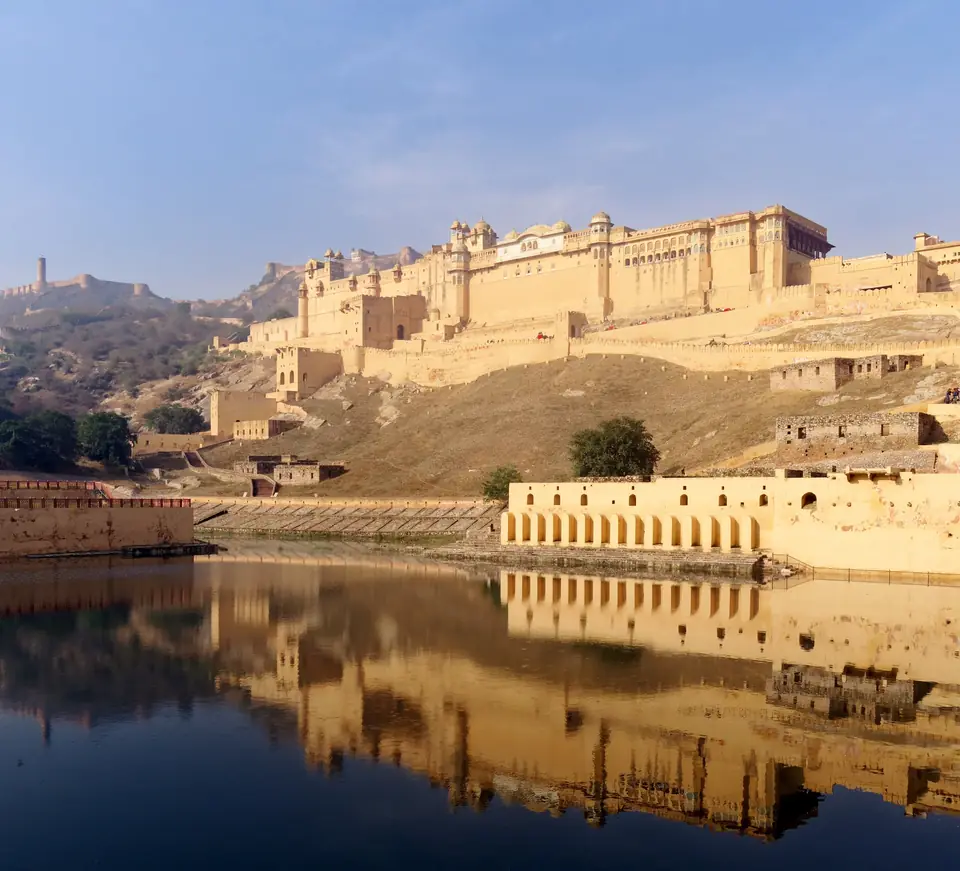
A goddess brought home as a trophy from Bengal, Belgian mirrors meant to multiply a single candle and a king who hid in a maze: above Lake Maota, Amber Fort keeps the court that the Kachwahas abandoned when they founded Jaipur.
- 120 min of audio
- Rajput and Mughal architecture
For centuries the hill of Amber was the capital of the Kachwahas, the Rajput dynasty that lived here through 28 kings until Sawai Jai Singh II moved the court to the newly founded Jaipur in 1727. The present fort was commissioned in 1592 by Raja Man Singh I, a general of the Mughal emperor Akbar, and his successors extended it in red sandstone and marble until it linked four sections, each with its own courtyard.
What began as a soldiers' fortress ended up as a court of mirrors, water and lattice screens. There is a hall cooled by a channel running through the floor, a marble panel that hides seven different figures and paintings that, according to a disputed story, a jealous emperor had covered in lime for being too beautiful.
Highlights
- Jaleb Chowk — a parade ground of about 100 by 65 metres where the spoils of war were paraded
- Shila Devi Temple — a goddess who arrived from Bengal in 1604, behind a double silver door
- Diwan-i-Aam — 27 double-row colonnades with elephant-shaped capitals
- Sheesh Mahal — convex mirrors with Belgian glass of 1623 and a marble flower with seven figures
- Man Singh I Palace — the oldest core of the fort, completed in 1599
The history of Amber Fort begins before its builders. Before the Kachwahas, Amber was a Meena state ruled by the Susawat clan, until Kakil Deo, son of Dulha Rai, defeated them and made Amber the capital of Dhundhar in place of Khoh. The dates of that origin are a matter of debate: sources speak of a Meena foundation in the 10th century, of a first Rajput building in the early 11th or of Kakil Deo’s conquest in 1207, and they do not agree.
What is documented is the turn that changed everything. On 6 February 1562, at Sambhar, Hira Kunwari, daughter of Raja Bharmal of Amber, married the emperor Akbar and went down in history as Mariam-uz-Zamani. Four days later the young Man Singh, Bharmal’s grandson, was presented to the emperor and left with him for Agra. That boy would become one of the generals of the Mughal empire, and in 1592 he commissioned the fortress-palace that now overlooks Lake Maota.
The architecture of Amber Fort reads like a climb through the inside of a dynasty: from the parade ground to the temple of a conquered goddess, from the audience hall to the halls of mirrors and, at the end, to the oldest palace, where the queens lived. That is how the audio guide lays it out, courtyard by courtyard, up to the hill the court left empty in 1727 when it went down to found Jaipur.
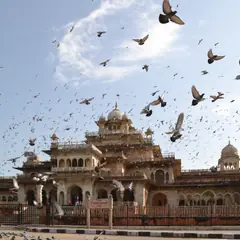
From the same ridge, Nahargarh Fort closed the defensive ring of the new capital together with Amber, and below, on the plain, the City Palace became the court’s new home. The Persian garden carpet of 1632 that turned up forgotten at Amber is now on display in the Albert Hall Museum.
Four courtyards and an entrance for the army
Jaleb Chowk
Summary of this stop
The route starts at Jaleb Chowk, the first great courtyard, reached through the Suraj Pol, the Sun Gate, which faces east. It measures about 100 by 65 metres and was built during the reign of Sawai Jai Singh II (1693–1743). Around it remain the old stables and guardrooms, and from here the logic of the whole complex becomes clear: four linked sections, each with its own courtyard, running from the public space to the most intimate.
This was the stage of victory. After each campaign the army paraded through the courtyard with the spoils, while the women of the royal family followed from the lattices above, unseen. Today it is where visitors dismount.
The climb is also part of the story of the place. On 23 August 2025, after days of rain, a stretch of about 60 metres of the Rambagh wall collapsed, opposite the Jwala Mata temple and beside the path that climbs from the elephant stand to the palace. There were no casualties, but the elephant rides, already questioned for years by animal welfare organisations, were suspended. What that path says about the way one arrived at a Rajput court is revealed in the courtyard itself.
The goddess who arrived as a trophy
Shila Devi Temple
Summary of this stop
Beside the stairway that climbs from Jaleb Chowk opens the temple of Shila Devi, the fort’s protective goddess. Her image reached Amber in 1604 from Jessore, in present-day Bangladesh, after Man Singh I’s victory over the raja of that kingdom. Exactly how she arrived is told in several ways: an idol rescued from the sea after a dream, a black slab handed over in exchange for the recovery of a kingdom or a gift tied to a wedding. All agree on Bengal and on that date.
The sanctuary opens with a double door covered in silver, with reliefs of the nine Durgas and the ten Mahavidyas, commissioned, according to tradition, by Maharani Kishore Kanwar to pray for the health of her husband, Man Singh II. The marble temple seen today dates from 1906, when Maharaja Sawai Man Singh II rebuilt the original, which was of lime. Before this door, on the eighth day of Navratri, a buffalo and goats were sacrificed in the presence of the royal family until the law banned it in 1975; sources do not fully agree on the date it ended, but today the offerings are only vegetarian, and documented tradition records that the royal family still sends the goddess new dresses.
Tradition also keeps a story about her gaze. At first the image faced east, and when Sawai Jai Singh began to build Jaipur, the work stumbled again and again. The pandits consulted said that the goddess’s gaze fell askance. What the king did then, and what it has to do with the birth of the pink city, is told in front of the silver door.
Elephant columns and women behind the marble
Diwan-i-Aam
Summary of this stop
The second courtyard is occupied by the Diwan-i-Aam, the hall of public audience: a raised platform with 27 double-row colonnades of red sandstone and marble, each column topped by an elephant-shaped capital. Here the raja received petitions, and victories and Dussehra were celebrated. It is the space where the mixture born of that wedding with Akbar is best seen: a Rajput family turned into a piece of the Mughal empire.
Opposite rises the Ganesh Pol, the three-level gate covered in floral frescoes and presided over by Ganesha, which leads to the private palaces, built by order of Mirza Raja Jai Singh I (1621–1627). Above it is the Suhag Mandir, with marble lattices from which the women of the court followed the events in the audience hall without being seen.
A disputed story hangs over these walls. It is said that their paintings were so magnificent that the emperor Jahangir, jealous, had them covered in lime; another version places the punishment in the Diwan-i-Aam. If it happened, it must have been between 1621 and 1627. Where the remains of that whitewashed beauty show through today is one of the details revealed at this stop.
Mirrors to multiply a candle
Sheesh Mahal
Summary of this stop
The Sheesh Mahal, also called Jai Mandir, is the fort’s hall of mirrors. The most-cited date is 1623, in the reign of Mirza Raja Jai Singh I, with glass imported from Belgium that same year, although another source attributes it to Man Singh in the 16th century. Its panels and ceilings are covered in convex mirrors backed with coloured foil, designed to glitter by candlelight, with views over Lake Maota. At the base of one of its columns, a marble panel with two butterflies hides seven different motifs, from a fish tail to a scorpion, which appear when parts of it are covered with a hand.
Opposite, behind a sandalwood door, is the Sukh Niwas. An open channel carried water through the hall to cool it and then poured it into the sunken garden in the charbagh style, with little marble channels and a star-shaped pool, which fills the space between the two buildings.
So much luxury came close to being lost: the mirror decoration was left to deteriorate between 1970 and 1980 and has been under restoration ever since. And a cinematic confusion circulates: it is said that Madhubala’s famous song in Mughal-e-Azam was shot here, although it was filmed on a Bombay set that copied the Sheesh Mahal of Lahore. What part this hall really played in that film is told beside the mirrors.
The palace of the twelve queens
Baradari of Man Singh I Palace
Summary of this stop
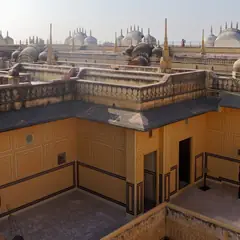
The route ends in the fourth courtyard, in the oldest core of the complex: the palace of Man Singh I, which took 25 years to build and was finished in 1599. At its centre stands a baradari, a pavilion of columns that was closed with curtains and was the meeting place of the maharanis, surrounded by small rooms with balconies and remains of frescoes and tiles, opening onto a shared corridor.
Tradition credits Man Singh I with twelve wives, each with an apartment almost identical to the others, so that the king could visit any of them without the rest knowing. Local custom tells that when he came back from war, with every wife wanting to be the first to see him, Man Singh did something unexpected in the palaces of the third courtyard. What that game consisted of, the most intimate side of a palace of warriors, is kept for the narration.
From the terraces one sees Lake Maota with the garden island of Kesar Kyari and, on the ridge, Jaigarh Fort, joined to Amer by passages. Here 28 Kachwaha kings lived until Sawai Jai Singh II took the capital to Jaipur in 1727. The hill was left empty, but not silent, and how that story closes with the lake in front is told by the last stop of the audio guide.