UNESCO World Heritage Site
Jantar Mantar Audio Guide
A king who distrusted small astrolabes had sundials built the size of a building, and every summer a flag is still hoisted on top of the largest to read the monsoon wind.
- 60 min of audio
- 18th-century astronomy in stone
Beside the City Palace, the founding king of Jaipur, Sawai Jai Singh II, built a garden of astronomical instruments in stone and marble: in 1735, at the height of the works, at least 23 astronomers worked here, and the site replaced Delhi as his main observatory until his death in 1743. It is headed by the Vrihat Samrat Yantra, a 27-metre sundial inclined at the latitude of the city, and since 2010 the complex has been on the UNESCO World Heritage List.
The most rational place in Jaipur carries a name with a double meaning: “jantar-mantar” arose from the popular corruption of “yantra-mantra”, instrument and calculation, but in Hindi and Urdu the same expression also means the spell, the fairground sleight of hand and the hoax. An observatory built to measure the sky with precision is called, in the language of the street, something very close to “abracadabra”.
Highlights
- Vrihat Samrat Yantra — a 27-metre sundial whose shadow moves about 6 cm per minute
- Jai Prakash Yantra — two 5.3-metre bowls that reproduce the inverted sky
- Rasivalaya Yantras — twelve zodiac instruments altered in the restoration of 1901
- Yantra Raj — a 2.43-metre bronze astrolabe used once a year
- Vayu Pariksha — the reading of the monsoon wind, repeated every summer on top of the great sundial
The history of the Jantar Mantar of Jaipur begins, according to a documented tradition, with a noisy argument. In 1719, at the court of the Mughal emperor Muhammad Shah, Sawai Jai Singh II witnessed a quarrel over the calculations meant to fix the auspicious day for the emperor to set out on a journey. From that scene he drew a conclusion: the country needed to learn astronomy. Years later he built a network of observatories, and the one at Jaipur, beside the palace of the city he had himself founded, ended up being the main one.
The exact dates of the work are disputed: some sources place it between 1724 and 1734, others between 1728 and 1734, and some document several instruments already standing in 1728 and works that continued until 1738. Nor is there agreement on how many instruments the site has, because depending on who counts, the figure comes out between 14 and 20. What is not disputed is the scale: ramps, bowls, rings and quadrants of stone that look like abstract sculptures and that served to fix the official time of Jaipur until 1944. Declared a national monument in 1948, it joined the UNESCO list on 1 August 2010, at the session of the World Heritage Committee held in Brasília.
The observatory has also seduced artists: Julio Cortázar photographed it, with the collaboration of Antonio Gálvez, for his “Prosa del observatorio” (Lumen, 1972), and Tarsem Singh turned it into a film labyrinth in “The Fall” (2006), with a warrior who runs up one of its stone staircases and leaps into the void, shot at the real site and without digital scenery. What to see at the Jantar Mantar and how to read each instrument is exactly what the audio guide arranges: a one-hour route from the entrance to the great bronze astrolabe, documented and checked against historical sources.
It stands beside the City Palace, the work of the same king, and on the ridge that dominates the city, the cannon of Nahargarh Fort gave Jaipur its official time by gunfire.
A court quarrel turned to stone
Jantar Mantar
Summary of this stop
The visit starts beside the Unnatamsa Yantra, a large graduated metal ring hung between two pillars on a circular platform, to the left of the entrance. From here the first question the site raises becomes clear: why is everything so big? Jai Singh II began with brass instruments in the Samarkand style, among them a two-metre armillary sphere, and discarded them as too small.
With his stone giants he believed he had found an error of half a degree in the position of the Moon in the tables of John Flamsteed, a European astronomer who already worked with a telescope, and he attributed it to the small size of European instruments. That conviction explains the landscape: in 1735, at the height of the works, at least 23 astronomers worked in this observatory, which displaced Delhi as the raja’s main one until his death in 1743.
Between the court quarrel of 1719 and these stone hulks lies a road with more than one unexpected turn, and the narration retraces it at the very point where the visit begins.
Walking inside the inverted sky
Jai Prakash Yantra
Summary of this stop
The two bowls of the Jai Prakash Yantra are half-buried in the ground, complementary to each other, 5.3 metres in diameter, with the marble graduated like a celestial dome turned upside down. Inner passages let the observer walk inside, and over them run wires with a central plate whose shadow marks the position of the Sun on the inverted vault.
It is one of the instruments Jai Singh II boasted about. In the preface to his Zij-i Muhammad Shahi, the king presents himself as the inventor of the Jai Prakash, the Ram Yantra and the Samrat Yantra itself. How far those tables came from the stone observations is a disputed matter: their content largely adapts earlier tables by Ulugh Beg and Philippe de La Hire.
Here the name of the place also makes sense. In street speech “yantra-mantra” ended up sounding like “jantar-mantar”, an expression dictionaries record at once as observatory and as spell or fairground trick. How that double meaning fits a king who wanted to measure the sky to the millimetre is heard standing beside the bowls.
A shadow that moves a handspan a minute
Vrihat Samrat Yantra
Summary of this stop
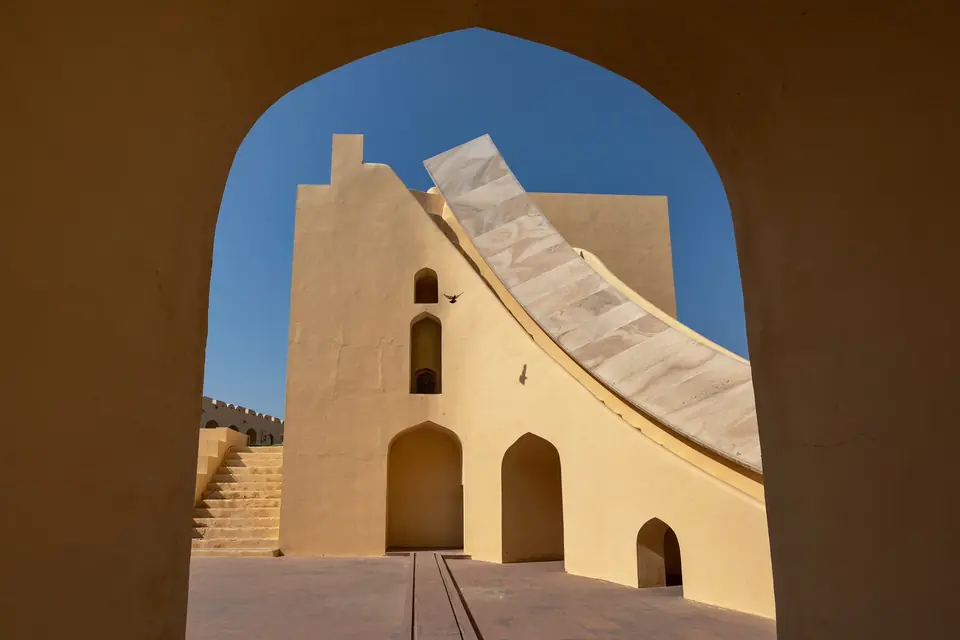
At the foot of the quadrants of the Vrihat Samrat Yantra, time can be seen moving. The triangular ramp is 27 metres high, although the figures vary greatly by source, and is inclined at 27 degrees, the latitude of Jaipur; a small chhatri sits on its top. The shadow of the gnomon moves one millimetre per second, about 6 centimetres a minute: a handspan that slides in plain view across the curved wings, to the west in the morning and to the east in the afternoon.
The quadrant is graduated in hours, minutes and intervals of 6 and 2 seconds, but the shadow is not sharp. To find its centre, a twig or a taut string is held parallel to the edge, one centimetre from the surface, until its own shadow disappears. The real precision of the instrument is a matter of debate, because the penumbra can cover several marks and the foundations have settled over time.
Even so, this sundial served to fix the official time of Jaipur until 1944. What it means to read time with a twig in the hand, and why it worked, is best understood in front of the ramp.
Twelve signs remade by mistake
Rasivalaya Yantras
Summary of this stop
The twelve Rasivalaya Yantras resemble one another, but each has a different inclination, one per sign of the zodiac, and today visitors photograph themselves in front of the one for their sign. Their history is one of loss. According to James Tod, when Jai Singh II died in 1743, three of his wives and several concubines climbed onto his pyre, “upon which science expired with him”; the same raja is credited with reforms that included the abolition of sati.
Under Pratap Singh, who reigned between 1778 and 1803, astronomical activity faded: a temple was built in the compound and the observatory became an arms factory. Ram Singh II completed a first restoration in 1876, with lead inlaid in some graduations and stone in place of plaster. Between 1901 and February 1902, by order of Madho Singh II, came another, with the team of Major Arthur Garrett and the writer Chandradhar Sharma Guleri, author of the celebrated Hindi story “Usne Kaha Tha”.
That team found no description of the Rasivalaya and altered their heights to fit the hypothesis that each one served a sign of the zodiac. A review of 1906 lamented that in this way Jai Singh’s original arrangement was lost for ever. What remains of the king’s layout and what is reconstruction is unravelled by the audio guide in front of the instruments themselves.
The astrolabe used once a year
Yantra Raj
Summary of this stop
The Yantra Raj is a 2.43-metre bronze disc suspended in its frame, one of the largest astrolabes in the world. It is used only once a year to calculate the Hindu calendar, and the calculations of the yantras still feed the publication of the panchang, Jaipur’s local almanac: the observatory is not a museum of stone, it is still at work.
The most spectacular test comes with the full moon of Ashadha Shukla Purnima, between June and July. At dusk, astrologers of the city celebrate the flag ritual, the dhwaj pujan, and climb the Samrat Yantra to read the direction of the wind and forecast the monsoon rains; on 3 July 2023 the 296th edition of this Vayu Pariksha was held. The flag raises the observation point to 35 metres.
But the city has grown up around it. Vinod Sharma, head of Astrology at the Sanskrit University of Jaipur, complains that tall buildings now deflect the wind. How the story of a science of stone that still looks at the sky among skyscrapers ends is told by the last stop on the route.