Rajasthan's oldest museum
Albert Hall Museum Audio Guide
It was named in 1876, before anyone knew what it would be for: the Albert Hall was born as a town hall and ended up preserving, against inflated prices, neglect and floods, the memory of what the hands of Jaipur made.
- 75 min of audio
- Indo-Saracenic architecture
In the Ram Niwas garden, Samuel Swinton Jacob built between 1876 and 1887 an Indo-Saracenic palace of domes, chhatris and lattice screens with the idea that the walls themselves should be a museum, copying motifs from monuments in Delhi and Agra. Sawai Ram Singh II conceived it as a town hall; his successor, Sawai Madho Singh II, decided in 1880 to turn it into a museum of local crafts, and in 1887 it received the pieces of the great Jaipur Exhibition of 1883. It is the oldest museum in Rajasthan.
Its collection was assembled by a surgeon with no artistic training, Thomas Holbein Hendley, who had to send Indian agents to the bazaar because prices doubled as soon as he appeared. Among its rooms are a Persian garden carpet of 1632 that turned up forgotten in a storeroom of the Amber palace and an Egyptian mummy, Tutu, who in 2020 was carried by hand out of the flooded basement.
Highlights
- Persian Kerman garden carpet — dated 1632, about 8.5 metres, with a dragon that bites and is bitten by the fish
- Mummy of Tutu — a woman from a family of priests of the Ptolemaic period, saved from the flood of 2020
- Courtyard murals — six scenes of the Mahabharata copied from the Persian Razmnama
- South Kensington Cases — those of the 1883 Exhibition, copied from those of today's Victoria and Albert Museum
- Swinton Jacob façade — domes, chhatris and lattice screens in which no carving repeats
The history of the Albert Hall Museum begins with a ceremony and no plan. On 6 February 1876, during his visit to Jaipur, Albert Edward, Prince of Wales and future Edward VII, laid the foundation stone of a building that would bear his name and that Sawai Ram Singh II imagined as a town hall. Four years later his successor, Sawai Madho Singh II, changed the purpose of the work: it would be a museum of the arts of local artisans, in the heart of the new Ram Niwas garden. Some sources even dispute which Albert the name honours, and others bring forward or push back the dates of the commission and of the end of construction, but the most accepted account places the opening in February 1887, eleven years after that first stone.
In the meantime the Jaipur Exhibition of 1883, held in a large hall annexed to the City Palace, had received almost a quarter of a million visitors. Its pieces were moved to the newly finished Albert Hall, which opened with a great durbar and, the next day, a state dinner with nautch, electric light and fireworks in the gardens. That museum reserved Fridays for women, in a Jaipur where purdah was general, and Hendley introduced guides and demonstrators to accompany visits.
The architecture of the Albert Hall Museum, its history and what to see inside make up a single story: from the esplanade of the pigeons to the courtyard of the murals, from the 19th-century display cases to the Persian garden carpet and, finally, to the Egyptian gallery in the basement. The audio guide tours the building in that order, with narration that is documented and checked against historical sources.
Its Persian garden carpet turned up forgotten at Amber Fort, and the craftsmanship the museum set out to gather is still alive in the gem workshops of Johari Bazaar.
An English prince and a thousand pigeons
Albert Hall Museum
Summary of this stop
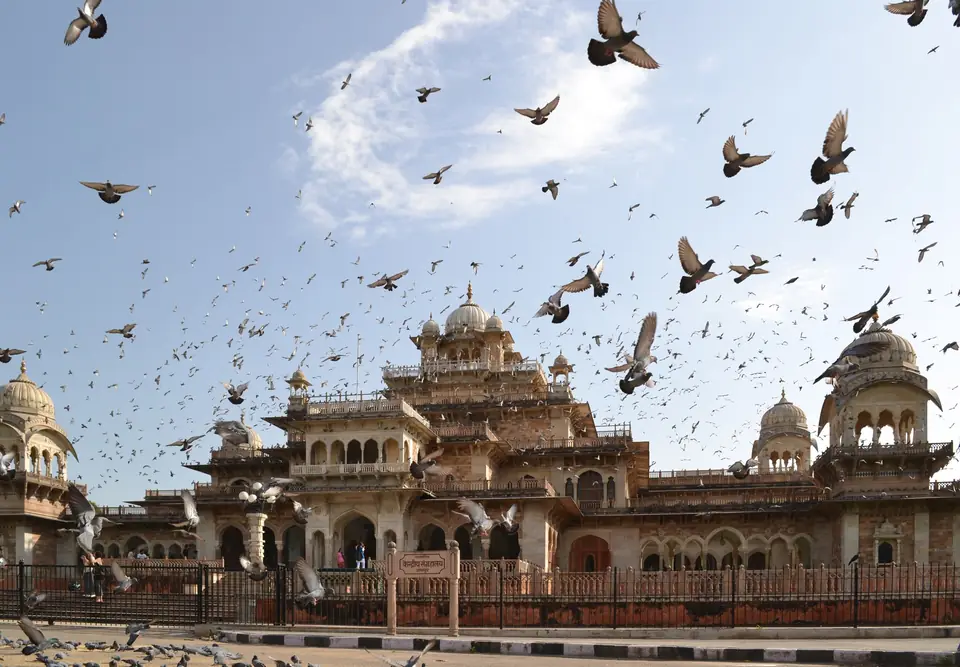
The visit starts on the esplanade, in front of a façade of domes, pavilions with chhatris, pointed arches and carved lattice screens, flanked by a pair of stone elephants. On the porch wait the mural portraits of the two maharajas who decided its fate: Sawai Ram Singh II, who conceived it as a town hall, and Sawai Madho Singh II, who turned it into a museum. The building was a name before it was a destiny.
The esplanade is now pigeon territory, and not without conflict. In 2007, during the renovation, the Government of Rajasthan banned feeding them here and even showed hawks to scare them away, because their droppings were damaging the mural paintings. After the protests, Chief Minister Vasundhara Raje ordered on 1 May the creation of feeding spots in Ram Niwas Bagh.
The palace raised in honour of a prince of the Empire has also become the stage where the elected governments of Rajasthan are sworn in: Ashok Gehlot and Sachin Pilot took the oath here on 17 December 2018, and Bhajanlal Sharma on 15 December 2023. Who took the oath at his side that day, and why his surname closes a circle with the history of the building, is something the narration reveals in front of the façade.
Walls that teach
Central courtyard with fountain
Summary of this stop
In the central courtyard, beside a fountain with carved edges, the idea of Samuel Swinton Jacob, director of Public Works of Jaipur, becomes clear: that the building should be a museum in itself. To achieve this he copied motifs from ancient monuments in Delhi, Agra and elsewhere, so that every carving is different. High up in the courtyard run inscriptions of religious texts, from the Quran to the Bible and the Indian epics, and on other walls appear scenes of ancient civilisations, from Egypt to China, Greece and Babylon.
Here the pieces of the 1883 Exhibition ended up in 1887, and here too the Mahabharata unfolds in six large murals: the great scene of the dice game, the abduction of the white horse or the swayamvara of Damayanti, among others. They are 19th-century copies of the Razmnama, the Persian translation of the epic made in the 16th century.
A Sanskrit poem told in the images of a Persian manuscript and painted in a building designed by a British engineer: what that layering says about Jaipur at the end of the 19th century is the thread the audio guide follows in this courtyard.
Cases from London and undercover buyers
South Kensington Cases
Summary of this stop
In the galleries the wood-and-glass display cases that debuted at the 1883 Exhibition are still in use, the “South Kensington Cases”, copied from those of today’s Victoria and Albert Museum in London. Behind them is Thomas Holbein Hendley, chief surgeon of the British Residency in Jaipur between 1873 and 1897, with no formal artistic training, whose register of every object remains the basis of the museum’s inventory.
Hendley soon learned that his presence made the bazaar dearer: prices doubled as soon as he appeared. From 1881 the purchases were made by Indian agents, such as the head clerk Pandit Braj Ballabh. And the museum was not only for looking: artisans could borrow pieces to study and copy them.
At the end of 1887 an unexpected visitor arrived, the young journalist Rudyard Kipling, who in his reports for The Pioneer described cases without a speck of dust, carved doors no two alike and labels with the measure and price of each piece, and called the museum “a reproach to all other museums in India”. What the curator ended up confessing to him in front of a map of the kingdom, and which had little to do with art, is told in this room.
A Persian garden forgotten at Amber
Persian garden carpet
Summary of this stop
The garden carpet, a chahar bagh, reads like a plan seen from the sky: a garden divided into four, with channels, a central pool with a pavilion, birds, animals and fish swimming in the water. In the pool a dragon bites and is bitten by them. Woven in Kerman, in southern Persia, it measures about 8.5 metres long by almost 4 wide and exceeds 4,700 knots per square decimetre.
Its story has something of a chance discovery: it turned up in 1937 forgotten in a locked storeroom of the Amber palace. An inscription on its lining bears the date of 29 August 1632.
How a woven garden is traversed with the eye, and what that scene of the dragon and the fish tells, is what the audio guide unfolds in front of the carpet.
Tutu and the night of the water
Basement Egyptian gallery
Summary of this stop
The route goes down to the basement, to an Egyptian gallery where Tutu rests, a woman from a family of priests of the god Kehm (Min) of Panopolis, of the Ptolemaic period (322–30 BC). Since April 2017 she has been displayed here with her sarcophagus and about 200 Egyptian pieces. How she came to Jaipur is a less clear matter: the version circulating in the press does not quite fit who was reigning then, and the figures for her age vary by source.
On 14 August 2020, 132 mm of rain fell on Jaipur and the water flooded the basement. The employee Kishore Singh and his team broke the display case and carried Tutu up to the first floor, while some 17,000 stored pieces were damaged. The museum closed for seven days.
It is the closing that best sums up the building: a museum that exists because someone decided, again and again, to rescue what others forgot. What that night was like on the basement stairs is told by the last stop of the audio guide.