The jewellers' bazaar
Johari Bazaar Audio Guide
In front, kundan display cases under pink arcades; behind, workshops where gems have been cut and polished since Jaipur was founded in 1727. Johari Bazaar is the jewellers' street, and also that of a sweet shop with three centuries of lineage and a wound for which people still pray.
- 60 min of audio
- Jewellery and trades of 1727
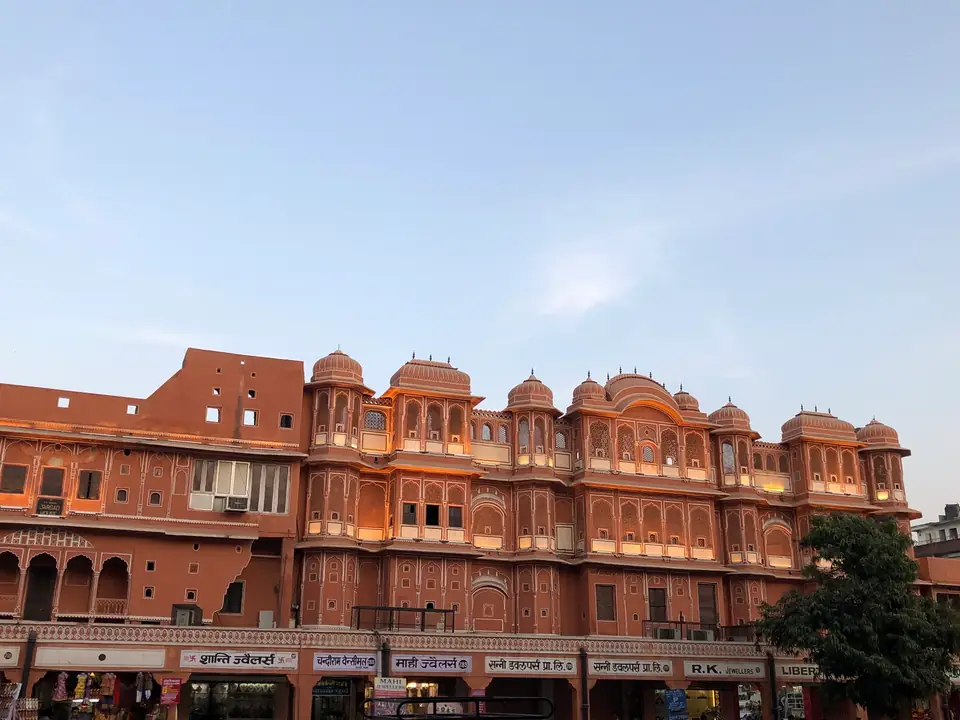
When Sawai Jai Singh II founded Jaipur in 1727, he divided the old town by trades and communities, and each street kept the name of its guild: Johari Bazaar means “jewellers' bazaar”. With it the city's gem industry began. The king attracted merchant communities, among them Jains from Amer, and the Shrimal and Osval families ended up forming the emerald elite here. Today it is the southern axis of the walled city, from the Sanganeri gate to the great square of Badi Chaupar, under a colonnaded gallery and façades of a pinkish tone.
What looks like pure shop window is a business of trust: the shop is only the façade, stones are cut in the back room and on the pavement brokers show coloured gems in packets. That same street keeps the memory of the bombs of 13 May 2008, a sweet that exists only with the humidity of the monsoon and a neighbouring house that opens to the public two days a year a relic that is not for sale.
Highlights
- Sanganeri Gate — the south entrance of the wall and a Hanuman temple, a memorial of the 2008 bombs
- LMB — a sweet shop tracing its lineage to the halwais of 1727 and its monsoon ghewar
- Pink arcades — a covered passage with a recessed first floor for watching processions
- Shop windows and workshops — more than 400 shops of kundan, meenakari, thewa and polki with a gem workshop behind
- Badi Chaupar — the great square where the Muharram tazias end up
The history of Johari Bazaar begins with Jaipur itself. In 1727 Sawai Jai Singh II laid out a capital divided by trades and communities, and the streets kept the name of the guild that occupied them. This one, Johari Bazaar, was the jewellers’: one of the oldest markets in the city and the starting point of its gem and jewellery industry. To populate it, the king offered lucrative incentives to merchant communities, among them the Jains of Amer and of other parts of the subcontinent. The Shrimal and Osval families, of the Shvetambara Jain community, formed the core of the emerald elite and lived in havelis crowded around the bazaar, in neighbourhoods that were sometimes closed off with guarded gates.
For a long time the street was the epicentre of Jaipur’s jewellery trade, with manufacturing, wholesale and retail in tiny premises. In recent years many jewellers have moved to M.I. Road and manufacturing to special economic zones, and textiles and spices fill the gaps. Even so, the bazaar, at the crossing with Haldion Ka Rasta and Gopalji Ka Rasta, brings together more than 400 shops of kundan, meenakari, thewa and polki jewellery, alongside fabrics dyed in leheriya and bandhej.
What to see at Johari Bazaar depends on reading its layers well: the architecture of arcades, the pink of the façades, the hidden workshops, a sweet shop that looks back to 1727 and the memory of 2008. The audio guide’s route runs from end to end, from the gate of the wall to Badi Chaupar, and ties all those pieces together in a single walk.
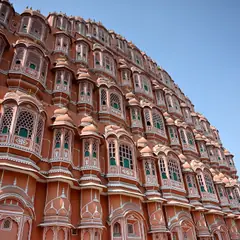
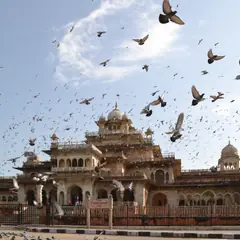
To the north, past Badi Chaupar, rises the lattice façade of the Hawa Mahal, and the jewels and trades of this street have their historical showcase in the Albert Hall Museum, born as a museum of local crafts.
The gate where people pray for justice
Sanganeri Gate
Summary of this stop
The walk starts under the Sanganeri Gate, at the southern end of the wall. Ahead opens a straight axis: everything indicates that Johari Bazaar is one of the great streets by which Jaipur was divided into six sectors, wide avenues of about 34 metres that already had pavements in 1905. Beside the gate stands the Hanuman temple, and that temple is also a place of memory.
On 13 May 2008, between 19:20 and 19:32, several synchronised bombs attached to parked bicycles exploded in the walled city. The sixth did so in front of the National Handloom shop in Johari Bazaar; the eighth, in front of this very temple, at the end of the street. After the first two explosions at Manak Chowk, the crowd ran towards the bazaar, and two more detonations beside the National Handloom Centre blocked that exit and pushed it back towards Tripolia Bazar and Chandpol. The toll varies by source: between 63 and 80 dead, and eight or nine bombs.
A special court sentenced four defendants to death in December 2019, but the Rajasthan High Court acquitted them all on 29 March 2023. On the anniversary in 2024, the victims’ families recited the Hanuman Chalisa together before the temple to ask for justice. Why the walk along the jewellers’ street begins precisely here is understood on hearing the narration under the gate.
Three centuries of syrup at the LMB counter
Laxmi Mishthan Bhandar
Summary of this stop
A few steps further on, the smell of ghee and syrup announces LMB, Lakshmi Mishthan Bhandar. Among the artisans invited in 1727 came a group of halwais, sweet makers, who opened a small sweet shop here. Around 1949 or 1950 their descendant Maliram Ghodawat gave it its present name, and in 1954 the hotel that now occupies the upper floors was added. That is why it is sometimes read that LMB “was founded in 1727”: that year belongs to the forebears’ sweet shop, not to the brand.
At the counter the ghewar rules, a honeycomb-shaped disc of batter fried in ghee and soaked in syrup. It is made only in the monsoon season, because it is the humidity in the air that gives it its texture, and it is the sweet of Teej. On the eve, the Sinjara, the maternal family sends the married daughter clothes, jewellery, the sixteen adornments of the solah shringar and sweets such as ghewar.
In Johari Bazaar that custom has its own address: LMB’s paneer ghewar and those of Sambhar Fini Wala, who answered the competition from other desserts with miniature ghewars in vanilla, strawberry and chocolate. What a box of ghewar leaving here in the height of the monsoon means is explained by the audio guide in front of the façade.
A continuous box seat above the street
Arcades of the covered passage
Summary of this stop
Under the arcades, the colonnaded pedestrian gallery gives shade in front of the shops, and above it the first floor is set back from the line of arches to leave room to circulate. It is reached by stairs and served as a viewing gallery for processions. This façade design goes back at least to the 15th century, and here it forms a continuous front in geru, pinkish terracotta, with the signboards aligned.
The pink has its own history, and it is not settled. The most repeated version says that, under Sawai Ram Singh II, the façades were renewed in that tone to receive Albert Edward, Prince of Wales, in 1876. Other sources bring the date forward to 1853, and some maintain that the colour comes from the local, pinkish stone itself, and that in 1876 the façades were only cleaned and touched up.
Shade, box seat, colour and the very name of the bazaar are pieces of a single idea of a city divided by trades. How they fit together is revealed by walking the arcades with the narration.
What happens behind the display case
Side streets of Gopalji Ka Rasta and Haldion Ka Rasta
Summary of this stop
At the crossing with Gopalji Ka Rasta, the display cases of kundan, meenakari and thewa are only half the story. In Johari Bazaar the shop is the façade: in the back room gems are cut and polished and jewellery is made, and on the pavement there are brokers showing coloured stones in packets. There are traders, such as Kamal Kothari, of Super Gems and Jewels, who have been working in the bazaar for more than forty years.
These side streets were the quarter of the Jain families that Jai Singh II attracted to his new capital, and they remain a web of jewellers and workshops. Everything rests on trust in a stone, and that trust has also been broken. In 2022 an American buyer contacted a jeweller in Gopalji Ka Rasta through Instagram and over two years paid him about 6 crore rupees for a diamond chain and pendant with a certificate of authenticity. In 2024 a purity test revealed that the chain was gold-plated silver and that the stones were not diamonds: they were worth about 300 rupees.
The police arrested the author of the false certificates and issued a search warrant against the jeweller, who in June 2024 was still on the run together with his father. What that episode says about a trade almost three centuries old is told at the crossing, between shop window and workshop.
The square where the street changes without ceasing to be itself
Badi Chaupar
Summary of this stop
The route ends at the edge of Badi Chaupar, the great square where Johari Bazaar meets Tripolia Bazaar. From here one sees how the jewellers’ street is transforming: jewellers leaving and fabrics arriving. At Diwali 2025, among the collective decorations of the markets, a replica of the Hawa Mahal mounted over the bazaar’s veranda drew the crowd.
In Haldion Ka Rasta, one of the side streets, stands the Salim Manzil, the haveli of a family of hakims, doctors of Unani medicine, who came from Delhi around 1812 and were welcomed at court by Maharaja Jagat Singh. Since 1876 it has kept in a glass case a cap that the family venerates as that of Imam Husayn, grandson of the Prophet. According to family tradition, at the beginning of the 17th century an ancestor cured a king of Iran and asked for that cap in place of the gold and silver he was offered.
Every Muharram, on the 9th and 10th of the month, the house opens to the public, Shias from Gujarat and Maharashtra arrive to pray and more than 300 tazias travel through the old town towards this square. How a walk that began with a wound and goes on among gems and sweets ends at Badi Chaupar is told by the last stop of the audio guide.