13th-century minaret
Al-Shafi'i Mosque Audio Guide (Masjid al-Shafi'i)
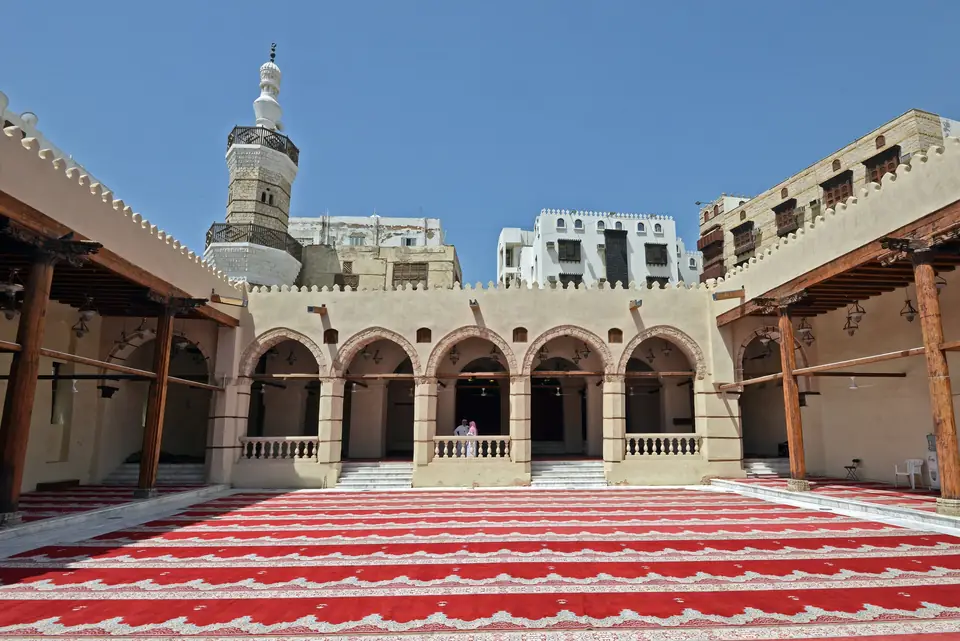
Jeddah's “old mosque” sits sunk below the level of the souq: the city rose around it over the centuries while it kept its original floor plan. It holds a 13th-century coral-stone minaret, wooden columns carved in the Kerala style and a mihrab that hid a much older one.
- 25 min of audio
- The oldest mosque in Al-Balad
The Al-Shafi'i Mosque, in Harat al-Mazloum, was for centuries al-Jami' al-Atiq, the old mosque of Jeddah. Tradition traces its foundation to the first caliphs, but the documented building was raised around 1250 by King al-Muzaffar of Yemen, a follower of the Shafi'i school of law, and that school gives it the name found in the records since the 18th century. Around 1538 an Indian merchant, Khawaja Muhammad Ali, rebuilt all of it except the minaret, which passes for the oldest in the Hejaz.
Above its Ottoman mihrab, the declaration of faith is written both straight and in mirror image until it draws a mosque with six minarets, the Blue Mosque of Istanbul. And beneath it, according to accounts from the survey before the 2014 restoration, another mihrab over a thousand years old came to light. The mosque reopened in June 2015 after works that were the first restoration of a Saudi heritage building carried out with the method adopted by UNESCO.
Highlights
- Southwest corner minaret — 13th century, as tall as the neighbouring houses out of respect for their privacy
- South door — three panels with the names of an emir of Mecca, an Indian merchant and a sultan of Cairo
- Courtyard wooden columns — cross-shaped brackets with an arm that supports nothing, in the Kerala style
- Mihrab — the mirrored declaration of faith that draws the Blue Mosque of Istanbul
- Sunken floor — proof that the city grew above the mosque
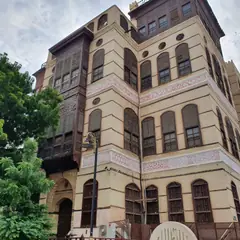
To enter the Al-Shafi’i Mosque you have to go down. Its floor lies clearly below the paving of the souq, and the explanation is the history of Jeddah summed up in a single step: for centuries the city rose in level around it while the building kept its original plan. Wedged between the souqs of Harat al-Mazloum, small and discreet, it is the oldest mosque in Al-Balad and an archive of eight centuries of routes, patrons and lawsuits.
The history of the Al-Shafi’i Mosque begins with a dispute. Some sources attribute its foundation to the caliph Umar ibn al-Khattab, in the 7th century; others prefer the time of Uthman ibn Affan, the caliph who made Jeddah the port of Mecca, and the historian Abd al-Quddus al-Ansari rules out Umar precisely because the city only gained importance under Uthman. Documentary historiography places the construction around 1250, under King al-Muzaffar of Yemen, although there is not even agreement on which Yemeni ruler it was. For centuries it was called al-Jami’ al-Atiq, the old or great mosque, and the name al-Shafi’i, after the legal school of its founder, appears in the records only from the 18th century.
The architecture of the Al-Shafi’i Mosque blends those centuries without disguise: crenellated coral-stone walls crossed by courses of teak, a courtyard of white marble slabs, a wooden dome on a drum with sixteen windows, a minbar set into the qibla wall and a cistern from al-Muzaffar’s time that collected rainwater and stayed in service well into the 20th century. It was also a school: the sheikhs Hassan Abu al-Hamail, Muhammad Saleh Abed and Ali Basabrib taught jurisprudence and religious sciences here. And it was a wedding venue. Until recent times, families brought the bridal procession here to celebrate the contract and pray, and custom required any groom from outside Harat al-Mazloum to ask the neighbourhood sheikh for permission first; more than one procession that did not ended up as a battlefield.
The audio guide walks through the mosque in four stops, from the minaret to the mihrab, with documented narration checked against historical sources that reads in each stone a different chapter of those eight centuries.
About 165 metres away, in the same neighbourhood, the Uthman ibn Affan Mosque keeps another story of layers under its floor, that of Ceylon ebony. To the south, already in Souq Al-Alawi, the Matbouli House Museum opens up a grain merchants’ tower house from the inside.
A minaret as tall as the houses
Southwest corner minaret
Summary of this stop
The southwest corner minaret was built in the 13th century and passes for the oldest in the Hejaz. It is a solid tower of exposed coral stone that starts with a square shaft, turns octagonal and has two balconies with wooden parapets over simple muqarnas. It served as a model for many later minarets in Jeddah.
Its most eloquent trait is its discretion: its height matches that of the neighbouring houses, so that from the top nobody could intrude on the privacy of the courtyards and roofs around. It also survived the great 16th-century rebuilding, which remade the whole building except this tower.
The neighbourhood around it, Harat al-Mazloum, means “the quarter of the wronged”, and its name carries a legend. The version repeated by local historians attributes it to a sayyid executed by the Ottoman authorities whose blood, according to popular memory, wrote the word “mazloum”. The historian Abd al-Rahman al-Arabi considers it a legend, because a chronicler of Jeddah who died more than a century before that execution already called the place by that name because of a saint’s tomb. Who that saint was is what the narration reveals beneath the minaret.
Three names carved above the south door
South door of the Al-Shafi'i Mosque
Summary of this stop
The main door on the south side is a large wooden portal with geometric and floral decoration that opens onto the east-west souq. In front of it, the dispute over the mosque’s origin is summed up: a tradition that speaks of the caliphs Umar or Uthman, in the 7th century, and a documented building that King al-Muzaffar of Yemen raised around 1250 and dedicated to the imam Muhammad ibn Idris al-Shafi’i.
Above the door remain three panels of inscriptions. One names al-Sharif Hasan ibn Ajlan, emir of Mecca between 1395-96 and 1426; another, al-Khawaja Muhammad Ali, with the date 944 AH, 1538; the third, badly damaged, lets you read in its second line the name of Barsbay, Mamluk sultan of Egypt between 1422 and 1437. The researcher Hidaya Abbas proposes that the first and the third are from the same period and prove a Mamluk renovation earlier than the Indian merchant’s.
Along the south wall stood shops that belonged to the mosque’s waqf and financed it. The 2015 restoration removed almost all of them, and today only a few remain at the western end of that façade. What those three names reveal together is part of what you hear in front of the door.
Kerala columns below the souq’s level
Courtyard wooden columns
Summary of this stop
Once in the courtyard, the difference in level becomes obvious: just compare the building’s plinth with the souq’s paving to understand that the city rose around the mosque while it stayed where it was.
On either side, two galleries with six tall wooden columns, three per side, topped by brackets carved in the shape of a cross. One arm of each cross juts out into empty space without supporting anything, and its carving resembles that of the Thazhathangady mosque in Kerala. It is the legacy of the rebuilding of around 1538, when Khawaja Muhammad Ali remade the mosque with fine timber and carved columns that arrived via Yemen. The sources do not agree on the exact date, which ranges between 1533 and 1539, nor on the merchant’s full name, nor even on the origin of the columns: some speak of reddish marble brought from Ethiopia in the early days of Islam or of Ottoman stone columns.
The merchant’s legacy had a bitter ending. According to the documented tradition, he gathered the money among viziers of India and built houses and shops around the mosque to maintain it; when he died, his daughter claimed them as her own. What happened to the mosque afterwards is the dark episode the narration tells in the courtyard.
A Blue Mosque written in mirror image
Mihrab of the prayer hall
Summary of this stop
The mihrab is a semicircular niche with a hood decorated with calligraphy and geometric and floral motifs. Above it, the declaration of faith is written both straight and in mirror image until it draws a mosque with six minarets, the Blue Mosque of Istanbul: a decorative signature of the Ottoman administration. In the lower band runs a hadith on congregational prayer.
Beneath that niche lies the mosque’s other surprise. According to accounts from the survey before the 2014 restoration, under the current mihrab another one over a thousand years old appeared, and beneath repairs five centuries old, precious stones and coral. The archaeological teams also detected lead in the foundations and in the column bases.
The works were ordered by King Abdullah, who had the two oldest mosques in Jeddah restored, al-Shafi’i and al-Mimar, with a budget of 7 million riyals; al-Shafi’i reopened in June 2015. Not everything was praise: Spahic Omer’s architectural analysis criticises that the glass wall between the prayer hall and the rear area and the air conditioning fragment a mosque designed to be lit and ventilated naturally. How the signature hidden in the calligraphy is read is the finale of the narration.