Tower house of 1872
Nasseef House Audio Guide (Bait Nasseef)
A tower house of coral and lattices on the main street of old Jeddah, with the neighbourhood's only tree at its door and a staircase made for camels. It hosted the Hashemite kings of the Hejaz and in December 1925 became the residence of Abdulaziz ibn Saud, newly arrived in the city.
- 45 min of audio
- UNESCO heritage
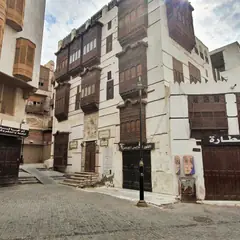
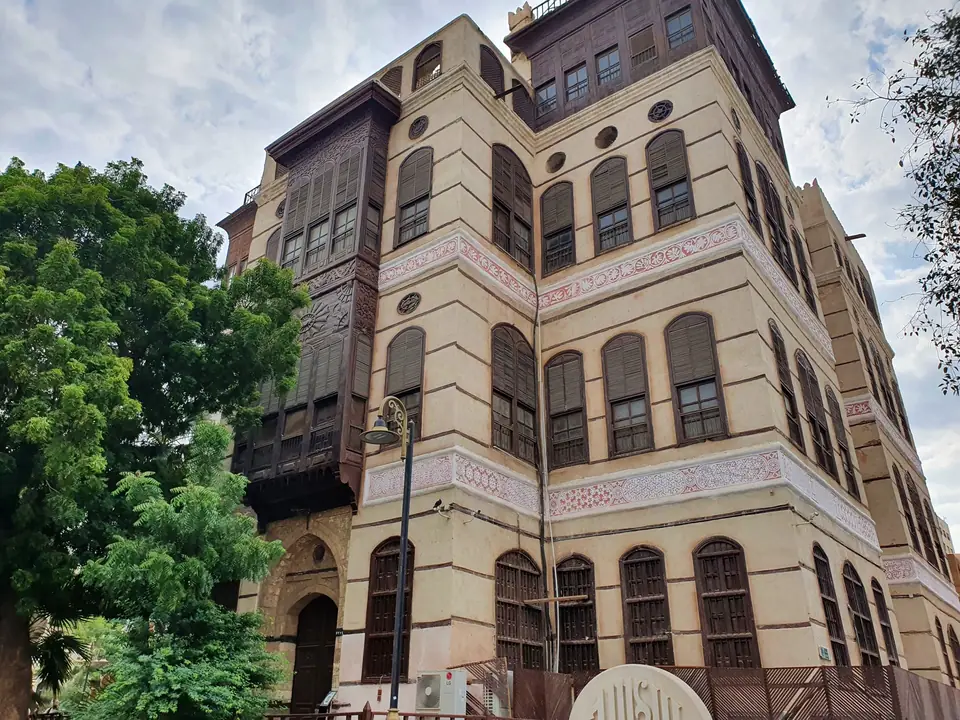
Nasseef House, Bait Nasseef, began to be built in 1872, the year 1289 AH, in Suq al-Alawi, commissioned by Omar Nasseef Effendi, a member of a wealthy merchant family and governor of Jeddah. Its walls are of kashur, the coral stone of the Red Sea shore coated in lime, and its roshan, the openwork wooden bay windows, were made with timber from India and Indonesia and with that of an English ship wrecked off the coast. It is one of the merchants' tower houses for which UNESCO listed historic Jeddah as a World Heritage Site in 2014.
Before 1925, when Jeddah had no hotel or guesthouse, this private house served as the Hejaz's guest palace: King Husayn ibn Ali and his son Ali stayed in it. After the siege of the city, the man who had displaced them, Abdulaziz ibn Saud, settled in it, receiving here the oath of allegiance of the ulema and notables of the Hejaz, and he returned to it on every stay in Jeddah for more than ten years.
Highlights
- Neem tree — the only tree in Al-Balad, which gave the house the nickname “house of the tree”
- Roshan façade — lattices of timber from India, Indonesia and a wrecked English ship
- Ramp staircase — wide, low steps up which camels and horses climbed
- Abdulaziz's majlis — the second-floor room where the future king sat from 1925
- Upper floors — the malqaf al-hawa niches where the family sought the summer breeze
In old Jeddah a saying went around about this house: whoever visited the city and did not stop at Nasseef House had not really known Jeddah. The history of Nasseef House explains the fame. Omar Nasseef Effendi, merchant and governor of the city, began it in 1872, three years after the opening of the Suez Canal, when the Red Sea merchant elites were raising tower houses with roshan along the streets of Al-Balad. All sources agree on the start of the work; on the end they differ, and the completion is placed, depending on who tells it, around 1876, 1879 or 1881.
The architecture of Nasseef House is laid out vertically: some 900 m² and 40 rooms on four floors, according to Saudi sources, the first for receiving guests, the second for lodging them, the third for the family and the fourth open to the air. Other figures circulate: English Wikipedia speaks of 106 rooms and the newspaper Asharq Al-Awsat describes two blocks, a western one of four floors and an eastern one of eight for the women. Nor is there agreement on its style: some consider it the first Ottoman-style house in the Hejaz, Saudipedia describes it as Hejazi architecture and others maintain that the Ottoman label says more about the period than about its forms, which are closer to the Red Sea tradition.
Hospitality was as much a part of the house as its stone. Abdullah Nasseef recalled that in his grandfather Muhammad’s time guests were never lacking, and that on the day there were none the children were sent to the door to invite whoever passed in the street to eat. What to see at Nasseef House follows that same order of ascent: the little tree square, the ramp staircase, the second-floor majlis and, above, the rooms where the family spent the summer.
The audio guide climbs through the house in four stops, with documented narration checked against historical sources, and on each floor tells what happened there: from a daily alms handed out from a window to the room where Jeddah changed hands.
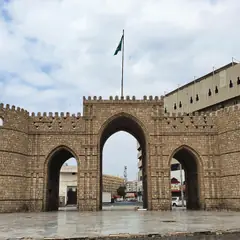
The Nasseef square is the traditional entrance to Souq Al-Alawi, the perfumers’ street that crosses the old city toward the Mecca Gate, and about 150 metres away stands the Matbouli House Museum, another coral tower house open inside.
The neem that named the house
Nasseef House
Summary of this stop
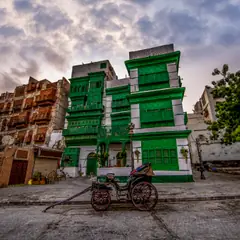
The tour begins in the small square north of the house, where a neem grows, a tree of the species Azadirachta indica. Because of it the house was called “the house of the tree”: it was the only one in Al-Balad to have one. Some guides go further and claim that around 1920 it was the only tree in all of Jeddah, an extension that not every source supports.
From here you read the whole façade: the coral stone whitened with lime, the carved wooden doors and the cascade of roshan, the lattice bay windows that make this the most photographed house on the street. Work began in 1872 in Suq al-Alawi, then the main street of old Jeddah, and it belongs to the generation of late 19th-century tower houses that UNESCO recognised in 2014 and that the traffic opened by the Suez Canal in 1869 had made possible.
Behind those bay windows there was a daily custom. According to family memory, Muhammad Nasseef, grandson of the founder, sat each morning by a window overlooking the market, followed the life of the souq from it and now and then took a few coins from a little box for anyone who came to ask. What that window held besides alms is what the narration reserves for the square.
Steps sized for a camel
Ramp staircase
Summary of this stop
At the foot of the staircase you understand what the house is made of. The walls are of kashur, a fragile coral stone taken from the Red Sea shore that insulates against heat and cold and softens humidity; the lime plaster protects it so that damp does not corrode it, and where the plaster is missing the porous texture of the coral shows. The timber of ceilings and roshan came from India and Indonesia and was topped up with that of an English ship wrecked off the Jeddah coast.
The staircase is the house’s great oddity: wide, shallow steps built so that camels and horses could climb to the roof. Its origin is disputed. The newspaper Okaz presents it as part of the original design and Lonely Planet attributes it to ramps that King Abdulaziz is said to have installed for his messengers on camelback. The animals, in any case, were part of the house’s landscape: on 15 December 1880 the British traveller Lady Anne Blunt visited Omar Nasseef and noted in her diary the chestnut mare standing by the small courtyard.
Up these steps also came a guest book hard to match in a private house: King Mohammed V of Morocco, the Syrian president Shukri al-Quwatli, Imam Ahmad ibn Yahya Hamid al-Din of Yemen, Abdullah Philby and the Egyptian poet Ahmed Rami, among other scholars, thinkers and writers.
The majlis where Jeddah changed hands
Abdulaziz's majlis
Summary of this stop
On the second floor is preserved the majlis where Abdulaziz ibn Saud sat, and its story begins with other occupants. Before 1925 Jeddah had no hotel or guesthouse, and Nasseef House worked as the Hejaz’s guest palace: King Husayn ibn Ali and his son Ali, the region’s Hashemite sovereigns, stayed in it.
After the siege of Jeddah, Abdulaziz entered the city in December 1925 and settled right here. In this house he received the bay’a, the oath of allegiance of the ulema and notables of the Hejaz, and here the agreement on the “handover of Jeddah” was signed, along with other pacts with ambassadors and foreign delegates. For private talks he used the mukhalwan, an annex of the reception hall.
The house remained his base in Jeddah for more than ten years, on every one of his stays, until his own palace was built, today’s Qasr Khuzam. How a home that hosted a king came to receive the man who had displaced him is the central scene of the narration in this room.
Summer breeze and a thousand pounds of books
Rooftop ventilation niches
Summary of this stop
The upper floors close the house’s vertical layout. The fourth has wall niches called malqaf al-hawa, designed to cool the air, and was the family’s favourite corner in summer, when the humid heat of the coast pressed down below.
Up here a library’s story is also told. According to family memory, when he was very young Muhammad Nasseef was sent to the market to buy a slave girl; the treatment he saw there troubled him and he spent the money on the library of a scholar that his heirs were selling, and the grandfather approved the decision. On another occasion he bought thirty volumes of al-Tabari’s Quranic commentary for five pounds, and Omar told him he had permission to spend up to a thousand on books. The writer Ameen Rihani described him as a talking encyclopaedia and wrote that his library was not for show but for use. Those thousands of humanities titles ended up donated to King Abdulaziz University.
The last chapter is that of the house itself. By order of King Faisal ibn Abdulaziz, the state bought it and transferred its ownership to the Municipality of Jeddah to preserve it, and since then it has been a museum and cultural centre. What the roof terrace adds to that story is saved for the end of the tour.