Gate of Jeddah's city wall
Bab Makkah Audio Guide
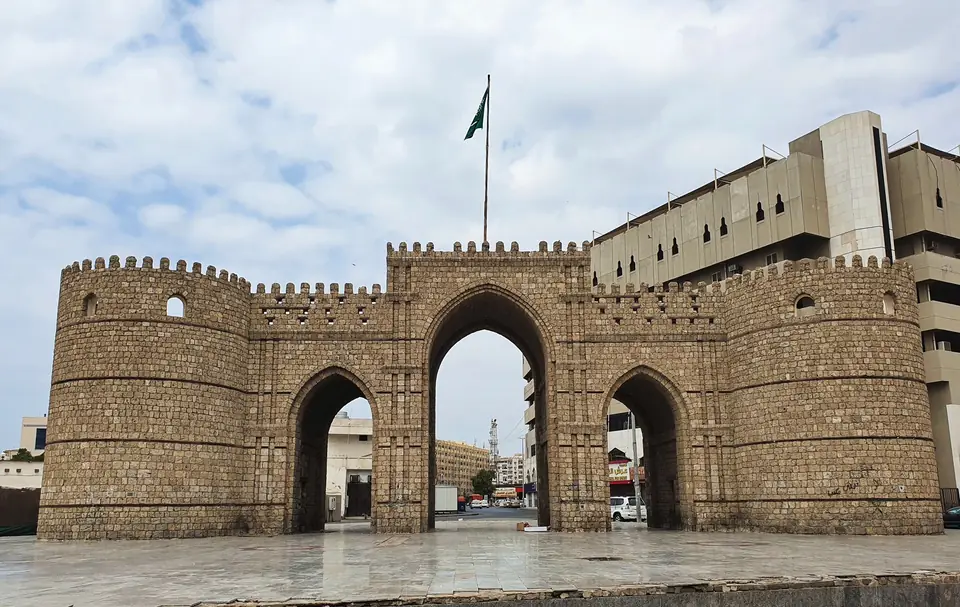
Three arches and two towers standing alone amid the traffic, at the spot where pilgrims, caravans and funeral processions left walled Jeddah for Mecca. The wall was torn down in 1947; the gate and the Bedouin souq beside it are still standing.
- 20 min of audio
- Threshold to Mecca
The Mecca Gate, Bab Makkah, was the eastern exit of the wall that the Mamluk sultan Qansuh al-Ghuri had built in 1509 against Portuguese attacks in the Red Sea. After repelling the Portuguese siege of 1517, the Ottomans rebuilt it in stone in 1525 with six towers and six gates, and in the 19th century it remained one of the city's four great gates. UNESCO's 2014 listing, “Historic Jeddah, the Gate to Makkah”, makes this axis between the sea and the Mecca Gate the thread that links Jeddah to the hajj.
The original Bab Makkah has not survived. The current structure, with three arches and two watchtowers, evokes the lost gate on its site, although the Saudi press often presents it as a restored survivor of the wall. Nor should it be confused with the other “Mecca Gate”, the Quran Gate, a 1979 monument that rises over the Jeddah–Mecca highway, some 60 kilometres from here.
Highlights
- Three passage arches — the exit toward Mecca of a wall raised in 1509 against the Portuguese
- Mecca road — where night caravans and funeral processions set out
- The gap in the wall — torn down in 1947, its gates once closed at the night prayer
- Souq al-Badu — the Bedouin souq of Arabic coffee, cardamom and saffron beside the gate
A gate without a wall seems a contradiction, and that is the first oddity of the Mecca Gate. On either side of its three arches there is no wall: the wall that continued it was torn down in 1947 and the gate was left standing alone among streets, buses and traffic. For centuries, however, it was the threshold between the port and the holy city, the gate through which you left Jeddah for Mecca and through which pilgrims entered on their way back.
The history of the Mecca Gate is that of Jeddah’s wall. The Mamluk sultan Qansuh al-Ghuri had it built in 1509 and the emir Husayn al-Kurdi directed the work, with a moat outside, to protect the city from the Portuguese prowling the Red Sea; the townspeople themselves built it, under forced labour. The dates wobble: some sources give the year 915 AH and others 917, another chronology places defensive works from 1506, and the official website recalls that as early as the 11th century the traveller Nasir-i Khusraw mentioned a wall. The counts of gates do not agree either: two in the original wall, six after the Ottoman reconstruction, seven or eight according to other sources and four great gates in the 19th century.
From this gate you also set out for stranger places. Jeddah boasts of holding the tomb of Eve, mother of humankind, and the British explorer Richard Burton left through the Mecca Gate to ride half an hour northeast to the enclosure, where he was made to kiss a carved stone called al-Surra, “the navel”. The popular belief belongs to legend; the anecdote of the dollar he left the guardian, who was expecting someone far more important, is one the city still tells.
The audio guide goes around the gate outside and inside in four stops, with documented narration checked against historical sources, and ends among the coffee and spice stalls of the Bedouin souq.
To the west starts Souq Al-Alawi, the perfumers’ street along which pilgrims climbed from the port, and at the other end of that road, nearly a kilometre away in a straight line, the Red Sea Museum occupies the old sea gate where they disembarked.
Three arches facing Mecca
Bab Makkah
Summary of this stop
In front of the gate you see three entrance openings flanked by two medium-height towers with decoration and reliefs, meant to watch who came in and out. It is one of the largest gates in the eastern wall of historic Jeddah, and through its arches passed pedestrians and goods on their way to Mecca.
The early wall of Qansuh al-Ghuri, from 1509, had only two main gates: one facing the sea and one facing Mecca, the present Bab Makkah.
What stands today, however, is not that gate. The original Bab Makkah has not survived, and the current structure of three arches and two towers evokes the lost gate on its site. On this point there is no unanimity: the Saudi press and popular accounts present it as a restored survivor of the wall, while the Ministry of Culture’s entry on Google Arts & Culture states that the original no longer exists. What truly remains of the old gate is the first question the narration answers.
Night caravans to the holy city
Start of the Mecca road
Summary of this stop
On the east side begins the road along which pilgrims and caravans set out, today a street of dense traffic and bus stops. Here the pilgrims of the hajj and the umrah left for Mecca, and here too passed funeral processions to the al-Asad cemetery, which lay outside the walls on that side.
In 1814 the Swiss traveller Johann Ludwig Burckhardt saw that, in the four months before the hajj, caravans left Bab Makkah every evening after sunset. Loaded camels took two nights to reach Mecca, resting by day halfway, at Hadda; every evening a small caravan of lightly loaded donkeys also set out, making the fifteen- or sixteen-hour journey in a single night. At this same gate the duty was collected on provisions coming in from the interior, above all livestock, butter and dates.
That link between gate and pilgrimage is the one captured by UNESCO’s 2014 listing, which joins Jeddah to the hajj through the souqs running from the sea to the Mecca Gate and the ribats and wakalas that housed pilgrims. Why the sacred journey was made at night, and who chose the donkey over the camel, is told while looking at the road.
The gap where the wall stood
Side tower of Bab Makkah
Summary of this stop
Next to the side tower you can see the void the wall left. After repelling in 1517 the siege of the Portuguese fleet of Lopo Soares de Albergaria, the Ottomans rebuilt the wall in stone in 1525, with six watchtowers and six gates, and the Mecca Gate was the eastern one.
The wall imposed its own timetable. In the last years of the Hashemite period, until 1925, the gates were closed just after the night prayer and opened with the first call to the dawn prayer, a custom abolished at the start of the Saudi era. In 1947 the wall was demolished: the demolition began at Bab al-Madina, to the north, and advanced clockwise.
For some, this arch was for a time a border. According to accounts of that era, in the days of the sharifs of Mecca the few Christians who traded in Jeddah, mostly Greeks from the Aegean islands, had to dress distinctively and could not approach the Mecca Gate; the Ottomans lifted those restrictions. What happened to those who died in the city is the dark episode the narration tells beside the tower.
Coffee and cardamom in the Bedouin souq
Spice stalls of the Bedouin souq
Summary of this stop
Right beside the gate still stands Souq al-Badu, a souq some 140 years old that takes its name from Bedouin products: Arabic coffee, cardamom, saffron, ginger and Bedouin women’s dresses. Farmers from Mecca once came to it to sell grain and dates. In 2012 Bab Makkah was still one of the busiest gates of historic Jeddah, a departure point for city buses, with honey and spice sellers on its west side.
The souq’s veterans keep its memory. Mohammed Baquis recalled that most of the merchants were Hadrami and that the shops, of sea coral and mud brick like the houses of old Jeddah, belonged largely to religious endowments, to which rent was paid. The journalist Radi Hanin evoked his childhood trips with his father, a village shopkeeper, to do the month’s shopping.
They arrived for the dawn prayer, tied the camel on a nearby esplanade among all the camels come from afar and left before the afternoon prayer. What taste stayed with him for ever from those trips is the memory with which the tour says goodbye.