The old sea gate
Red Sea Museum Audio Guide
Through these coral-stone arches came the pilgrims who reached Jeddah by sea, the last stage before Mecca and Medina. The old maritime gate of Bab Al-Bunt, from 1866, opened in December 2025 as a Red Sea museum, although the sea no longer reaches its door.
- 90 min of audio
- Opened in 2025
The Red Sea Museum occupies Bab Al-Bunt, the port buildings that the Ottoman governor of Jeddah raised in 1866 to serve pilgrims and merchants and that also worked as a customs house and medical control centre. Restored by the French architect François Chatillon with the original coral stone and timber beams, it opened to the public on 6 December 2025 with more than 1,000 archaeological pieces and artworks spread over 23 galleries and seven thematic sections.
The sea gate was left without a sea. With the construction of a new port in the second half of the 20th century the building became municipal, was abandoned around 2004, and land reclamation pushed back the shore that once reached its arches. Of the long row of coral canopies that faced the water only seven remain, and today a car park and a ring road separate the Red Sea museum from the water that gives it its name.
Highlights
- Double-curve arcade — the first thing pilgrims arriving by sea saw
- Seven coral canopies — the only ones to survive the 20th-century demolitions
- 18th-century anchor — some 400 kg of wrought iron reassembled from fragments
- Umluj wreck — blue-and-white Chinese porcelain rescued from an 18th-century merchant ship
- Mahmal cover — the ceremonial litter Egypt sent to Mecca with the kiswa
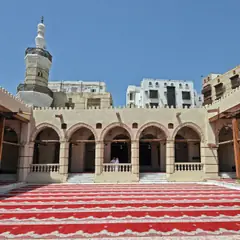
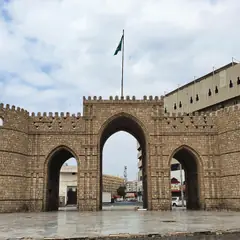
For decades, many pilgrims approaching Jeddah by sea saw, before anything else, a set of pointed double-curve arches. Ships anchored in front of the building, travellers went into it to complete the entry formalities for the holy lands and from there continued to Mecca and Medina. That threshold is today the Red Sea Museum, and the paradox is plain from the door: the sea that justified it can no longer be seen.
The history of the Red Sea Museum begins in 1866, when the Ottoman governor of Jeddah erected the port buildings of Bab Al-Bunt. It began as a small wooden structure and in the 1930s was extended into a great concrete gate; as the city’s main port, it was also a customs house and medical control centre. Not all sources agree: a list of Jeddah’s monuments speaks of a building on land reclaimed from the sea by Nuri Pasha in 1862 and renovated by King Abdulaziz in 1933, and other Saudi chronicles date the founding of the Bunt port to 1867. Port activity ceased in the mid-1950s, when Jeddah Islamic Port took over the arrival of ships and goods.
Before it had display cases, the building already told its story on its own skin. In June 2019 the Saudi photographer Marwa al-Muqait projected on its walls a light work titled “Al-Bunt”, as part of the 21,39 initiative of the Saudi Art Council: night after night, the public gathered in front of the façade to watch an account of the sea reaching Jeddah and of the waiting of the pilgrim parties, and the projection ended with a pilgrim’s poem by Abu Nuwas, the Abbasid poet. The Ministry of Culture announced the museum in September 2020 with opening planned for late 2022; it finally opened on 6 December 2025, although some reports place the ceremony on the 5th.
What to see at the Red Sea Museum covers the building and its collection: the arcade and the canopies outside; inside, more than 1,000 pieces in 23 galleries and seven sections, among them Al-Bunt, devoted to the history of the building itself, and Sea of Faith, on journeys to the holy cities. The manuscripts pavilion gathers illuminated Qurans of the 17th century from China, Kashmiri texts of the 19th century and a 1506 manuscript with scenes of the holy mosques of Mecca and Medina. On the roof, a teak façade commissioned from Ahmad Angawi reinterprets Jeddah’s traditional lattice with a wave motif and mother-of-pearl inlays.
The audio guide walks through the museum in five stops, from the arcade to the pilgrimage section, with documented narration checked against historical sources that gives each room back the port it was.
From here began the pilgrims’ road, which crossed the walled city to the Bab Makkah, the Mecca Gate, at the opposite end. One of its stages is the Uthman ibn Affan Mosque, about 430 metres away, named after the caliph who made Jeddah the port of Mecca.
The arches that announced Mecca
Red Sea Museum
Summary of this stop
The tour begins before the arcade of pointed double-curve arches, the façade that for decades announced to pilgrims the end of the crossing. Beneath it today opens the temporary exhibition space, inaugurated with The Gate of Gates, photographs by Moath Alofi taken weeks before the restoration, when the building had gone over two decades without official use: fly swatters and coat hangers hanging from nails, ladders leaning against the windows.
The building was born in 1866 as a small wooden structure, raised by the Ottoman governor to expand the city’s capacity to serve pilgrims and merchants, and in the 1930s it was extended into a great concrete gate. It worked as main port, customs house and medical control centre: here the entry formalities for the holy lands were completed.
Even the name is an enigma. One tradition derives it from the small boats locally called “bunt”, which before the modern quays carried passengers and goods between the ships anchored offshore and the shore. The museum’s catalogue proposes instead the Arabic word “bunt”, “impression”, perhaps from the port’s sign or from the customs registers, and another version links it to an old currency-exchange market. Which of the three is most convincing is what the narration poses in front of the arches.
Seven canopies and no trace of the sea
Coral stone canopies
Summary of this stop
In front of the building line up seven rectangular coral-stone structures with openwork arches. They are the survivors of a long row of canopies that faced the water: urban development tore down all the others.
What is missing here is the sea. With the urbanisation of the second half of the 20th century a new port was built, Bab Al-Bunt became a municipal building and around 2004 was abandoned, while land reclamation pushed back the coastline that once reached its arches. Today a car park and a ring road occupy the land won from the sea.
The story, however, has a second part. The building looks out onto the Al-Arbaeen lagoon project, which is to rejoin the waters of the Red Sea after more than sixty years of being cut off. What that half-return of the water means for a gate left without a sea is what is told in front of the canopies.
A broken anchor under original beams
18th-century anchor
Summary of this stop
In the centre of the ground floor stands an 18th-century wrought-iron anchor of some 400 kilos, found in fragments off the Jeddah coast and reassembled for the museum.
Above it, the ceilings are the same as ever. The restoration, led by François Chatillon of Chatillon Architectes, restorer of the Grand Palais in Paris, reused the original coral stone and timber beams, respected the old building techniques and left the wooden ceilings exposed, rerouting the wiring and pipes outside them.
The road to here was long: the Saudi Ministry of Culture announced the museum in September 2020 with opening planned for late 2022, and the doors did not open until 6 December 2025. What a building and an anchor reassembled with their own pieces have in common is the idea the narration develops in this room.
Jeddah’s black coral and sunken porcelain
We Are Coral installation
Summary of this stop
From the ceiling hang, on ropes, the glass corals of We Are Coral, the installation by Manal Al Dowayan. Beside them are displayed rosaries of Red Sea black coral beads made by Ahmed al-Halabi, from one of Jeddah’s oldest artisan families in this trade.
On the upper floor awaits the Umluj wreck, an 18th-century merchant ship 40 to 45 metres long, of pine and oak, found north of Jeddah by a Saudi-Italian mission. It carried water jars and cups and bowls of blue-and-white Chinese porcelain, which are displayed alongside figurines and a video of the divers bringing them up from the seabed.
The sources do not agree on the date of the find, which some place in 2007 and others in 2015-2016. How the Red Sea keeps giving back pieces, and what they say about who sailed it, is what you hear beneath the corals.
The pilgrims’ guide and his granddaughter
Mahmal cover
Summary of this stop
The Sea of Faith section, on the upper floor, is devoted to the pilgrimage. Among its pieces stands out a 19th-century Egyptian mahmal cover, the ceremonial litter that Egypt’s rulers sent each year to Mecca accompanying the kiswa, in a room with photographs, drawings and recordings of those processions.
The museum also puts faces to that journey. An old photograph shows Hassan Banna, a mutawwif who guided pilgrims from North Africa; in the newly opened museum, his granddaughter Yara Banna stopped before her grandfather’s portrait.
Having landed at the Bunt, pilgrims followed a fixed route to Mecca, on foot or on camelback: along today’s King Abdulaziz Street and Qabil Street to Souq Al-Alawi and, from there, to Bab Makkah. In June 2026, on the twelfth anniversary of the listing of historic Jeddah by UNESCO, free tours retraced that route. Where the pilgrims set off on leaving under these arches is the close of the narration.