Zen monastery of the Hōjō
Engaku-ji Temple Audio Guide
A Zen monastery that the regent who defeated the Mongols founded in 1282 to pray for the dead of both sides. Terraced up a valley in Kita-Kamakura, it begins on the far side of a level crossing and ends before a National Treasure reliquary that almost never opens.
- 50 min of audio
- Zen and National Treasures
In 1282 the regent Hōjō Tokimune founded Engaku-ji with the Chinese monk Mugaku Sogen as first abbot, to protect the country, spread Zen and pray equally for the fallen of the Mongol invasions of 1274 and 1281, Japanese and enemy without distinction. Fires in 1374, 1526 and 1563, the earthquake of 1703 and the Great Kantō Earthquake of 1923 have cut it back: of the 42 sub-temples of its heyday, 19 remain, spread over terraces up the valley.
The monastery keeps the only National Treasure building in Kanagawa Prefecture, the Shariden, and the largest bell in Kantō. And yet the first thing a visitor arriving by train meets is the railway itself: since 1889 the Yokosuka line has cut the temple's formal entrance between its pond and its first gate.
Highlights
- The Ōgane — a National Treasure bell of 1301, 259.5 cm tall, the largest in Kantō
- The Shariden — Kanagawa's only National Treasure building, a reliquary of a Buddha tooth opened only a few days a year
- The Sanmon — a great two-storey timber gate of 1785, with a plaque in the calligraphy of the retired emperor Fushimi
- The Butsuden — the Buddha hall rebuilt in 1964 from a plan of 1573, with a White Dragon painted on the ceiling
- The Byakurochi pond — split by the Yokosuka line tracks since 1889
The history of Engaku-ji, 円覚寺, begins with a victory and a prayer for the enemy. In 1282 Hōjō Tokimune, the regent who had resisted the two Mongol invasions, inaugurated it with Mugaku Sogen as first abbot, and dedicated the monastery to the dead of both sides. The chronology of the beginnings is not entirely unanimous: some sources place the first works in 1277, with Rankei Dōryū as the intended abbot and the work halted by his death in 1278, and others date the start of construction to 1281. Tokimune died in 1284 and rests in the sub-temple Butsunichi-an, beside the 9th regent Hōjō Sadatoki and the 14th, Hōjō Takatoki; his anniversary is held there every 4 April.
Centuries later, the valley also entered the modern history of Zen and of Japanese culture. In the Meiji era, the abbots Imakita Kōsen, from 1875, and Shaku Sōen made it Kantō’s great Zen training centre; in 1893 a speech by Sōen, translated into English by his pupil D. T. Suzuki, who would later bring Zen to the West, was read at the World’s Parliament of Religions in Chicago. Natsume Sōseki practised zazen at the sub-temple Kigen-in, model for the Issō-an of his novel “Mon” (1910), and Kawabata Yasunari set the opening of “Thousand Cranes” in the tea room of Butsunichi-an. On the cemetery slope, the film director Ozu Yasujirō rests with his mother beneath a nameless gravestone bearing a single character: 無, “nothingness”.
The audio guide, documented and checked against historical sources, covers the monastery in five stops, from the level crossing at Kita-Kamakura station to the hidden gate of the reliquary, at the back of the valley.
A short distance away, in the same Kita-Kamakura, Kencho-ji Temple completes the pair of the Hōjō’s great Zen monasteries. On the other side of the city, Hokoku-ji Temple shows the Rinzai Zen of the following era, that of the Ashikaga, in a bamboo valley.
A heron, some deer and the train
Byakurochi Pond
Summary of this stop
On leaving Kita-Kamakura station the Byakurochi pond appears, the “pond of the white heron”, with its little bridge, and right behind it, the tracks. In 1889 the Yokosuka railway line, opened toward the naval port, crossed the precinct between the pond and the Sōmon gate and cut the water to almost half. Since then, the formal entrance to one of Japan’s great Zen monasteries has gone through a level crossing.
The pond’s name comes from a legend of documented tradition: when Mugaku Sogen arrived in Kamakura, the messenger of the god of Tsurugaoka Hachimangū took the form of a white heron and guided him to this place, which was thus marked out for building the temple. The entrance crosses the water by the Gomabashi bridge, the “bridge that subdues demons”, beside a stone with the inscription “Daihonzan Engakuji”.
At the top of the stone steps, the plaque of the Sōmon reads “Zuirokusan”, “mountain of the auspicious deer”. According to tradition, it recalls the white deer that came to listen to Mugaku Sogen’s sermon at the inauguration, and the temple’s own name, “perfect enlightenment”, would come from a sutra that appeared underground when the foundations were dug. Which sutra it was and why it marked the name is told in the narration, in front of the tracks.
A gate for the monk who felt no fear
Engaku-ji Sanmon Gate
Summary of this stop
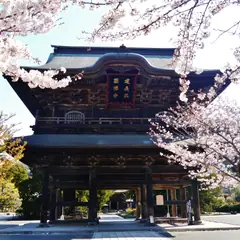
The Sanmon is the monastery’s great two-storey timber gate, with a copper roof and a plaque, “Engaku Kōshō Zenji”, in the calligraphy of the retired emperor Fushimi. It was rebuilt in 1785 by Daiyū Kokushi (Seisetsu Shūcho), the restorer of the monastery. The temple ties the date to the 500th anniversary of Mugaku Sogen’s death; other sources speak of the anniversary of the founding or date the gate to around 1783. The upper floor, closed to the public, houses Kannon, the Twelve Heavenly Generals and the Sixteen Arhats.
Beneath that gate the monastery’s reason for being makes sense. Tokimune did not found it only to protect the country and spread Zen, but to pray equally for the dead of 1274 and 1281, Japanese and enemy without distinction.
And the monk whom the gate honours arrived with a reputation for not fearing death. According to tradition, in 1275, four years before travelling to Japan, Mugaku Sogen was surrounded by Mongol Yuan troops at Nōnin-ji temple on Mount Gantō, in Wenzhou. Faced with the sword he recited a poem, the Rinjinge, and the soldiers left without touching him. The last line of that poem is heard in the audio guide, beneath the Sanmon.
A white dragon over the ruins
Engaku-ji Butsuden
Summary of this stop
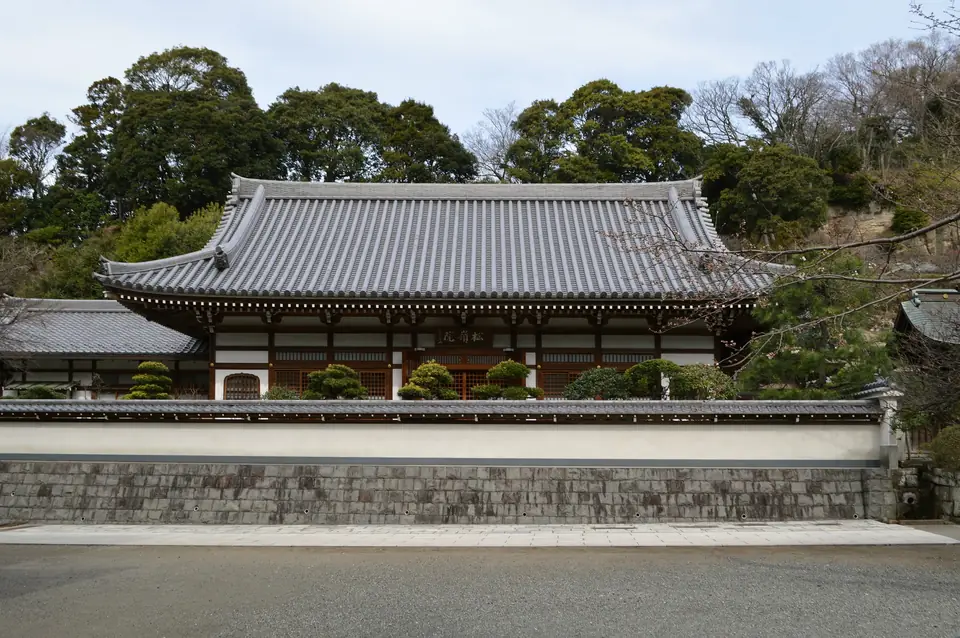
Surrounded by old junipers, the Butsuden is the hall of the main Buddha, with the plaque “Daikōmyō Hōden” and, inside, a crowned Shaka Buddha. What it does not show is its age: the original hall collapsed in the Great Kantō Earthquake of 1923 and the present one was raised in 1964, in reinforced concrete, following a building plan of 1573. On the ceiling, the White Dragon was painted by Moriya Tadashi under the supervision of Maeda Seison.
The earthquake of 1923 was only the last blow. Engaku-ji suffered great fires in 1374 and 1563, the fire of the troops of Satomi Yoshitoyo in 1526 and the earthquake of 1703. Of the 42 sub-temples it once had, 19 remain, and near the Butsuden the meditation hall Senbutsujō, of 1699 and thatched roof, also served as main hall until 1964.
In front of the Hōjō, the junipers that according to tradition grew from seeds brought from China by Mugaku Sogen are protected as a natural monument of the city. What the plan of 1573 says about the temple that was lost is revealed in the narration in front of the hall.
The bell that asked Enoshima for help
Engaku-ji Ōgane
Summary of this stop
Up a steep stairway to the right of the Butsuden waits the Ōgane, the great National Treasure bell: 259.5 centimetres tall, the largest in Kantō. It was donated in 1301 by Hōjō Sadatoki, son of Tokimune, to pray for the peace of the country; it was cast by Mononobe Kunimitsu and its inscription was composed by the Chinese abbot Seikan Sudon (Xijian Zitan).
Beside it stands the small Benten-dō, and its presence has an explanation in a documented tradition. When the Mononobe founders began to cast the bell, the casting would not come out well for no apparent reason, and the Hōjō asked for help from the Benzaiten of Enoshima, one of Japan’s three great Benten. After the prayer, the casting of 1301 came out well, and in gratitude this branch of the goddess was raised beside the bell, where it remained as the monastery’s guardian. Every 28 November the monks recite sutras before it.
The alliance between the Zen monastery and the sea shrine is still alive: Engaku-ji and Enoshima-jinja hold together every 60 years the Ōgane Benten Taisai, a festival seen once or twice in a lifetime, whose last edition was on 29 October 2023. Who went to pray on the island, according to each version of the story, is told by the audio guide on the bell’s terrace.
A borrowed reliquary and a disputed tomb
Shariden
Summary of this stop
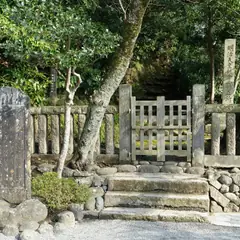
At the back of the precinct, beyond the gate of the sub-temple Shōzoku-in, the Shariden appears, the only National Treasure building in Kanagawa: a steeply pitched bark roof over a low lower roof, eaves with fan-shaped rafters and katōmado windows. It keeps a Buddha tooth that Minamoto no Sanetomo had brought from Nōnin-ji temple in Song China, and it opens to the public only on set dates: 1 to 3 January, 3 to 5 May and 31 October to 2 November, according to the 2026 calendar. The rest of the year it is seen from outside.
The temple’s great treasure, moreover, came from elsewhere. For a long time it was taken for a building of the Kamakura period, and the temple’s website still presents it as a model of the style that came from China in that period; the Agency for Cultural Affairs, by contrast, dates it to the mid-Muromachi period and identifies it with the Buddha hall of the Taiheiji convent in Nishi-Mikado, moved here after the great fire of 1563.
The gate of the Shōzoku-in also holds a dark episode. Mugaku Sogen left Engaku-ji at Tokimune’s death and died in 1286 at Kenchō-ji, which buried him within its grounds. Engaku-ji was left without its founder’s tomb, and the rivalry between the two neighbouring monasteries grew until 1335. How that dispute was resolved, and why an imperial order had a part in it, closes the audio guide’s route before this same gate.