Shinto shrine
Zeniarai Benzaiten Shrine Audio Guide (Zeniarai Benzaiten Ugafuku-jinja)
A hollow closed in by rock, without a single building visible from outside, entered through a tunnel: inside, in a cave lit by candles, money has been washed in the water of a spring since the Middle Ages.
- 30 min of audio
- Shinto and Buddhism
According to tradition, Minamoto no Yoritomo founded the shrine in 1185 after dreaming of Ugafukujin, and in 1257 the regent Hōjō Tokiyori washed his coins here, a gesture that people began to imitate. Local historiography accepts the antiquity of the spring and its cult, but places the built shrine in the late 19th century; since 1970 it has been independent under the name Zeniarai Benzaiten Ugafuku Jinja.
After the separation of Shinto and Buddhism in the Meiji era, most shrines got rid of their Buddhist objects. This one did not: among dozens of torii it keeps Buddhist statues and the smoke of incense, and its object of worship is a stone serpent with a human head, a symbol of Ugajin, god of water and grain.
Highlights
- The entrance tunnel — a gallery cut into the rock around 1958, beneath a group of yagura tombs
- Kakurezato — the hidden village, a hollow closed by ridges on three sides
- The row of torii — hundreds of gates donated by grateful merchants
- The Okumiya cave — candles, paper cranes and the spring where money is washed
- Shimo-no-suijin — a waterfall of some 3 m, a pond with koi carp and offered eggs
At the back of the Sasukegayatsu valley, in Kamakura, there is a shrine that cannot be seen. Ridges close it in on three sides, and since ancient times the place was called Kakurezato, “the hidden village”, home of a god of fortune. Its fame fits in one gesture: in a cave lit by candles, people wash coins and banknotes in the water of a spring so that they come back multiplied. According to tradition, the cult starts in 1185 with a dream of Minamoto no Yoritomo and the washing of money in 1257 with Hōjō Tokiyori, although local historiography dates the built shrine to the late 19th century.
What to see at Zeniarai Benzaiten goes beyond the rite: a tunnel opened in the rock around 1958, hundreds of torii paid for by merchants, incense and Buddhist statues that survived the Meiji era and one of Kamakura’s Five Famous Waters. The story of Zeniarai Benzaiten mixes Shinto and Buddhist gods, a serpent with a human head and a calendar that turns around the day of the snake. The audio guide, documented and checked against historical sources, covers it in five stops, from the tunnel to the waterfall.
The two figures of its legend each have their own stage in the city: Yoritomo, at Tsurugaoka Hachimangu Shrine, and Tokiyori, at Kencho-ji Temple, which he himself founded. Another cave Benzaiten waits on the slope of Hase-dera Temple.
An entrance that did not exist before the war
Zeniarai Benzaiten Ugafuku Shrine
Summary of this stop
The route begins at the end of a slope, before a torii planted in front of a hole in the rock wall. It is the main entrance in practice, but not the original: until the Second World War there was no tunnel, and the only way to arrive was the narrow path from the south, today called the ura-sandō, beside the tea houses. The passage and its access were opened around 1958.
The gallery is short and dim, and the rock it crosses holds another story. In 1970 a survey located right above it a group of yagura, tombs dug into the stone, and the excavations turned up several Buddhist stelae that are now kept in the Kamakura Museum of National Treasures. The age of those tombs is a matter of debate: some take them back to at least the 10th century, while yagura are usually associated with the Kamakura and Muromachi periods. What it means to enter a shrine of fortune by passing beneath a medieval cemetery is told right there, before crossing.
The hidden village and its corridor of torii
Row of donated torii
Summary of this stop
On leaving the tunnel, the hollow opens suddenly, surrounded by cliffs that hide it from the outside. To the right appears the small Shichifuku-jinja, dedicated to the Seven Gods of Fortune, and after the ablution pavilion a succession of torii begins. They are donations from merchants who credit their prosperity to Ugajin; the most devout come back every month, on the day of the snake, to wash wads of 10,000-yen notes.
That day, the mi no hi, returns every twelve days and sets the rhythm of the shrine: it is its market day, it opens at 6:00 instead of 8:00 and car access is cut. The great annual festivals fall on the first day of the snake in April and on the Hakuro day in September.
Before the regents and the tourists, Kakurezato already had its own legend, documented in the mid-19th century: in the great crag at the back of the valley, human voices were heard at night pronouncing only good omens, and the one who washed coins in the cave was the god of fortune himself. The audio guide gathers that forgotten version beneath the same torii.
Incense smoke where it should not be
Honsha and shrine office
Summary of this stop
In front of the Honsha, the main shrine dedicated to Ichikishimahime, there is a candle stand and an incense burner, and in the adjoining office candles and incense are bought and the baskets for washing are lent. In a Japanese Shinto shrine, that smoke is a rarity. After the separation of Shinto and Buddhism decreed in the Meiji era, most shrines had to part with their Buddhist objects; Zeniarai Benzaiten, unlike Tsurugaoka Hachimangū, kept its Buddhist statues and the use of incense.
The mixture goes back a long way: around 1192 the local god Ugajin merged with the Buddhist goddess Benzaiten. Its object of worship is a stone serpent with a human head, carved in andesite brought from the Izu peninsula. The building, on the other hand, is younger than its sign suggests: Edo-period surveyors record Kakurezato and its water without any shrine, which leads to dating it probably to the late 19th century.
Popular belief has it that Ugajin was a god of grain before he was a god of money: “uga” means food, and the farmers of the surroundings washed rice seed here to ask for a good harvest. How a god of the rice paddies ended up protecting bank accounts is one of the twists that the narration reveals in front of the Honsha.
Three ladles of water in the Okumiya cave
Okumiya cave
Summary of this stop
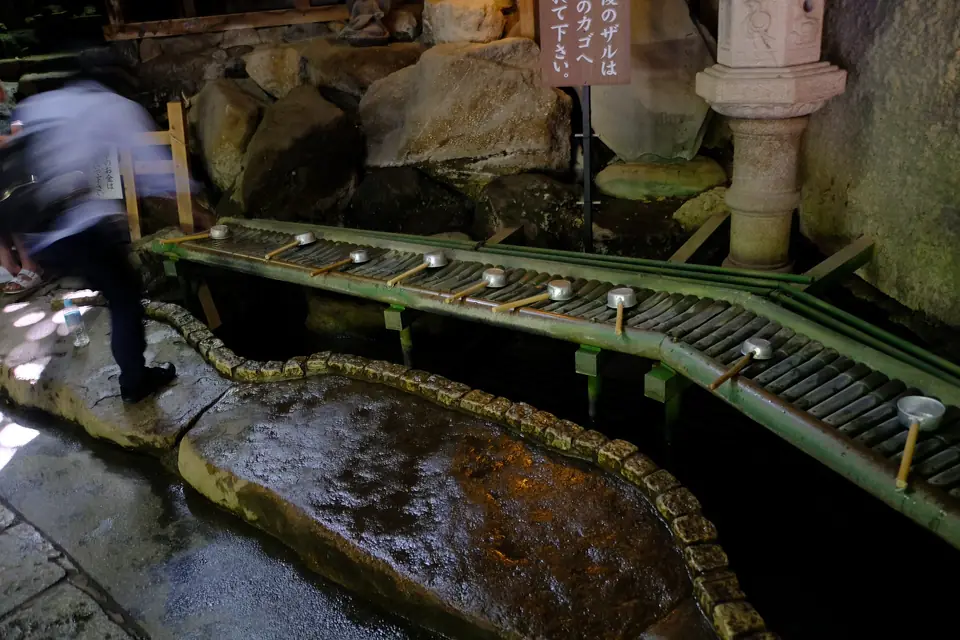
The most visited place in the precinct is not a building but a cave, that of the Okumiya, lit by candles and hung with garlands of a thousand paper cranes. Inside flows the Zeniarai-mizu, the “coin-washing water”, and on its shelves baskets and ladles wait. The rite is precise: the money is placed in a bamboo basket, the zaru, and about three ladles of water from the spring are poured over it without rubbing. Afterwards, custom says to dry it, put it back in the wallet and spend it, not keep it.
According to tradition, it all began in 1185, a year of the snake, when Minamoto no Yoritomo dreamed of Ugafukujin, who pointed out a spring among the rocks; Yoritomo ordered the cave dug, raised a shrine and had that water brought every day as an offering. The sources do not agree on the figure in the dream: some speak of an old man who introduces himself as lord of the hidden village, others of the god with a serpent’s body and a human head. In 1257, another year of the snake, the regent Hōjō Tokiyori washed his coins here, and people began to imitate him.
Tradition holds, moreover, that the gesture was not born to multiply money but to cleanse it of its “impure dust and dirt” and turn it into fukuzeni, money of good fortune. The meaning of that purification, and the idea of money as something impure, are explained inside the cave itself, with the cold water running through the basket.
Eggs, a waterfall and banknotes stuck to the glass
Shimo-no-suijin, waterfall and pond
Summary of this stop
Water is the thread of the whole precinct. Beside the Shimo-no-suijin, the lower water shrine, a waterfall of about 3 metres falls into a pond with koi carp. The Zeniarai-mizu is listed among Kamakura’s Five Famous Waters, although that numbered list is not medieval: it was fixed in the 17th century by the Shinpen Kamakurashi, the guide that Tokugawa Mitsukuni had compiled and that was published in 1685.
Besides candles and incense, raw eggs are offered here, because the serpent, Benzaiten’s messenger, holds them to be its favourite delicacy; in 2020 they were sold at 5 for 300 yen at the Shichifuku-chaya and Benten-chaya tea houses. The precinct also keeps other rituals, such as a blank fortune slip whose letters appear only when it is wet, or an amulet shaped like an aubergine.
There was a time when the washed money went from the shrine straight to Kamakura station: when train tickets were still sold at the window, visitors paid with it and the wet banknotes were left stuck to the glass of the ticket booth. What happened when someone wanted to truly test the water’s promise closes the route.