Temple of the eleven-headed Kannon
Hase-dera Temple Audio Guide
A temple terraced up a hillside facing Sagami Bay, which begins in a cave of goddesses carved in the rock and ends before one of Japan's largest wooden Kannon: 9.18 golden metres that, according to tradition, arrived floating across the sea.
- 60 min of audio
- Hillside temple facing the sea
According to the temple's tradition, in 721 two eleven-headed Kannon were carved from a single camphor tree in Yamato: one stayed at Hase-dera in Nara and the other was cast into the sea, until it reached Nagai beach, on the Miura peninsula, in 736. The documented history begins later, with a bell of 1264 that calls it Shin-Hase-dera, the new Hase-dera, and continues with the restorations by the Ashikaga shoguns in 1342 and 1392 and by Tokugawa Ieyasu in 1607. The Kantō earthquake of 1923 forced its halls to be rebuilt, and the present Kannon-dō was not finished until 1986.
Halfway up, the hillside is covered with small stone jizō: since the post-war years more than 50,000 have been placed for children lost before birth, and the temple receives up to 20 requests a day for this rite. Higher up, the great golden Kannon holds Jizō's ringed staff, has one little finger raised and carries behind it an aluminium halo of 1991.
Highlights
- The eleven-headed Kannon — 9.18 metres of gilded camphor, with Jizō's shakujō staff and an aluminium halo of 1991
- The Benten-kutsu cave — Benzaiten and her sixteen companions carved in the rock, among little figures with written wishes
- The Jizō-dō — more than 50,000 small jizō placed since the post-war years for children who were never born
- The bell of 1264 — an Important Cultural Property, the oldest proof of the temple's existence
- The Kaikō terrace — a view over Yuigahama and a path of some 2,500 hydrangeas of more than 40 varieties
The history of Hase-dera begins, according to the temple’s own account, in the sea. In 721, tradition tells, two eleven-headed Kannon were carved from the same great camphor tree in Yamato, today’s Nara; one stayed there and the other was entrusted to the waves, and fifteen years later, in 736, it appeared on Nagai beach, on the Miura peninsula. The figures are not unanimous: one source gives 711 and sixteen years adrift. And there are no documents fixing that origin: the chronicle of the Kamakura shogunate, the Azuma Kagami, does not even mention the temple, and the statue that presides over the Kannon-dō today is dated to around the Muromachi period. That is why the great Kannon, one of the largest wooden statues in Japan, is not listed as a designated Cultural Property.
What is documented is a bell of 1264, the third oldest in Kamakura, and a long chain of restorations: the Ashikaga in the 14th century, Tokugawa Ieyasu in 1607, who tied it to the Jōdo (Pure Land) school, and the rebuilding after the Kantō earthquake of 1923. Since the post-war years it has been an independent temple. What to see at Hase-dera is really a climb: from the rock and the dimness of a cave to the silent mourning of the jizō, and from there to the golden hall and the terrace that looks out to sea. The audio guide, documented and checked against historical sources, covers that hillside in five stops.
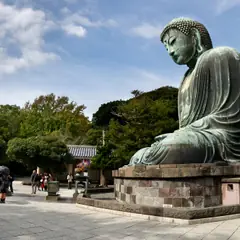
Very close by, in the same Hase neighbourhood, the Great Buddha of Kamakura sits in the open air. The Amida that wards off misfortune, attributed to Minamoto no Yoritomo, links the temple with the founder of Tsurugaoka Hachimangu Shrine, and its Benzaiten cave has a counterpart in the grotto where money is washed at Zeniarai Benzaiten Shrine.
Tiny goddesses in the dim of the cave
Benten-kutsu Cave
Summary of this stop
The temple of the great Kannon begins underground and on a minimal scale. Beside the pond of the lower precinct, a red torii marks the entrance to the Benten-kutsu cave: a low-ceilinged passage where the goddess Benzaiten and her sixteen child attendants, the dōji, appear carved in the rock. The cave also venerates Ugajin, a popular deity with a human head and a serpent’s body who is identified with Benzaiten herself.
The custom is still alive. In the last chamber, the floor gradually fills with little figures of Benzaiten, the Hōnō Benzaiten, on which each visitor writes a wish and a name before leaving them as an offering. In the dim chambers, candles are also offered with the name of the deity whose favour is sought, and by their light the carved figures emerge from the rock; it is said that this is how the wish comes true. The narration on site accompanies that stooped advance among hundreds of goddesses handwritten by strangers.
A rite of mourning that fills the hillside
Jizō-dō and the fields of jizō
Summary of this stop
Halfway up, before the Jizō-dō, the temple changes tone. The hall is surrounded by tiered rows of small stone jizō, set up in memory of unborn children and also of ancestors. They are the mizuko jizō: figures dedicated to children lost through miscarriage, stillbirth or interrupted pregnancy.
It is the quietest corner of the precinct and, at the same time, the most alive. Since the post-war years after the Second World War more than 50,000 figures have been placed at Hase-dera, and the temple receives up to 20 requests a day for this rite. The figures do not stay forever: after a time they are removed to make room for others, so that the hillside is constantly renewed. At this point the audio guide explains what this modern mourning means within a temple with more than seven centuries of documented history.
The bell that dates the legend
Bell tower and Kakigara Inari
Summary of this stop
At the foot of the bell tower, the history of Hase-dera changes register. The original bell, of bronze, bears an inscription of 1264, the first year of the Bun’ei era: it was commissioned by the abbot Shinkō and cast by a craftsman of the Mononobe line. That inscription is the proof that the temple already existed in the 13th century, when it was called Shin-Hase-dera, “the new Hase-dera”. Declared an Important Cultural Property in 1953, it is now kept in the Kannon Museum; the one that hangs in the bell tower was cast in 1984 and rings every morning at 8:00, at opening time, and on New Year’s Eve.
From that bell on, the temple’s history passes through the hands of the Ashikaga shoguns: in 1342 Ashikaga Takauji restored the buildings and the images, with the gilding of the Kannon, and in 1392 Ashikaga Yoshimitsu remade its halo. Beside the bell tower, the small Kakigara Inari shrine keeps telling another version, that of the oyster shells that, according to the temple’s account, attached themselves to the Kannon as it drifted; visitors leave shells there with wishes written on them. The narration beside the bell tower sets both stories against each other, the documented one and the marine one.
A nine-metre Kannon with Jizō’s staff
Eleven-headed Kannon
Summary of this stop
Inside the Kannon-dō, the main hall finished in 1986, rises the eleven-headed Kannon: 9.18 metres of gilded camphor wood, dated to around the Muromachi period. An inspection in 1964 brought to light a repair tablet of 1485, and another repair is recorded in 1677. It follows the so-called “Hase-dera style”: in the right hand it holds the ringed shakujō staff, proper to the bodhisattva Jizō, in the left a vase, and it stands on a square rock. It also has its left little finger raised. The original halo was removed after the damage of the 1923 earthquake; the present one is of aluminium and was made in 1991 under the supervision of the sculptor and restorer Nishimura Kōchō.
The first Western travellers did not see it like this. When Lafcadio Hearn visited the temple, in an account published in 1894, the statue stood in a dark chamber, and to show it lanterns were hoisted with a rope mechanism that uncovered it little by little, from the feet upward; Countess Iso Mutsu also describes that “dark chamber” in her book of 1918. Today only one day a year, 18 December, at the Mi-ashi mairi, is it permitted to enter the inner sanctuary and touch the Kannon’s feet directly. In front of the statue, the audio guide tells which face appeared last in the light of those lanterns.
The sea light that names the mountain
Kaikō terrace
Summary of this stop
The route ends on the Kaikō terrace, beside the Kannon-dō, with an open view over Yuigahama beach and the Miura peninsula; on clear days the horizon reaches as far as Izu Ōshima. It is the sea by which, according to legend, the statue arrived. In its most novelistic version, a monk named Tokudō saw at night a glow like the moon rising from a fallen camphor tree, and an old man and an old woman offered to carve the image: they split the trunk into two halves and in three days finished two Kannon, before revealing themselves as gods and rising to heaven.
Tradition says that, on arriving at Kamakura at night, the statue radiated so much light that it looked as though the sun was shining on the water, and that the fishermen went out in boats to look for it. Hence would come the name of the temple’s mountain, Kaikō-zan, “sea light”. At one side of the terrace, the path along the slope gathers some 2,500 hydrangeas of more than 40 varieties, cultivated since the early Heisei era and in bloom from late May to late June. The narration closes the visit here, with the full legend in front of the water.