Buddhist temple
Great Buddha of Kamakura Audio Guide (Kōtoku-in)
An 11.3-metre, 121-tonne bronze Amida, cast in stages like a tower from 1252, has sat in the open air for more than five centuries: it lost the hall that covered it, lost its gold and keeps a last glint on its right cheek.
- 40 min of audio
- 13th-century bronze
The Jōdo-sect temple of Kōtoku-in keeps the Great Buddha that the monk Jōkō began to fund with alms in 1238. The first one was made of wood; casting of the present bronze began on the 17th of the eighth month of 1252 and was finished by 1264. A great hall more than 40 metres on a side sheltered it until the storms of the 14th century brought it down again and again.
The Buddha is hollow and can be entered. Inside you can read the joints of some 40 pours, the neck reinforced in the 1959-1961 restoration and the marks of centuries of visitors: bets in the 15th century, Englishmen shouting in 1613 and chalk and ink signatures that a 2016 cleaning could not remove without damaging the bronze.
Highlights
- The Great Buddha — a seated Amida of 11.3 m (13.35 m with the base) and 121 tonnes
- The right cheek — the last trace of 13th-century gold leaf
- The hollow interior — the joints of some 40 bronze pours
- The foundation stones — andesite discs of about 2 m from the vanished hall
- Giant waraji — straw sandals of 1.8 m and 45 kg, renewed every three years
Few statues have survived by losing almost everything. The Great Buddha of Kamakura, at Kōtoku-in temple, was born of a fundraising drive: on the 23rd of the third month of 1238 the monk Jōkō, who travelled the country begging alms from nobles and commoners, began to raise at Fukasawa a first wooden Buddha and its hall, consecrated in 1243. Casting of the present bronze Buddha began in 1252, and by 1264 a founder was already signing as author of the “New Great Buddha”. Then came the storms, the vanished roof, the lost gold and a temple that in the 18th century had to be refounded under another name.
What to see at Kōtoku-in goes far beyond the front-on photo: the story of the Great Buddha of Kamakura is spread across the guardians’ gate, the statue’s hollow interior, the stones of the hall that covered it and a corridor with sandals almost two metres long. The audio guide, documented and checked against historical sources, covers the precinct in five stops and tells how each era has used and rescued this giant in its own way.
A few steps away, on the same slope of Hase, Hase-dera Temple keeps its great wooden Kannon. And the wish that, according to tradition, set the Great Buddha in motion leads back to Minamoto no Yoritomo, the founder of the shogunate who made Tsurugaoka Hachimangu Shrine the head of the city.
The temple refounded under a patron’s name
Niōmon of Kōtoku-in
Summary of this stop
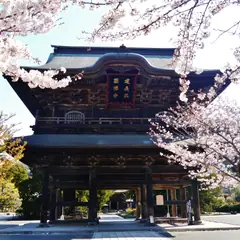
The entrance is through the Niōmon, a gate bearing the plaque of the mountain name Daii-san, moved here from elsewhere in the early 18th century, and two Niō guardians carved in 1742. It is the first clue that the temple around the Buddha is much younger than the statue: an Edo-period refoundation.
In 1712 the monk Yūten of Zōjō-ji relaunched worship with the money of Nojima Shinzaemon, a wealthy merchant from Asakusa. Continuous nenbutsu was begun, the lands around the Buddha were bought back and the temple took as its official name Kōtoku-in, the Buddhist name of the patron himself, who was banished soon afterwards. The state in which the first abbot, Yōkoku, found the statue around 1733 explains why that rescue was needed: holes all over the body, lost curls, the door in the back missing and birds nesting inside.
With the alms that Yōkoku collected in Edo from 1734, the ūrṇā, the cranial bump and the curls were remade in 1735-1736. How a temple ended up bearing the name of a disgraced merchant is told beneath the gate itself.
The Buddha’s scale and the last of the gold
The Great Buddha from the front
Summary of this stop
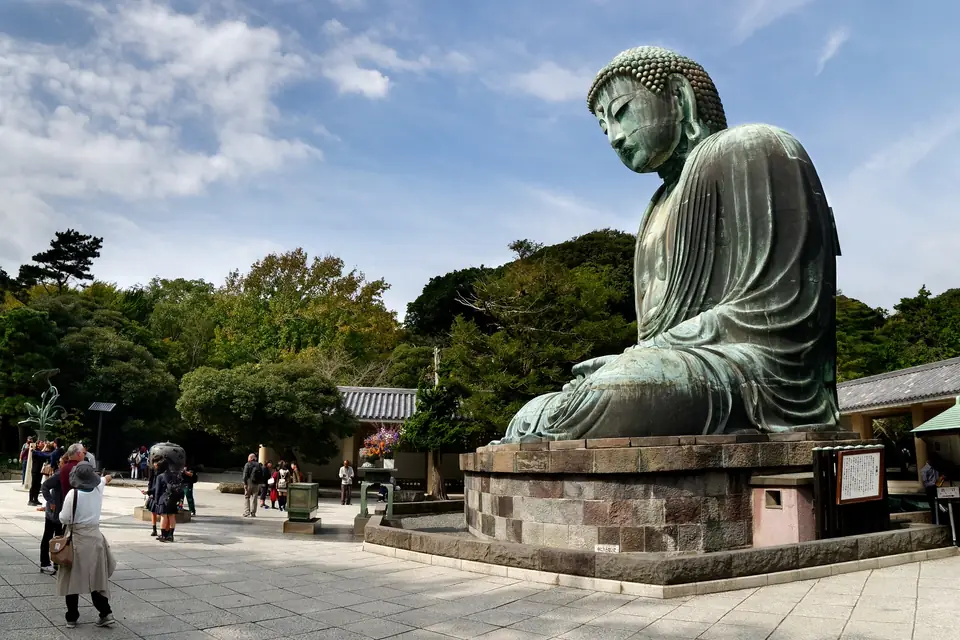
On the esplanade the Great Buddha appears from the front: a seated Amida of 11.3 metres, 13.35 with the base, with its large head tilted forward, its back slightly hunched, the flat Song-style face and the hands in the lap in Amida’s meditation mudra. According to tradition, it all began with a wish of Minamoto no Yoritomo, founder of the shogunate, who in 1195 saw the Great Buddha of Tōdai-ji in Nara reinaugurated and wanted one for his capital; after his death, a lady of his court, Inada, is said to have commissioned Jōkō to raise the funds. The shogunate’s chronicle, the Azuma Kagami, names only Jōkō as promoter.
That same chronicle records in 1252 the start of the casting of an “eight-jō Shaka”, although the statue is an Amida. The dominant reading takes this for a copying error; another proposes that it was conceived as Shakyamuni and identified with Amida over time. The debate is still open.
In the 13th century the bronze was covered in gold leaf. Today it is bare, except for a patch on the right cheek that gleams in the afternoon, when the sun strikes the face of the statue, which faces south. The base, broken by the Kantō earthquake of 1923, was seismically isolated in the 1959-1961 restoration, when the statue was raised some 55 centimetres with 23 hydraulic jacks in order to weigh it: 121 tonnes.
Inside a giant cast in stages
Hollow interior of the Great Buddha
Summary of this stop
For an extra 50 yen you can enter the hollow interior, and there you understand how it was made. The body was cast from the bottom up in 7 successive sections, and the head in 5 at the front and 6 at the back; each pour was made between an outer mould and an inner one held by mounds of earth that grew with the statue. The walls keep the joints of some 40 pours, and in the back opens the window through which the inner mould was removed, now turned into a skylight.
The metal has its own enigma. Analysis from the 1959-1961 restoration gave an average alloy of 68.7% copper, 19.6% lead and 9.3% tin. That very high proportion of lead has led some to propose that the bronze comes from melted Chinese coins of the Song dynasty, a hypothesis with no established supply route.
The interior has had some less than pious uses: in 1486 people gambled there in broad daylight, and the 2016 cleaning removed more than a dozen pieces of chewing gum and several graffiti. Some strokes of sumi ink could not be removed, and their origin is disputed: some suspect that the temple itself supplied brush and ink in exchange for a donation, and the abbot denies it. Why that same abbot is reluctant to close the interior is discovered inside the bronze.
The stones of a hall the wind brought down
Foundation stones of the hall
Summary of this stop
Scattered around the precinct, large andesite discs about 2 metres in diameter peek out, some with a cross carved to centre the pillar or with chisel marks. They are the foundation stones of the vanished hall. The municipal excavation of 2000-2001 reconstructed it: 43.94 by 42.42 metres, five bays per side and a perimeter eave. Not a single roof tile turned up, so the roof was of wooden shingle or bark, and the Buddha has not moved or changed orientation since its creation.
That hall collapsed around 1305, an attempt to rebuild it was made with the funds of a trading ship to China approved in 1329, it fell in the storm of 1334 and again in that of 1369, with no later reconstruction recorded. In 1486 the poet-monk Banri Shūkyū found the statue already roofless. The temple’s website attributes the final destruction to the Meiō earthquake and tsunami of 1498, while the state’s record of the historic site mentions only the collapses caused by storms: the exact end of the hall remains disputed.
The Taiheiki, a 14th-century war chronicle, places in one of those collapses more than 500 soldiers of Hōjō Tokiyuki, sheltering from the storm inside the hall and crushed when the building fell. How that scene weighs on the stones that remain is told beside them.
New sandals for a seated Buddha
Giant waraji
Summary of this stop
In the corridor to the right of the Buddha hang some waraji, straw sandals 1.8 metres long and weighing 45 kilos. They began in 1951, in the midst of the post-war years, with the children of a village in Ibaraki, today Matsuzaka in Hitachiōta: they braided them so that the Great Buddha could walk across Japan and make all people happy. Since 1956 the children’s association of Matsuzaka has woven new ones every three years.
The precinct has also given things back to the world. Behind the Buddha lies the empty site of the Kangetsudō, a Korean pavilion of the Joseon period that was used as a Kannon hall: it was dismantled in 2024 and on 23 June 2025 it officially passed to the Overseas Korean Cultural Heritage Foundation, in the first return of a whole Korean building from abroad. Nearby, a stele of 1991 honours J. R. Jayewardene, who at the San Francisco peace conference of 1951 quoted the Dhammapada, “hatred ceases not by hatred, but by love”, and announced that Ceylon was waiving reparations from Japan.
Shoes for a pilgrim who never gets up, a building that returns home and a sentence of forgiveness: the close of the route brings together three gestures that say a great deal about what this Buddha has meant beyond Kamakura.