Japan's first Zen temple
Kencho-ji Temple Audio Guide
A Zen monastery laid out in a straight line over an old valley of executions, governed by Chinese masters who were treated as spies and dressed today in the gold of a Tokugawa mausoleum. Only a bell of 1255 has survived all its fires.
- 60 min of audio
- Rinzai Zen monastery
Kencho-ji was founded in 1253, the fifth year of the Kenchō era that gives it its name, by Hōjō Tokiyori, fifth regent of the Kamakura shogunate. As first abbot he installed the Chinese monk Lanxi Daolong (Rankei Dōryū), and the layout copied that of Jingshan monastery in Hangzhou, first of China's Five Mountains: gates and halls almost in a straight line, an axis that still marks the route today. At its height it came to gather some 1,000 monks, more than 400 branch temples and 49 sub-temples.
Beneath that serene order there was once something else: Jigokudani, the valley of hell, a place of executions with a small chapel dedicated to Jizō. Because of that inheritance, the temple's main object of worship is not the Shaka Buddha usual in Zen, but a Jizō. And no hall of 1253 still stands: the earthquake of 1293 and later fires finished them all, and what is seen today are reconstructions and pieces brought from elsewhere.
Highlights
- The bell of 1255 — a 2.1 m, 2.7-tonne National Treasure, inscribed Kenchō zenji, still rung every afternoon
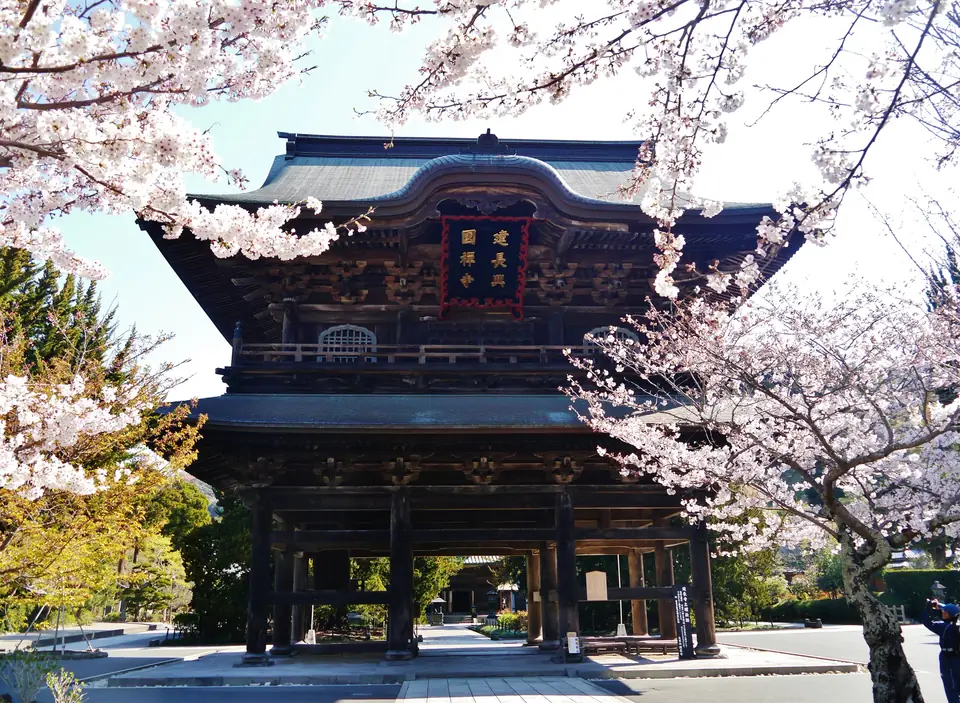
- The Sanmon gate — some 20 m of timber without gate leaves, open to anyone who wants to learn Zen
- The seven byakushin junipers before the Butsuden — twisted trunks that tradition attributes to the Chinese founder
- The dragon of the Hattō — a dragon among clouds painted in ink by Koizumi Junsaku and finished in 2003
- The Butsuden and the Karamon gate — a Tokugawa mausoleum from Edo moved to the temple in 1647
Kencho-ji (建長寺) is usually presented as the oldest Zen temple in Japan, and the claim has nuances. The bell cast in February 1255 bears the inscription “Kenchō zenji”: it was the first temple in the country to call itself a “Zen temple” and a monastery devoted only to Song-style Rinzai Zen, when the earlier Kennin-ji and Jufuku-ji combined Zen with other doctrines. Other sources recall that, as a place of pure Zen practice, it comes after Shōfuku-ji in Hakata. The primacy depends, in the end, on what is meant by a Zen temple.
The history of Kencho-ji is that of a monastery raised over a valley of executions, which had as abbots two Chinese monks suspected of espionage and which, after the earthquake of 1293 and the fires of 1315 and the early 15th century, rebuilt itself with donations, with a merchant ship chartered to China and with buildings lent by the Tokugawa. After the fall of the Hōjō in 1333 it lost its great patron; today it keeps 12 sub-temples. The audio guide, documented and checked against historical sources, covers that axis of gates and halls in five stops, from the plaque at the entrance to the golden gate of the Hōjō.
In the same Kita-Kamakura, Engaku-ji Temple, the other great Zen monastery of the Hōjō regents, rises in terraces. To the east of the city, Hokoku-ji Temple belongs to the Kenchō-ji branch, and Hōjō Tokiyori himself, according to tradition, washed his coins in the spring of Zeniarai Benzaiten Shrine.
The spy monk’s plaque
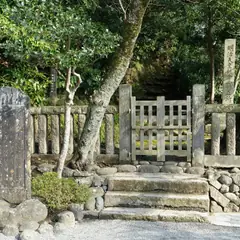
Sōmon gate and the Kofukusan plaque
Summary of this stop
The visit begins at the Sōmon gate, a first gate built in 1783 for Hanju Zanmai-in in Kyoto and moved here in 1940. Over it hangs the plaque with the temple’s mountain name, “Kofukusan” (巨福山), which reproduces the calligraphy of Yishan Yining, a Chinese monk who arrived in Kamakura in 1299 with a letter from the Yuan court.
The shogunate arrested him as a spy and banished him to Shuzen-ji, in Izu; he ended up, nevertheless, as the tenth abbot of Kencho-ji. He was not the temple’s first Chinese master: the founder, Lanxi Daolong, had arrived in Japan in 1246 at the age of 33 and was the abbot whom Hōjō Tokiyori chose in 1253. The temple, in other words, presents itself to the visitor in the handwriting of a suspect.
The first character of the plaque, 巨, carries one stroke too many that looks like a typo. According to local tradition it has a name of its own, “hyakkan-ten”, the “hundred-kan dot”, an ornament that lends dignity to the character. Why a single brushstroke could be worth so much is told in the narration, in front of the plaque.
A gate without doors and its bell
Sanmon gate
Summary of this stop
The Sanmon gate, two storeys and about 20 metres high, was raised with donations from all over the country after the previous one burned down; the date given by most Japanese sources is 1775, although others speak of 1754. It has no gate leaves, as a sign that the temple is open to anyone who wants to learn Zen, and on its upper floor, closed to the public, it keeps statues of 500 arhats. Beneath its columns, a seated figure of Binzuru greets visitors, who by custom rub the part of its body that hurts on their own.
That openness extends, according to the temple’s tradition, to the dead. Every 15 July, once the Obon segaki is over, the monks hold a second service beneath the Sanmon, the Kajiwara Segaki-e, dedicated only to the samurai Kajiwara Kagetoki, who died in 1200. The legend that explains it goes back to the founder’s time and features a warrior who arrived too late.
To the right of the path, beneath the only thatched-roof bell tower in the precinct, hangs the bell of 1255: 2.1 metres and 2.7 tonnes, the work of the bell-founder Mononobe Shigemitsu with text by Lanxi Daolong. It survived the fires of the 14th and 15th centuries, escaped the metal requisition of the Second World War, is a National Treasure and is still rung daily between 5 and 6 p.m.
Junipers above the valley of hell
Row of byakushin before the Butsuden
Summary of this stop
Before the Butsuden stand seven byakushin, Chinese junipers with twisted trunks that the temple’s tradition attributes to Lanxi Daolong; their age, depending on the source, ranges from over 700 to over 760 years. Together with the pond garden, they form part of the “Garden of Kencho-ji”, a national Historic Site and Place of Scenic Beauty since 1932. Beneath the largest, a monument remembers the Kamakura residents who died in the Russo-Japanese War.
This quiet walk occupies what before 1253 was Jigokudani, the “valley of hell”, a place of executions with the small temple Shinpei-ji, dedicated to Jizō. Hōjō Tokiyori moved the chapel to the Kobukurozaka slope (today it is in the Sankeien garden in Yokohama), and the Jizō came to preside over the Zen temple. Legend has it that a small figure of Jizō saved an innocent condemned man from the executioner’s sword and that it ended up hidden inside the great seated Jizō of the Butsuden.
The hall, with a hipped roof, is under works planned until July 2027. Its very existence is the fruit of the temple’s misfortunes: after the earthquake of 1293 and the fires that finished all the founding buildings, in 1325 the shogunate went so far as to authorise the “Kenchōji-bune”, a merchant ship sent to Yuan China to pay for the reconstruction. The narration, among the junipers, tells what marks that sword left.
The dragon of 2003 over the teaching hall
Dragon on the Hattō ceiling
Summary of this stop
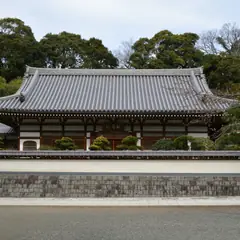
The Hattō, raised in 1814 and finished in 1825, is one of the largest wooden buildings in Kamakura: a teaching hall without interior partitions. On the ceiling, a dragon among clouds painted in ink by Koizumi Junsaku and finished in 2003 for the 750th anniversary; below it, since 2005, a replica of the Fasting Buddha of the Lahore Museum, a gift from Pakistan after Expo Aichi.
From here the complete layout can be understood. The plan “Kenchō-ji sashizu” of 1331 shows the outer gate, the Sanmon, the Butsuden and the Hattō almost in a straight line, with the kitchen and the monks’ hall symmetrical at the sides, just as at Jingshan monastery in Hangzhou. The axis walked up to this point keeps that arrangement.
The man who laid it out did not have a quiet life. In the era of the Mongol invasions, Lanxi Daolong was suspected of spying for the enemy and exiled twice to Kai province, although one of the temple’s biographies attributes the exile to the hostility of the monks of Mount Hiei. He returned as abbot in 1278 and died at Kencho-ji that same year, aged 66; his posthumous name, Daikaku Zenji, was the first title of “Zen master” granted in Japan. Beneath the ceiling, the audio guide reveals the last detail of that dragon.
Gold from a Tokugawa mausoleum
Karamon gate
Summary of this stop
The Karamon gate, lacquered and gilded, gives access to the Hōjō and was restored in 2011 to its appearance of 1647. It came from the same place as the Butsuden: the mausoleum of Sūgen-in, wife of the shōgun Tokugawa Hidetada, raised between 1624 and 1644 at Zōjō-ji temple in Edo and moved to Kencho-ji in 1647. Because it was a mausoleum, the Butsuden has a hipped roof and a coffered ceiling with birds on a gold background, nothing like the sobriety of a Zen hall.
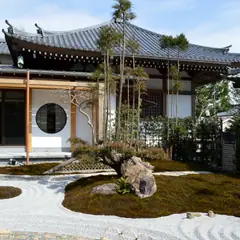
Behind the Hōjō, visible from the gallery, stretches the pond garden, whose shape evokes the character 心 (“heart, mind”) and which in 2003 was remade with lawn following the style of old gardens; its authorship is disputed between Lanxi Daolong and Musō Soseki. Far from the gold, the temple’s most widespread legacy is a soup: kenchin-jiru, of sautéed vegetables and tofu, whose name is written with the characters of Kenchō and which, according to the most-cited explanation, spread across Japan with the monks trained here.
The monks of Kencho-ji still eat a single broth with one side dish and every January go begging for daikon radishes around the Miura peninsula. The narration closes the visit before the Karamon, joining the austerity of that table with the gold of a shōgun’s tomb.