SANAA architecture, 2004
21st Century Museum Audio Guide (Kanazawa 21 Seiki Bijutsukan)
A 112-metre glass disc with no main facade, four entrances and no door of honour, set on the lawn where a school once stood. Inside, a pool you walk under the water of, a room open to the sky and a ceiling the 2024 earthquake left exposed.
- 90 min of audio
- Contemporary art
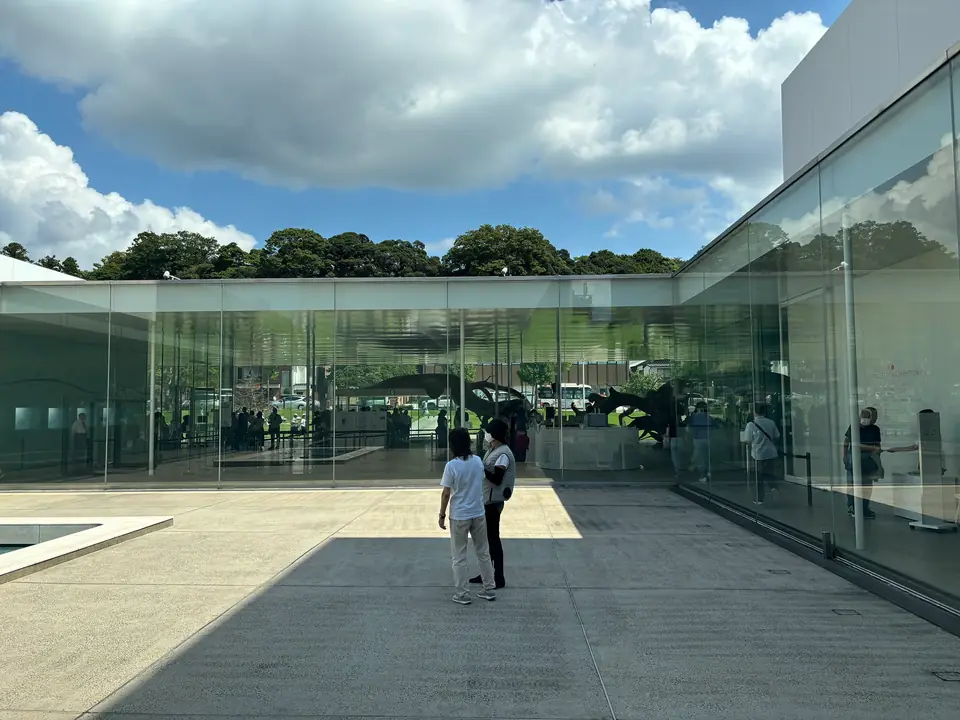
The 21st Century Museum, the Kanazawa 21st Century Museum of Contemporary Art, opened on 9 October 2004 on the site of the schools attached to Kanazawa University. It was designed by SANAA, the studio of Kazuyo Sejima and Ryue Nishizawa, chosen in March 1999: a circle 112.5 metres across, closed by 122 panes of glass, with two floors above ground, two basements and a maximum height of 14.9 metres. In September 2004, a month before opening, it won the Golden Lion at the 9th International Architecture Exhibition of the Venice Biennale.
It was conceived as a popular museum of the art of its time, sharing the work with the traditional Ishikawa Prefectural Museum of Art a few steps away. Its first-year target was 300,000 visitors: it reached a million in 247 days, 1,570,000 after one year and about 2.58 million in fiscal 2018. Locals call it Marubi, “the round museum”, or simply Nijuichi-bi, “the 21”.
Highlights
- The Swimming Pool — Leandro Erlich's pool you walk under the water of
- Blue Planet Sky — James Turrell's room with a 5.6 m oculus open to the sky
- L'Origine du monde — Anish Kapoor's black oval that looks flat and is an abyss
- Klangfeld Nr.3 für Alina — twelve speaking tubes scattered across the lawn
- The glass ring — four entrances and no main facade
The story of the 21st Century Museum begins in May 1995, with a joint committee of Ishikawa Prefecture and the city of Kanazawa to reorganise the centre of the old castle town. The move of the schools attached to the university freed the site, and the future museum’s first office was set up inside the school building itself. The form comes from that site too: surrounded by three streets, it called for a building with no front or back, and SANAA solved it with a circle and four entrances, Honda-dori, Hirosaka, Kakinokibatake and the city hall side.
The architecture of the 21st Century Museum plays with transparency. The curved glass ring lets you see from outside what happens within and, from inside, the city; the galleries, white boxes peeking above the roof, close in on themselves instead. Outside wait Olafur Eliasson’s Colour activity house, from 2010, with three curved glass walls in cyan, magenta and yellow spiralling around a lamp, and Patrick Blanc’s Green Bridge, a plant wall only 14 centimetres thick with about 100 varieties of plants. Part of the route, such as Turrell’s room or the edge of the pool, is free to enter.
The museum opened in style. From 2 July to 25 August 2005, in its first summer, it hosted Matthew Barney’s first major solo exhibition in Japan, “Drawing Restraint”, with the complete series and the premiere of “Drawing Restraint 9”, a work about Japan: 22 sculptures, 74 photographs, 11 drawings, 6 videos and a film. It was curated by Yuko Hasegawa, who joined the team preparing the museum in 1999 and has directed it since 2021. For anyone planning a trip there is a practical note: the museum will close from May 2027 to March 2028 for renovation works.
The audio guide covers the museum in five stops, from the lawn to the galleries, with documented narration checked against historical sources.
About 400 metres away, Kenroku-en Garden offers the counterpoint of the Maeda lords’ garden, and a little further on Kanazawa Castle is still being rebuilt in wood, piece by piece.
A lawn that talks, on a former school site
Klangfeld tubes on the lawn
Summary of this stop
The tour starts outside, on the lawn around the building. Twelve tuba-shaped metal mouths peek out: they are Klangfeld Nr.3 für Alina (2004), by Florian Claar, tubes joined in pairs underground, so that what is said into one comes out of another that may be far away. Beneath that same lawn stood the junior high school, the primary school and the kindergarten attached to Kanazawa University, until the museum opened in their place on 9 October 2004.
From here you take in the whole shape: a circle 112.5 metres across, which the official sheet rounds to 113, closed by 122 panes of glass and 14.9 metres high at most. That shape gave the museum its nicknames, and the narration tells on the lawn how locals made a building awarded in Venice their own.
Four doors and no main one
Glass ring corridor
Summary of this stop
The glass corridor around the perimeter works like one more street of the city. The building has no main facade and is entered from four sides, Honda-dori, Hirosaka, Kakinokibatake and the city hall side, because that is what a site surrounded by three streets called for. It was the answer of SANAA, the studio of Kazuyo Sejima and Ryue Nishizawa, which won the Golden Lion at the Venice Architecture Biennale with it in September 2004, a month before the opening.
The openness had a programmatic meaning too. With the traditional Ishikawa Prefectural Museum of Art a few steps away, the new museum was defined in the mid-1990s as a popular museum focused on the art of its time. Through the Museum Cruise programme, every fourth-grade pupil in the city’s schools passes through its rooms in turn: in the 2018-2019 school year that meant 4,171 children from 62 schools over 41 days, accompanied by 77 volunteers. What they do when the group visit ends is part of what the narration tells in the corridor.
A square of sky that looks painted
Blue Planet Sky by James Turrell
Summary of this stop
Blue Planet Sky (2004), by James Turrell, occupies one of the white boxes that peek above the roof: an 8.5-metre-high room with stone benches along the walls and a square oculus of 5.6 by 5.6 metres open in the centre of the ceiling. It is permanently installed in the free-access area.
These closed rooms have their own story. As the story goes, in the first designs the independent rooms were pierced by many windows so they could see one another, and the curators, who wanted autonomous galleries, vetoed the idea; Sejima also tried to deform the glass circle into a subtle oval. Why a framed piece of sky can look painted on the ceiling is what the narration invites you to check from the stone benches.
The pool you walk under the water of
The Swimming Pool by Leandro Erlich
Summary of this stop
The Swimming Pool (2004), by Leandro Erlich, occupies one of the courtyards. From the edge, made of limestone and free to enter, it looks like a deep pool with people walking under the water. The trick is a layer of water about 10 centimetres deep suspended over transparent glass; beneath it lies an empty room with aquamarine walls, entered with a paid ticket, from which you look up through the water. The piece measures 280 by 402 by 697 centimetres.
Today it draws queues for the photo, but it was born against the current. Yuko Hasegawa recalls that in the project’s briefing sessions nobody understood contemporary art, describes Kanazawa as a very conservative place and says that even the pool met head-on opposition. The public turned it around: the museum expected 300,000 visitors in its first year, reached a million in 247 days and 1,570,000 after one year. What Hasegawa adds about those first visitors and their phones closes the stop.
A black hole under a wounded ceiling
L'Origine du monde by Anish Kapoor
Summary of this stop
L’Origine du monde (2004), by Anish Kapoor, is a 7-metre black oval on a slanted concrete wall. It looks flat, but it is a deep hollow lined with blue pigment, and its title refers to Gustave Courbet’s painting of the same name.
Above there is another wound, this time a real one. The Noto Peninsula earthquake of 1 January 2024 damaged 70 glass panes in the ceiling of the galleries, with cracks, deformations and falls; it was a closing day and nobody was hurt. The roof glass was removed from 15 galleries and the museum reopened in June with the ceiling exposed, in some rooms covered with cloth depending on the exhibition. From May 2027 to March 2028 it will close to repair that ceiling, waterproof the roof and replace the air conditioning. What an abyss that looks flat and a broken ceiling in a museum made of transparency have in common is the reflection with which the narration says goodbye.