Castle of the Maeda clan
Kanazawa Castle Audio Guide (Kanazawa-jō Kōen)
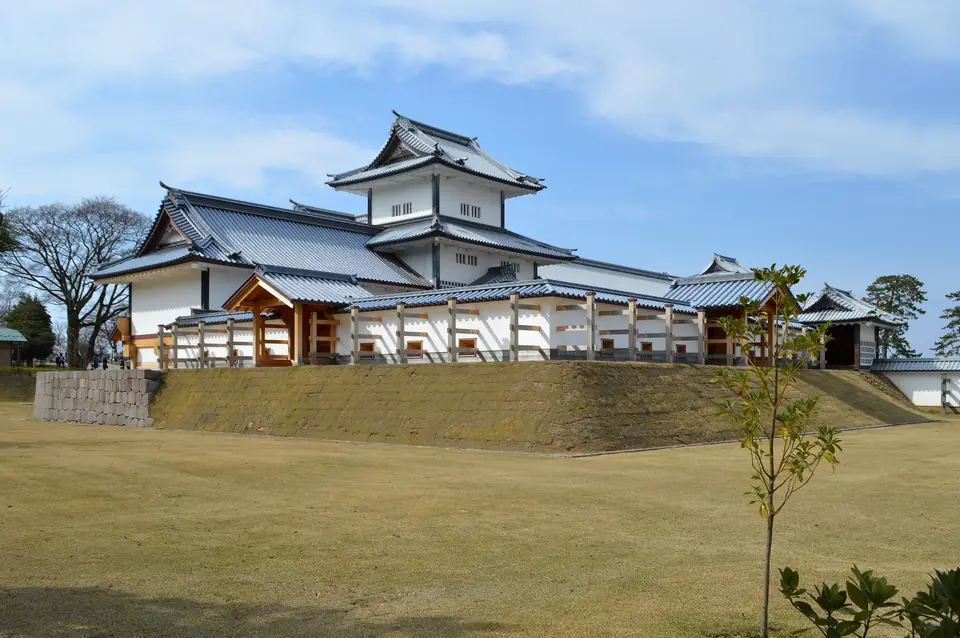
A castle without a keep since lightning burned it down in 1602, with lead roofs the rain turns silver and stone walls from every era. Fire took it again and again, and Kanazawa keeps rebuilding it in wood, piece by piece.
- 75 min of audio
- Silver lead roofs
Kanazawa Castle was born on top of a temple: in 1580 Sakuma Morimasa took the Oyama Gobō, the fortified temple of the Ikkō-ikki founded in 1546 on the tip of Kodatsuno hill, and turned it into his residence under the name Kanazawa Castle. In 1583, after the battle of Shizugatake, Maeda Toshiie entered, and with the Maeda came the great remodelling of the late 16th century, in which Takayama Ukon, a Christian daimyo and castle expert, took part; in 1592 the stone walls and the Hyakken-bori moat were built.
What can be seen today is a park of walls, survivors and reconstructions. The fire of 10 January 1881, which started in the barracks of the 7th Infantry Regiment, left only the Ishikawa-mon gate, the Sanjukken Nagaya and the Tsurumaru storehouse standing. Since 2001 the castle has been returning in wood and with traditional techniques, and on 9 March 2025 reconstruction began on the Ninomaru palace, which once exceeded 10,000 square metres and 60 rooms.
Highlights
- Ishikawa-mon — the 1788 gate with its complete masugata courtyard, a rarity in Japan
- Gojikken Nagaya — a roughly 90 m storehouse-wall rebuilt in wood in 2001
- Hishi-yagura — the diamond-plan tower with loopholes for dropping stones
- Gokuraku-bashi — the “Bridge of Paradise”, said to be inherited from a temple
- Gyokusen'inmaru — the lords' private garden, with 22 m of stepped walls
The story of Kanazawa Castle is that of a city that refuses to give it up for lost. The six-storey keep burned in 1602, struck by lightning, and never came back. Fire returned in 1631, in 1759 and in 1808, and the one of 1881 left almost only walls. Then came the army, which set up the headquarters of the 9th Division here from 1898, and Kanazawa University, with a campus on the grounds from 1949, until in 1996 the land passed to Ishikawa Prefecture. The Noto earthquake of 1 January 2024 brought down four stretches of wall and damaged 27 points, and still the reconstruction of the palace began the following year. There is no agreement on its birth date: the founding is attributed to Sakuma Morimasa in 1580, but many guides start the castle with the arrival of Maeda Toshiie in 1583.
The architecture of Kanazawa Castle reads in three materials. Tomuro stone, quarried on Mount Tomuro some 10 kilometres to the southeast, reddish or bluish, forms walls of different techniques, sometimes in the same courtyard. Wood once again holds up towers and storehouses rebuilt from Meiji-era photographs, Edo-period plans and excavations. And lead covers the roofs: sheets about 1.8 millimetres thick nailed with copper nails over a wooden core shaped like a tile, which turn silvery white in the rain. Why lead is an open debate: people speak of fire resistance, of lightness against snow and of the legend that it could be melted down for bullets in a siege.
The grounds hold scars and charms. In the northwest corner of the Honmaru only the base of the Inui-yagura remains, a two-storey tower that burned in 1759, and on the stones of the wall leading to the Honmaru you can see whitish stains: lead from the roofs melted by fire and stuck to the stone, next to a brick tunnel opened by the former Army. On the wall of the Dobashi-mon gate, hexagonal stones, the kikkō-ishi, symbolise turtles, animals associated with water, as a wish for protection against fire, and it is said that thanks to them the gate escaped the great fire of the Bunka era. Beneath it all runs the Tatsumi canal, which from 1632 carried water to the castle and sent it up by inverted siphon to the Ninomaru. It was built by Itaya Heishirō, an engineer who came from the common people of Komatsu, and a suspicion hangs over him: it is said the clan had him murdered so he would not reveal the system’s secrets, although it is also told that five years later he was directing hydraulic works in Toyama, and some believe the legend loaded him with the fate of Inaba Sakon Naotomi, a senior domain official who committed seppuku in 1640.
The audio guide covers the park in five stops, from the original gate to the lords’ garden, with documented narration checked against historical sources.
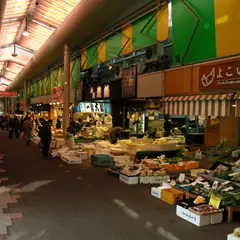
Opposite the castle, on top of the plateau, stretches Kenroku-en Garden, the great garden of the same lords. The defence of the castle town continues outside the park: on the slope of Omicho Market the double line of moat and embankment of 1599 shows, and across the Saigawa river Myoryu-ji Temple was the most fortified piece of the belt of temples that guarded the castle.
Ishikawa-mon, the gate that survived
Ishikawa-mon
Summary of this stop
The visit starts at the Ishikawa-mon, the castle’s back entrance, its karamete-mon. It suffered fires in 1631 and 1759, was rebuilt in 1788 and was one of the three buildings that survived the fire of 1881. Its value lies in the whole: together with the Ōtemon of Osaka Castle, it is the only Japanese castle gate that keeps the structures of its masugata enclosure complete, the square courtyard where an attacker was trapped. It has been an Important Cultural Property since 1950.
Inside the courtyard, the walls teach you to read the castle. They are Tomuro stone in two tones, the reddish Aka-Tomuro and the bluish Ao-Tomuro, and in this same space two ways of working it coexist: dressed stone on the west and north sides, rough-cut stone on the south side. Above, the lead tiles gleam, silvery white from the rain. What those two stonework styles face to face say is the first thing the narration deciphers in the courtyard.
Ninety metres of newborn wood
Gojikken Nagaya
Summary of this stop
The Gojikken Nagaya is a two-storey storehouse-wall of about 90 metres that joins the Hishi-yagura with the Hashizume-mon Tsuzuki-yagura tower. In peacetime it kept provisions; in case of attack, it became a fortress. Inside it leaves its whole wooden structure in view, and that is its singularity: the complex, originally built in 1632, was rebuilt in 2001 with traditional techniques from Meiji-era photographs, Edo-period plans and excavations, and was the first wooden structure restored in the park.
The Hishi-yagura, the diamond-plan tower, was at the end of the Edo period the tallest structure of the castle, and it is pierced by numerous ishi-otoshi loopholes for dropping stones. Everything rests on walls from the great remodelling of the late 16th century, in which Takayama Ukon took part, a Christian daimyo expert in castle design invited by the Maeda. How a Christian fits into the layout of a samurai fortress is one of the stories this stop keeps.
Ninomaru, the palace that burned and returns
Ninomaru palace works
Summary of this stop
At the third stop there is no building, but scaffolding and a temporary roof. Here stood the Ninomaru palace, the lords’ residence, with more than 10,000 square metres and more than 60 rooms, and here it has been rebuilt since 9 March 2025, with the first phase planned for fiscal year 2033.
Behind the void lies a long chain of fires. The one of 1808 began around six in the evening on the 15th day of the first month, with embers from a brazier in the Matsu-no-ma room, and jumped to the Hishi-yagura, the Gojikken Nagaya and the Hashizume-mon; to save part of the firearms and the books, they were thrown into the moat. The lord, Maeda Narihiro, was in Edo and found out six days later; he refused to ask the shogunate for a loan, and vassals, merchants and peasants paid close to 86% of the reconstruction. The final fire came on 10 January 1881, from the barracks of the 7th Infantry Regiment, and left only three buildings standing.
The stubbornness continues: the 2024 Noto earthquake brought down stretches of wall and the work began anyway. What the previous, retired lord was doing while the palace burned in 1808 is the almost comic detail with which the narration tells this story.
Gokuraku-bashi, a Buddhist paradise among walls
Gokuraku-bashi
Summary of this stop
The Gokuraku-bashi, the “Bridge of Paradise”, crosses the dry moat between the Ninomaru and the Honmaru, and its Buddhist name clashes with the fortress around it. The explanation lies in what stood here before: in 1580 Sakuma Morimasa took the Oyama Gobō, the fortified temple of the Ikkō-ikki founded in 1546 on the tip of Kodatsuno hill, and turned it into Kanazawa Castle. Three years later, on the 28th day of the fourth month of 1583, 14 June in today’s calendar, Maeda Toshiie entered; since 1923 that entry has been commemorated with the festival now called Hyakumangoku Matsuri.
It is said the bridge inherited its name from the Kanazawa Midō temple: worshippers crossed it in the morning reciting the nenbutsu and, on the way back, prayed facing the sunset over the Sea of Japan to ask for rebirth in the Pure Land. Past the bridge, a large stone with a round hollow passes for one of the two ablution basins of the temple’s front courtyard.
Up in the Honmaru, the piece anyone expects from a Japanese castle is missing: the six-storey keep burned in 1602 and was never rebuilt; a three-storey tower was raised in its place. What that bridge reveals about the origin of the whole compound is what the narration saves for this point.
A secret garden and the mouse gate
Gyokusen'inmaru Garden
Summary of this stop
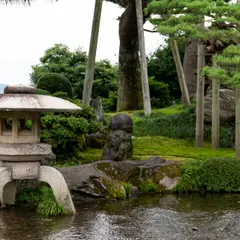
The last stretch descends to the Gyokusen’inmaru, the lords’ private garden begun in 1634 by Maeda Toshitsune, the third Maeda lord. It was fed by the Tatsumi canal and is enclosed by an amphitheatre of stepped walls, with a 22-metre drop between the bottom of the pond and the highest tier and the Shikishi-tanzaku wall with its waterfall. The garden you walk today, with its pond and islands, is the recreation of March 2015.
From here leads the Nezumita-mon, the “mouse gate”, which connected the garden with the present Oyama Shrine. Its namako walls have black mortar joints instead of white. It withstood the great fires of the Edo period, including that of 1759, which razed almost the whole castle, burned in 1884 and returned in wood, with its bridge, in 2020. Two explanations circulate about its name: mice that came out of the ground during construction, or mouse-grey walls. Which has prevailed, and why, is settled by looking at those dark joints while the narration plays.