Garden of the Maeda lords
Kenroku-en Garden Audio Guide
A garden that looks self-grown and is pure engineering: water brought by canal to a plateau with none of its own, a fountain that rises without pumps and a lantern with uneven legs that turns out to be a copy. Its name, from 1822, promises to unite six virtues a Chinese text held to be incompatible.
- 90 min of audio
- The Maeda strolling garden
Kenroku-en Garden began in 1676 as the Renchi-tei, the lotus pond garden that the fifth lord of Kaga, Maeda Tsunanori, laid out around his villa, on the slope facing the castle. It was a private retreat for the Maeda and their senior vassals, with banquets for viewing the moon and the autumn maples. The fire of 1759 razed almost all of it, Maeda Harunaga rebuilt it with the Midori-taki waterfall and the Yugao-tei tea pavilion in 1774, and in 1822 the place received the name Kenroku-en, usually attributed to Matsudaira Sadanobu, lord of Shirakawa.
Kenroku-en means “garden that combines six”. The idea comes from the Chronicle of the Famous Gardens of Luoyang, by the Song-era author Li Gefei, which groups six virtues into three pairs almost impossible to reconcile: spaciousness and seclusion, human artifice and the patina of age, abundant water and panoramic views. A century of doors open day and night ended in 1976, when thefts of stones and smashed lanterns forced an admission fee and fixed opening hours.
Highlights
- Kotoji-tōrō — the 2.7 m lantern with uneven legs, the garden's emblem
- The fountain — considered the oldest surviving in Japan, it rises without pumps
- Karasaki pine — grown from Lake Biwa seeds and tied with yukitsuri every winter
- Gankō-bashi bridge — eleven red slabs worn by those hoping to live longer
- Meiji Kinen no Hyō — the first outdoor statue of a human figure in Japan
The story of Kenroku-en Garden is written with water in a place that had none. The garden occupies the top of a plateau facing Kanazawa Castle, and almost everything that runs, falls or springs up in it arrived by canal. It was born in 1676 as a private retreat of the Maeda lords, burned in 1759, was rebuilt with a waterfall and tea pavilions, received its name in 1822 and opened officially to the whole public on 7 May 1874, after some limited openings from 1871; until March 1924 it was called Kenroku Kōen, Kenroku Park. There are two clocks for its beginning: the official date is 1676, although another version ties it to the Tatsumi canal that Maeda Toshitsune finished in 1632 and whose water later fed the streams of 1822.
The architecture of Kenroku-en is understood by climbing. Below lies the Hisago-ike, the gourd-shaped pond of the original garden, shaded and secluded; above, the great Kasumiga-ike, with its island, the Uchihashi-tei pavilion leaning over the water and the Kotoji-tōrō lantern. Between the two appear the winding stream that runs down beside the highest mound, with irises in spring and summer, the Neagari-no-matsu pine with exposed roots and a viewpoint over the lower town and, on clear days, the mountains. From November to March, the rope cones of the yukitsuri change the silhouette of the pines.
On the southeast edge, beside the Kanazawa-jinja shrine and the Zuishin-zaka slope, a well under a small roof that many walk past holds the legend that explains the whole city. It is the Kinjō-reitaku spring, where, as the story goes, Tōgorō the yam digger washed the mountain yams he dug up and left grains of gold in the water. From that “stream where gold is washed” would come, according to tradition, the name of Kanazawa, “marsh of gold”; it is also said that the spring never dries up in droughts nor clouds over in rains. The well and its small roof were ordered by Maeda Narinaga in 1819. Another tradition links the garden with Kyoto: the Kiku-zakura cherry, with flowers of more than 300 petals, is said to descend from a specimen given by Emperor Kōmei to Maeda Nariyasu, which is why it is also called Gosho-zakura, the cherry of the imperial palace.
The audio guide covers the garden in six stops, from the oldest pond to the bronze monument, with documented narration checked against historical sources that saves for each corner the detail the stroll does not tell at a glance.
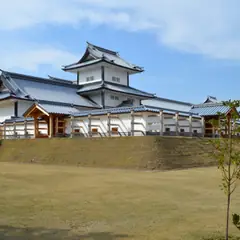
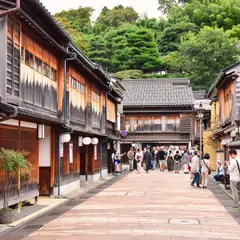
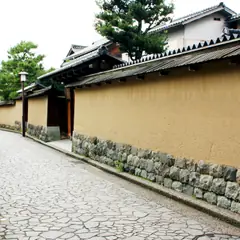
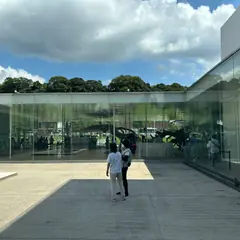
Opposite the garden rises Kanazawa Castle, the compound to which, it is claimed, the fountain’s trial was aimed; about 400 metres away is the 21st Century Museum, and in the Nagamachi Samurai District a former samurai laid out in 1894 a strolling garden inspired by this one.
The gourd pond where the garden was born
Hisago-ike
Summary of this stop
The tour starts below, in the shadiest part of the garden, on the shore of the Hisago-ike, the gourd-shaped pond that was the heart of the Renchi-tei. Here was Maeda Tsunanori’s original garden: an enclosed space where the lords and their senior vassals held banquets to view the moon and the autumn maples. Opposite falls the Midori-taki waterfall, and beside the water stands the Yugao-tei, a small tea pavilion from 1774, the oldest building in the garden.
Both came after the disaster. The great fire of 1759 razed almost all of the Renchi-tei, and the eleventh lord, Maeda Harunaga, restored it and added the waterfall and the pavilion in 1774, and the Uchihashi-tei two years later.
On the pond’s island rises the Kaiseki-tō, a 4.1-metre stone pagoda whose name is attributed to its six stacked small roofs looking like sea stones. Its origin is disputed: one version has it come from a thirteen-storey pagoda in the Gyokusen-in garden of the castle; another, far more romantic, says General Katō Kiyomasa brought it from Korea after the campaigns of the late 16th century, gave it to Toyotomi Hideyoshi and he gave it to the first Maeda lord, Toshiie. Which version holds up better is the question the narration leaves floating over the water.
A fountain that rises without pumps
Fountain
Summary of this stop
In the lower part of the garden, a vertical jet rises from a small pond with not a single machine nearby. It is the Kenroku-en fountain, considered the oldest surviving in Japan, and its mechanism is pure gravity: a stone pipe connects it with the Kasumiga-ike, located higher up, and the water rises almost to the level of that pond’s surface.
The fountain is attributed to a trial by Maeda Nariyasu to bring water to the Ninomaru of Kanazawa Castle. Seen that way, it stops being an ornament and becomes an open-air engineering test, and a clue: on a plateau with no water of its own, the entire garden is a hydraulic work. The stop works as a hinge of the tour, because it forces you to ask where that water comes from, and the answer is further up.
The lantern with uneven legs
Kotoji-tōrō
Summary of this stop
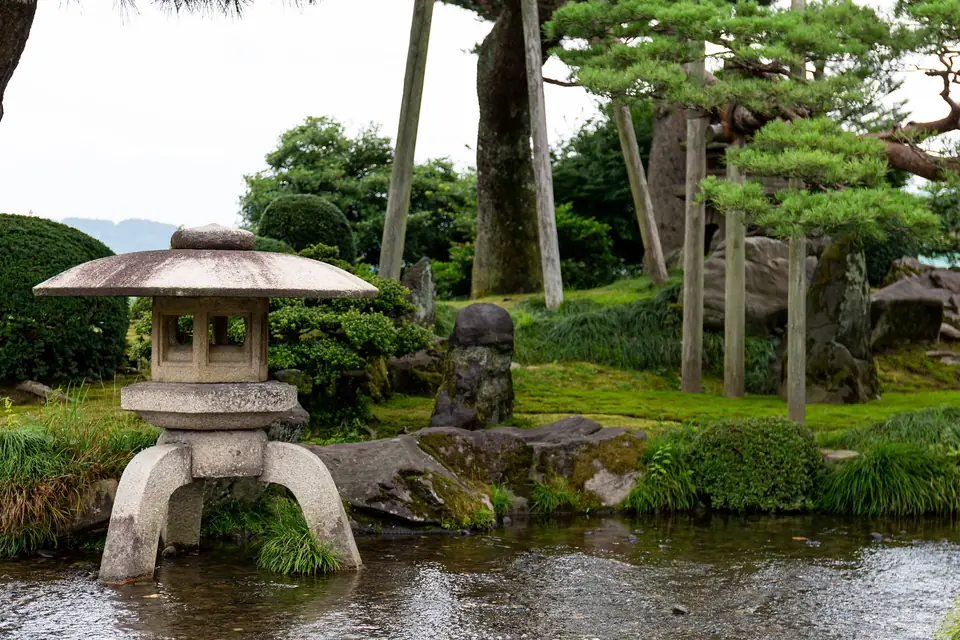
After the climb, the garden changes scale. On the north shore of the Kasumiga-ike appears the Kotoji-tōrō, a 2.7-metre stone lantern with one leg in the water and another, shorter, on a rock. Its name comes from the kotoji, the bridge that holds the strings of the koto, and it is the garden’s emblem. A painted scroll of 1863 shows it, however, in another place and with both legs equal.
It is here that the garden’s name is understood with the body: after the seclusion of the Hisago-ike comes the spaciousness of the great pond, and the six virtues of the Luoyang chronicle, which seemed to exclude one another in pairs, coexist in plain view.
The lantern has, besides, a not very photogenic secret. The one you see today is the second, installed in 1978: between 1962 and 1979 the lanterns were thrown into the pond six times, and the original is kept in the park office. What that story reveals about the garden and its visitors is part of what the narration tells facing the water.
A Lake Biwa pine above a lost palace
Karasaki pine
Summary of this stop
Beside the Kasumiga-ike, the Karasaki pine spreads its long branches over the water. It is a black pine grown from seeds that Maeda Nariyasu had brought from Karasaki, on the shore of Lake Biwa, one of the Eight Views of Ōmi. Every year, from 1 November, the gardeners stretch the yukitsuri over it, rope cones that hold the branches so the weight of snow does not break them, and in winter it is one of the most photographed trees in the garden.
The calm of this corner hides a demolition. In 1822 the twelfth lord, Maeda Narinaga, moved the domain’s schools from the Chitose-dai plateau to build his retirement residence there, the Takezawa Goten. After his death, his heir Nariyasu tore it down completely: more than 200 rooms and 13,224 square metres that by 1851 were already a cleared lot. Over that void he enlarged the Kasumiga-ike and joined the plateau with the old Renchi-tei. Why an heir erases his predecessor’s palace to enlarge a pond is the thread the narration follows under these branches.
Eleven stones worn by those who wanted to live longer
Gankō-bashi bridge
Summary of this stop
The Gankō-bashi bridge, “of the geese in flight”, is made of eleven slabs of red Tomuro stone shaped like turtle shells, laid out in a zigzag like a flock. So many people crossed it convinced that stepping on it lengthened life that the stones wore down, and today walking on it is forbidden.
The wear tells the other half of the garden’s story. On 7 May 1874 the Maeda’s private grounds opened officially to the whole public, and for a century you could enter free, day and night. In 1976, after continual thefts of stones and smashed lanterns, came the admission fee and the opening hours.
A chink of that open garden remains: before official opening time, Kenroku-en can be walked free from 4:00 from April to August, from 5:00 in March and from September to October, and from 6:00 from November to February, only through the Renchi-mon and Zuishin-zaka entrances. The condition for early risers, and what those almost empty hours give, is told beside the bridge.
The bronze hero pigeons avoid
Meiji Kinen no Hyō
Summary of this stop
The tour ends before the Meiji Kinen no Hyō, raised in 1880 in memory of 400 Ishikawa soldiers killed in the Satsuma war. On a large mound of stones stands a 5.5-metre bronze statue of Yamato Takeru, the legendary hero: the first outdoor statue of a human figure in Japan.
It also has a documented oddity: pigeons do not perch on it. Yukio Hirose, a professor at Kanazawa University, noticed that birds avoided the figure, studied its chemical composition and arrived at the formula of an alloy for making statues that scare off pigeons and crows. In 2003 he received the Ig Nobel Prize in Chemistry for it, the satirical award that honours research that first makes you laugh and then makes you think. What Hirose said then about the humour of his work is the farewell, between mourning and a smile, with which the audio guide closes the garden.