Kanazawa's kitchen since 1721
Omicho Market Audio Guide (Ōmichō Ichiba)
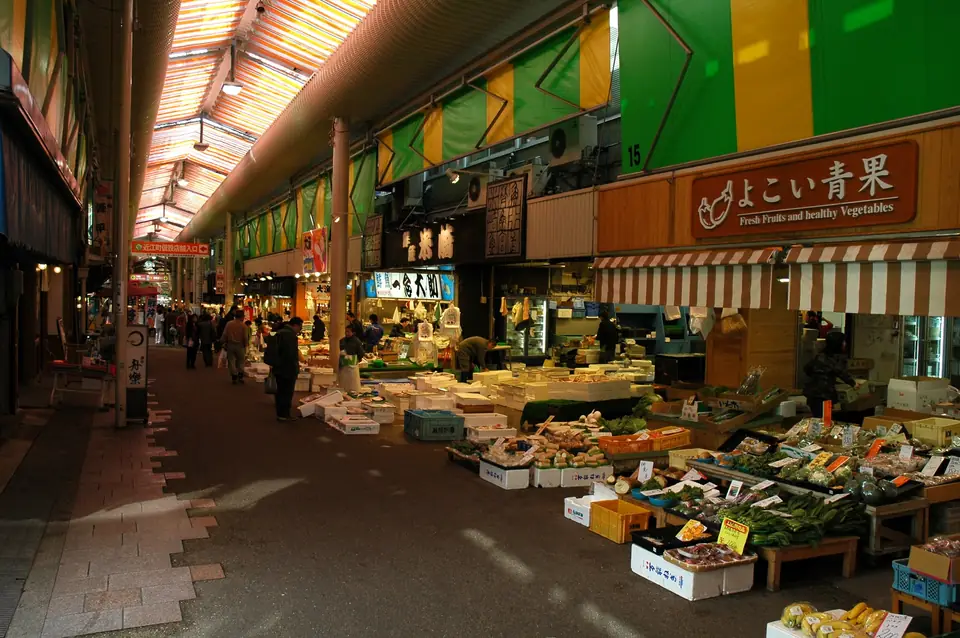
Some 170 shops under arcades, with crabs and Sea of Japan fish in plain view and priced. Beneath the bustle of daily shopping, the market keeps a wall from 1599, the trace of a snow pit and three centuries of licences.
- 45 min of audio
- Sea of Japan fish and crab
Omicho Market took shape between 1690 and 1721. After a fire in 1690, the Fukuromachi fish market moved to Ōmichō, and in 1721 the Kaga clan concentrated next to the castle the markets held along the Sai and Asano rivers; that is the year the market takes as its founding, and in 2021 it turned 300. The neighbourhood is older still: it was one of the eight Oyama districts founded by Sakuma Morimasa before the arrival of Maeda Toshiie in 1583.
Locals affectionately call it Omicho, and in the city it is known as “the kitchen of the citizens of Kanazawa”. It receives some 20,000 visitors a day on weekdays and 30,000 at weekends, and with the arrival of the Hokuriku Shinkansen in 2015 its footfall multiplied by 1.6. Every November, when the snow crab season opens, it holds its Crab Festival.
Highlights
- Musashi entrance — the stone post that inherits the official permit of 1904
- Slope from Kami-dōri to Naka-dōri — the trace of the 1599 moat and embankment
- Fish street — kanō-gani and kōbako-gani crabs from the Sea of Japan
- Ichihime Shrine — the protective goddess who, legend says, came from Kyoto
The story of Omicho Market is told in dates of fires. From the one of 1690 came the move of the Fukuromachi fish market; from the great fire of 3 June 1904, which razed 266 houses, came straight streets and, on 16 August that year, a market opened by 53 greengrocers with a permit from Ishikawa Prefecture. That is why the official leaflet carries the slogan “since 1904”, although the market celebrates its origin in 1721: more than a founding day, there was a process running from 1690 to 1721.
During the Edo period only licensed merchants could sell here, with the kansatsu, issued by the tōdori, managers authorised by the Kaga clan, a system abolished with the liberalisation of trade in the Meiji era. It returned for a time in the postwar years to curb the black market, after the market was even temporarily dismantled in the last months of the Pacific War. Before that war, between the stalls, art exhibitions were held, along with performances of jōruri recitals and manzai comic acts: the market was also the neighbourhood’s theatre.
The architecture of Omicho Market mixes three centuries. The arcades have covered its streets since 1956; the five-storey, one-basement Ōmichō Ichiba-kan culminated in 2009 a redevelopment during which no shop closed; and beneath the layout still runs the city wall of 1599. The name Ōmichō is attributed to the merchants brought from Ōmi province, although another source calls it uncertain and mentions an archer named Ōmi who is said to have lived there. Even the number of shops shifts with the year and the count, between about 170 and about 185.
The audio guide covers the market in four stops, from the Musashi entrance to the shrine at the exit, with documented narration checked against historical sources.
The 1599 wall you can make out on the slope protected the city from Kanazawa Castle, about 700 metres away. In the opposite direction, some 900 metres off, the Higashi Chaya District keeps its 1820 teahouses across the Asano river.
A 1904 post before a displaced bank
Omicho Ichibakan
Summary of this stop
The tour starts at the Musashi entrance, at the Musashigatsuji crossing, beside the Ōmichō Ichiba-kan, the five-storey, one-basement building opened on 16 April 2009 with 73 shops. The redevelopment began in 2007 because the 1956 arcade and the buildings had aged, and during the works all the shops stayed open.
The market’s true gate, however, is more modest: a stone post with the inscription 官許金澤青草辻近江町市場, raised in that redevelopment. It is the heir of the 1904 post, when, after the great fire of 3 June that razed 266 houses, 53 greengrocers opened on 16 August a market with a prefectural permit, the “officially licensed Aokusa-tsuji market”; the name Ōmichō was added to it between 1955 and 1964.
Next door, the Musashigatsuji branch of the Hokkoku bank, the work of the architect Murano Tōgo, hides a displacement: to widen national roads 157 and 159 by 3 or 4 metres, the building was moved back about 13 metres and integrated into the market’s new block. The narration tells on the corner why that bank is no longer where it was built.
The 1599 wall hidden in a slope
Drop between Kami-dōri and Naka-dōri
Summary of this stop
Between Kami-dōri and Naka-dōri, a sloping passage, more marked beside the butcher’s, looks like a simple drop. It is the trace of a wall. In 1599, by order of Maeda Toshinaga, Kanazawa raised in 27 days the inner sōgamae, a double line of moat and embankment to defend against Tokugawa troops, and its course crossed exactly the market’s site. Kami-dōri runs over the old embankment and Naka-dōri over the moat, where a branch of the Tatsumi canal still passes; the city of Kanazawa protects those stretches as a municipal historic site.
The neighbourhood that settled on top predates even the Maeda: Ōmichō was one of the eight Oyama districts founded by Sakuma Morimasa before 1583. The ground also keeps a small urban glory that the narration reveals on the slope: a first place in the city’s history that few would associate with a market.
The snow hole of the fish street
Setback of the Ōmichō Shokudō
Summary of this stop
Sengyo-dōri, the fish street, is the corridor of cries: ice boxes, sweet shrimp, Sea of Japan fish and snow crabs displayed in plain view and priced. The males landed at Ishikawa ports are sold as kanō-gani and the females as kōbako-gani; the season opens in November, and that month the market holds its Crab Festival. Fish is at the origin of everything: after the 1690 fire, it was the Fukuromachi fish market that moved to Ōmichō.
In the middle of the street, the Ōmichō Shokudō restaurant sits set back from the building line, as if on a whim. It is the hollow of a himuro, an Edo-period pit dug to keep food with snow, and it was so well known that a letter addressed only to “the hole of Ōmichō” reached its destination.
Snow still has its date in the market. Every 30 June, at the himuro-biraki of Yuwaku Onsen, the storehouse where pressed snow has been kept since winter is opened, in memory of the ice the Kaga clan sent to the Tokugawa shogunate, and blocks of that ice are displayed at Omicho. What people do before them, and what Kanazawa eats the next day, is what the narration tells in front of the setback.
The outsider goddess under the “kunoichi” arcade
Ichihime Shrine
Summary of this stop
The Ichihime-jinja exit opens in front of a small shrine venerated as the protective deity of the whole market. According to legend, she comes from the Ichihime shrine on Gojō Street in Kyoto, and it was the Ōmi merchants themselves who brought the goddess to Kanazawa.
Here the circle of three centuries closes. In 1721 the Kaga clan gathered next to the castle the markets on the banks of the Sai and Asano; during the Edo period only licensed merchants sold; and in 1966, with the opening of the Kanazawa Central Wholesale Market, wholesalers and middlemen left and Omicho remained an exclusively retail market, the one for residents’ daily shopping.
Overhead, the arcades hold a curiosity. When the Kami-dōri one was extended in 1981 towards the car park entrance, its plan seen from the air drew the signs く, ノ and 一, the market’s “kunoichi”, which the Ichiba-kan roof partly covered in 2009. That word written in the sky is the tour’s last wink.