Teahouse district of 1820
Higashi Chaya District Audio Guide (Higashi Chaya-gai)
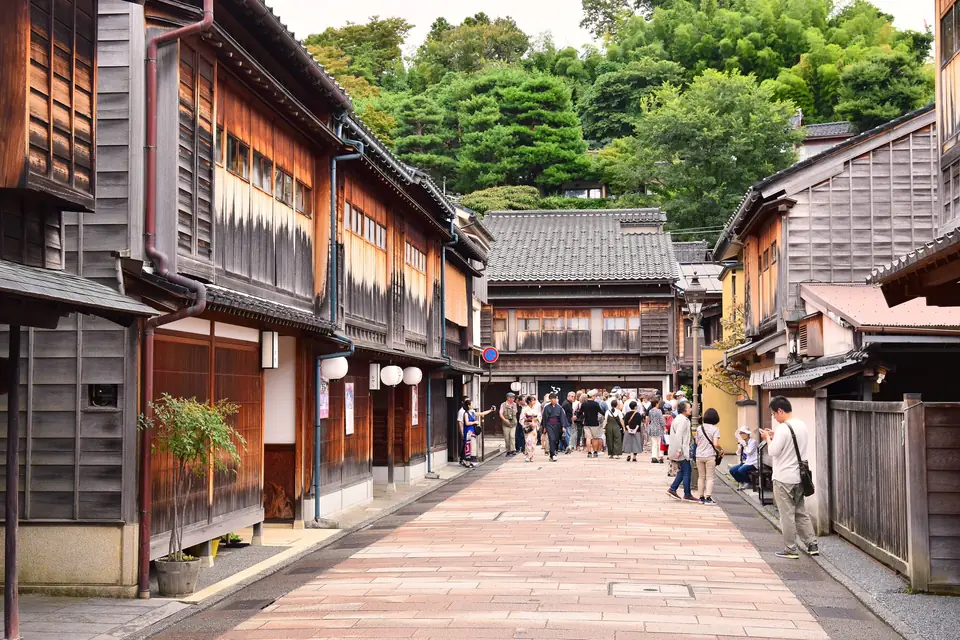
A cobbled street of wooden lattices designed to see without being seen, laid out all at once in 1820 across the Asano river. Behind some of those facades, geiko still perform for clients who only enter introduced by a regular.
- 60 min of audio
- Teahouses and geiko
The Higashi Chaya District was born by decree: in 1820, under the twelfth lord of Kaga, Maeda Narinaga, the teahouses scattered around the castle town were gathered into a district authorised by the domain on the east bank of the Asano river, with regular blocks in place of the earlier irregular layout. It was called Utatsu Chayamachi or Asanogawa Chayamachi, was abolished in 1831, authorised again in 1867 and, from the Meiji era, already as Higashi, was Kanazawa's highest-ranking and liveliest teahouse area.
Since 14 November 2001 it has been an Important Preservation District for Groups of Traditional Buildings: 1.8 hectares, roughly 130 by 180 metres, where two thirds of its 140 buildings are traditional, built between 1820 and the early Meiji era. A residents' agreement of 2003 bans eating while walking, covering the lattices and installing vending machines on the street or paid parking, and limits noren curtains to 120 centimetres in height.
Highlights
- Kimusuko lattices — the “wooden insect cage” that lets you see the street without being seen
- Shima teahouse — an 1820 ochaya built like a theatre, an Important Cultural Property
- Kaikaro — Kanazawa's largest teahouse, with a red staircase and golden tatami
- Utasu Shrine — the rabbit-and-dragon mirror and the Setsubun beans
The story of the Higashi Chaya District has something of an urban experiment. In 1820 the domain of Kaga decided to gather the teahouses spread around the castle town in one place and laid out the district from scratch across the Asano river, with regular blocks that can still be seen by comparing the maps from before and after. Eleven years later it abolished it, and did not authorise it again until 1867. Whether it was the first of Kanazawa’s teahouse districts is a matter of versions: some sources present it as the first to be born, others indicate that Higashi and Nishi opened at the same time in 1820.
The architecture of Higashi Chaya comes down to a vertical contrast. On the ground floor, the kimusuko lattice closes the facades; above, the tall second floors, with galleries or wooden blinds, held the banquet rooms. Along the main street, the Nibanchō, two-storey teahouses line up with small signs and no neon, noren curtains and andon lanterns, and gold-leaf shops set in former teahouses, with workshops for applying the sheets and gold-covered ice creams. Today five ochaya operate in the district with a little over a dozen geiko.
At the back, at the foot of the hill, the Utasu shrine keeps two stories of the Maeda clan. After the death of Maeda Toshiie, founder of the domain, his successor Toshinaga built a shrine on Mount Utatsu in 1599 that he said was dedicated to the war god Hachiman, although what was really worshipped was the spirit of Toshiie; in 1873 that cult passed to the new Oyama Shrine, next to the castle, and the Utasu also venerates Toshiie today. At the back of its grounds, the “sasayu well” of the third lord, Toshitsune, carries the popular belief that its water cured an illness of the fifth, Tsunanori; sasayu was hot water with sake in which, in the Edo period, children recovered from pemphigus were bathed.
The audio guide covers the district in four stops, from the bridge to the threshold of the city’s largest teahouse, with documented narration checked against historical sources.
At the other end of the centre, the Nagamachi Samurai District tells the other side of the Maeda city, that of the mud walls of their vassals. About 900 metres away, on the way to the centre, Omicho Market brings together the crab and fish of the Sea of Japan.
A new district across the river
Asanogawa Ohashi Bridge
Summary of this stop
The tour starts on the north bank of the Asanogawa Ohashi bridge, a registered tangible cultural property, at the district’s southern entrance. From here the decision of 1820 makes sense: in the time of Maeda Narinaga, the domain of Kaga gathered the teahouses scattered around the city into a district authorised on the east bank of the Asano river and replaced the irregular layout with regular blocks. Because of its location it was called Utatsu Chayamachi or Asanogawa Chayamachi.
The experiment was short-lived: in 1831, eleven years after its creation, the district was abolished, and it was not officially authorised again until 1867.
The first of those names, Utatsu, comes according to tradition from a discovery on this same bank: an ancient mirror decorated with a rabbit and a dragon, u and tatsu in Japanese, which led to a shrine being dedicated to the god Utatsu, “rabbit and dragon”. Where that name still resonates is what the narration traces from the bridge.
Lattices that look outwards
Main teahouse street
Summary of this stop
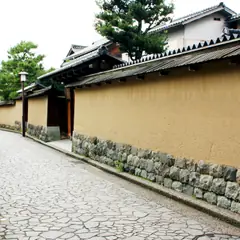
The cobbled main street is the showcase of the district protected since 14 November 2001: some 1.8 hectares in which two out of three buildings are traditional, built between 1820 and the early years of Meiji. What defines the facades is the kimusuko, literally “wooden insect cage”, a fine lattice of vertical slats on the ground floor. It is built so that from outside the interior can barely be seen while from inside the street is seen well: the gaze travels in one direction only.
The landscape has not preserved itself. Since the residents’ agreement signed with the mayor of Kanazawa on 21 October 2003, revised in 2014, 2016 and 2018, eating while walking, covering the lattices and installing vending machines on the street or paid parking are banned, and noren curtains cannot exceed 120 centimetres in height. Every discreet sign is part of a pact, and the narration explains on the street what that pact means for whoever walks it.
Shima, a house built for the show
Ochaya Shima
Summary of this stop
The Shima teahouse was built in 1820, the year the district was born, and can be visited inside as a museum. It measures 7.3 metres wide by 13.1 deep, has two floors with a three-storey part and has been an Important Cultural Property of Japan since 25 December 2003. On the ground floor, the mise no ma, where the geiko got ready, displays kanzashi hairpins and lacquerware of the period.
The entertainment was upstairs. On the second floor, the client sat in the maezashiki, with his back to the tokonoma; when the fusuma opposite opened, the hikae no ma became the geiko’s stage. Bark-covered pillars, dark tones, bengara-coloured earth walls and fittings with figurative motifs complete an interior designed as a miniature theatre. A missing detail, something any house would have, shows that this building served one single purpose, and the narration points it out in the room itself.
Kaikaro and the doors only a regular can open
Kaikaro
Summary of this stop
Kaikaro is the largest teahouse in Kanazawa, a building about 200 years old declared a conservation building by the city in 1991. It keeps a red staircase lacquered with Wajima lacquer, red rooms where banquets with geiko are still held and a tea room with “golden tatami”, made with gold leaf and mizuhiki cord, two traditional crafts of the city. It still operates as an ochaya and opens to the public by day for a fee.
It is the step from the museum to present-day life. The district that, from the Meiji era, already as Higashi Shinchi, was Kanazawa’s highest-ranking and liveliest teahouse area today keeps five ochaya with a little over a dozen geiko, and the rule of not admitting new clients without the introduction of a regular.
Only once a year does that discretion break. Every 3 February, at Setsubun, the Utasu shrine, at the back of the district, holds its festival with an offering dance and the throwing of lucky beans, and those who throw them are not priests. Who they are, and what happens that day, closes the tour.