Samurai district of the Kaga domain
Nagamachi Samurai District Audio Guide (Nagamachi Buke Yashiki)
Alleys between mud walls that dress in straw in winter, a fast-running canal at street level and samurai houses that no great fire or bombing ever touched. From the lord's guard to the humblest soldier, Nagamachi keeps an entire social order.
- 60 min of audio
- Samurai houses
The Nagamachi Samurai District gathered the residences of middle- and high-ranking samurai of the Kaga domain, among them those of the Murai and the Cho, two of the hakka families, the highest in rank and wealth of the domain. Throughout the Edo period and up to today it has been spared serious fires, and in the Second World War it escaped the incendiary bombings that razed Tokyo and Osaka: that is why it keeps narrow streets, earthen walls and nagaya-mon gates.
There are two explanations for the name. One attributes it to a long street of samurai residences, from naga, long, and machi, street; another, the one carrying most weight in official tourist documentation, to the Cho family, whose surname is written with the character for “long”, which is also read naga. With the abolition of the feudal class system after 1868, the district opened to any resident, and today it is still inhabited: most of its houses are not open to visitors.
Highlights
- Earthen walls — covered every December with rice-straw mats
- Onosho canal — Kanazawa's oldest, a route for timber and rice to the castle
- Nomura house — eleven generations of the lord's guards and a myrtle over 400 years old
- Takada house — a nagaya-mon gate and a pond fed by the canal
- Ashigaru houses — the hedge and private garden of the humblest samurai
The story of the Nagamachi Samurai District begins with an arrival. When Maeda Toshiie entered Kanazawa in 1583, he was followed by his direct vassal Nomura Denbei Nobusada, whose line would live in its Nagamachi residence for eleven generations, until the end of the samurai period in 1871. Around it lay the houses of middle- and high-ranking samurai, closed off from the street by earthen walls and gates of their own, and on another scale lived the ashigaru, the lowest rank, who in Kaga, unlike the usual in the Edo period, each received an independent house with a garden.
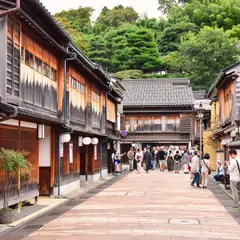
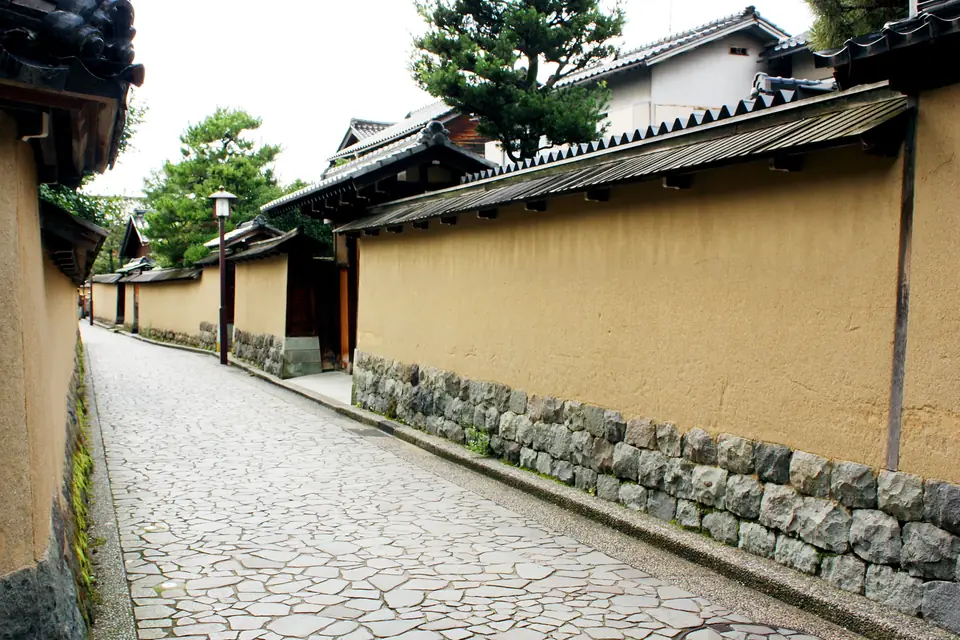
The architecture of Nagamachi is of mud, wood and water. The ochre earthen walls, topped with tiles, box in cobbled alleys that turn and close, with few modern houses in between. In the nagaya-mon gates, built into the wall, servants slept. At street level runs the Onosho canal, fast and clear, with stone banks and small bridges, which diverts water to the garden ponds. There is no settled figure for its age: the Tourism Agency lists its construction date as unknown and Ishikawa Prefecture places it about 400 years ago.
The most modest houses keep the most unexpected stories. The ashigaru dwellings that can be visited today came from the Hayamichi district, that of the hikyaku, the domain’s “fast feet”, couriers who carried letters, official documents, bills of exchange and parcels to Edo and to the Osaka and Kyoto area: an expert hikyaku covered the Kanazawa to Edo route in five days in summer and six in winter, with a reward if he arrived early and a pay cut if late. Of ashigaru origin was also Ōtsuki Tomomoto, whom the lord Maeda Yoshinori charged with fixing the domain’s finances in the 18th century. His rise to a high samurai rank unleashed the Kaga Sōdō, one of the murkiest episodes in Kanazawa’s history, which ended with his banishment, his death in 1748 and a chain of misfortunes that ended up on the kabuki stage.
The audio guide covers the district in five stops, from the alleys to the hedged cottages, with documented narration checked against historical sources.
The Senda-ke garden, opposite the Nomura house, was inspired by Kenroku-en Garden. The other side of the old city, that of the teahouses, is in the Higashi Chaya District, and a kilometre away, across the Saigawa river, Myoryu-ji Temple hides the traps with which the Maeda clan prepared the city’s defence.
Mud alleys nobody burned
Earthen-wall alley
Summary of this stop
The tour starts in an alley of earthen walls, where the view is boxed in and the city’s noise is muffled. It is a survivor’s landscape: throughout the Edo period and up to today Nagamachi has been spared serious fires, and in the Second World War it escaped the incendiary bombings that razed Tokyo and Osaka. Every December, in about three days of work, the walls are covered with komo, mats woven from rice straw that keep seeped water from freezing and cracking the mud, and they stay that way until early spring.
On these streets lived the Murai and the Cho, two of the hakka families of the Kaga domain. The Cho, whose surname is associated with the district’s name, came close to disappearing in 1577: during Uesugi’s siege of Nanao Castle, in Noto, Yusa Tsugumitsu conspired with other lords and murdered fourteen members of the line while the younger brother, Tsuratatsu, had slipped out by sea to ask Oda Nobunaga for help. What he found on his return, and how his house ended up among the eight highest-ranking of the domain, is the dark story the narration tells between these walls.
The Onosho canal, the castle’s freight
Onosho canal
Summary of this stop
In front of the Nomura house, the Onosho canal runs fast and clear at the foot of the walls. It is the oldest in Kanazawa: it takes its water from the right bank of the Saigawa river, upstream of the Sakura-bashi bridge, and runs about 10 kilometres through Nagamachi and Nagadohe until it irrigates fields in the west of the city, in the Kanaiwa area. In the Edo period it was road, pantry and defence at once: along it travelled the timber and the rice paid as tax to the castle, and it gave domestic water and a reserve against fires.
Popular tradition gave it another name, Onikawa, written both with the characters for “demon river” and with those for “river of the honourable burden”, and it is said that the timber to build the castle arrived this way. The canal still works: opposite it feeds the pond of the Senda-ke garden, which in 1894, when the samurai class was already abolished, the former Kaga samurai Norifumi Senda laid out inspired by Kenroku-en, and which opened to the public in April 2025. Which of the two writings suits this stream better, the narration leaves to the judgement of the listener.
The Nomura house and its borrowed room
Nomura Samurai House
Summary of this stop
The Nomura house belonged to the descendants of Nomura Denbei Nobusada, who followed Maeda Toshiie to Kanazawa in 1583. Eleven generations lived here, until 1871. With an income of 1,200 koku, the Nomura were heads of the umamawari mounted guard, which escorted the lord’s horse, and held bugyō posts: the middle rank of the Kaga samurai.
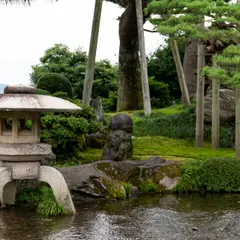
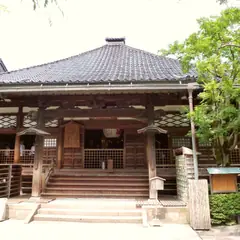
Of the original residence survive the earthen wall and the winding stream of the garden, a compact space between walls, with lanterns and stone bridges, ancient rocks of strange shapes and a Japanese bayberry, the yamamomo, more than 400 years old. In 2003 it ranked third in the ranking of Japanese gardens by a specialised American magazine. But the noblest room, the jōdan-no-ma, with its hinoki cypress coffered ceiling, and the audience room are not the Nomura’s: they were brought dismantled from the house of a great Kaga merchant who received the domain’s lord there. The doubts about their date and exact origin are part of what the narration tells in the house.
Fourth bridge and the Takada gate
Takada family house
Summary of this stop
At the Yon-no-hashi crossing, the canal’s “fourth bridge”, stands the house of the Takada, middle-ranking samurai, heishi. Its nagaya-mon gate, restored and open to visit, was at once a door and a servants’ dwelling, built into the wall. Behind it, a restored strolling garden surrounds a pond that takes its water from the canal itself, among Japanese red pines.
The plot gives the measure of a middle-ranking samurai house: today it occupies about 890 square metres and once exceeded 1,400. Compared with those walls and gates, the ashigaru of the last stop surrounded themselves with hedges that also enclosed the garden, and the narration explains beside the bridge what that difference said about who lived behind.
Hedged cottages of the ashigaru
Ashigaru Shiryokan Museum
Summary of this stop
The tour ends before two small wooden houses surrounded by a hedge, the Takanishi and Shimizu houses, which form the Ashigaru Museum. In the Edo period the ashigaru, the lowest samurai rank, generally lived in rows of nagaya dwellings; in the domain of Kaga, by contrast, each family received an independent house with a garden. The Takanishi house, one of the oldest ashigaru dwellings in Kanazawa, was inhabited by descendants of its original owners until 1994, when it was dismantled and moved here from the district of the hikyaku, the couriers on foot.
Among these families a singular custom prevailed: when a superior wanted to summon one of them, he sent a messenger to his house the day before, and the door by which he entered announced the news before he said a word. Which door brought joy and which misfortune, in a district open to all since 1868 and still inhabited, is the scene with which the narration says goodbye.