Art deco market
Central Market Audio Guide (Pasar Seni)
The great art deco provisions market that fed the Kuala Lumpur of tin came close to falling beneath an office tower; a recession saved it, and beneath its 122-metre skylight, where the price of mackerel was once shouted, batiks and portraits are now sold.
- 45 min of audio
- Art deco architecture
Central Market, renamed by the city Pasar Seni, “art market”, has occupied since 1888 a plot beside the Klang River to which the British colonial administration moved the fish, meat and vegetable market of the residents and the tin miners. The present building, the work of the local architect T.Y. Lee, is a reinforced-concrete box of about 122 by 61 metres, with stepped ziggurats above its 22 entrances, which when finished around 1937-1938 was the largest single hall in Kuala Lumpur.
It worked as a wholesale and retail market until the late 1970s and then stood empty, condemned to disappear beneath the Dayabumi office complex. The 1985 recession, with more offices than the city needed, changed the plans: in April 1986 it reopened as a cultural market, air-conditioned and with an eye on London’s Covent Garden, and the same strip of light that lit the fish stalls now falls on shops of Malay, Chinese and Indian crafts.
Highlights
- “Since 1888” façade — A pale blue and white front, with a date that marks not a founding but a move from Medan Pasar
- Entrance ziggurats — Stepped crowns and two rows of interlocked rings over each of the 22 doors, pure art deco
- Central hall skylight — A strip of blue-green glass along 122 metres that lets through 60% of the light and only 20% of the heat
- Kasturi Walk — The former Lorong Kasturi alley, covered since 2011 and presided over by three giant wau bulan moon kites
- Two-storey pavilions — Six pavilions joined by bridges, a scar of the 1986 conversion into a cultural market
A step from the Klang River, a long pale blue and white façade announces in large letters “Since 1888”. It is Central Market, which half of Kuala Lumpur knows as Pasar Seni, “art market”. That year the British colonial administration set up on this plot a wet market of fish, meat and vegetables for residents and for the tin miners who were building the city. The first building, completed in 1889, was a single-storey wooden hall, about 76 by 27 metres with a zinc-sheet roof, which cost 48,000 Straits dollars.
The history of Central Market is that of a city growing faster than its markets. From 18,000 inhabitants in 1889 Kuala Lumpur grew to 120,000 in 1930, and that year the colonial government declared the old market obsolete. The Sanitary Board commissioned the new one from the local architect T.Y. Lee; among 21 contractors, the job went to E. Brizay & Co., of Singapore, for 249,000 dollars, a figure that the decorative details pushed up. How much it finally cost and exactly when it was finished are questions the sources do not answer alike: “1936” is repeated, but the press of the time places the demolition of the old market in early 1937 and the completion between 1937 and early 1938.
The architecture of Central Market is a practical, luminous art deco: a trapezoidal reinforced-concrete box of about 122 by 61 metres, stepped ziggurats above each entrance and a strip of glass running the length of the roof. It worked as the central market until the late 1970s, stood empty, was condemned to the wrecking ball and in 1986 was reborn as a crafts bazaar.
For what to see at Central Market, the audio guide covers it in four stops and 45 minutes, from the façade to the inner pavilions, passing through the street of kites and the great central hall. The thread that links them: beneath the batiks and souvenirs the fish market that fed the tin city still beats, and it survived by a miracle.
About 350 metres away, Petaling Street keeps the bustle of Chinatown’s market street, and less than half a kilometre to the north Merdeka Square gathers the buildings of colonial power.
A “Since 1888” that hides a move
Central Market
Summary of this stop
Facing the symmetrical main façade, with the Malaysian flag and a concrete flagpole on top, the first reading seems simple: a market founded in 1888. The date, however, tells another story. That year the colonial government moved the market here from its original site on Market Square, today Medan Pasar, where around 1880 the Kapitan Cina Yap Ah Loy had built one. The operator and several websites credit Yap with the 1888 market, but he had died in April 1885, and other sources assign the one on this plot to the British administration.
The façade is also a showcase of art deco. Each of the 22 entrances carries a stepped crown in the form of a pyramid or ziggurat and two vertical rows of interlocked rings, with the door set back in the background, and a band of white fluted concrete runs across the front from side to side to mark the line of the building.
That line is low, although it was not meant to stay so for ever. In August 1936 the Sanitary Board announced that the new market would be ready to bear more weight if needed, and its architect boasted of the strength of its structure. Facing the façade, the audio guide tells what T.Y. Lee promised for this building and how much of that promise, almost ninety years later, is still waiting.
Moon kites over the old alley
Kasturi Walk
Summary of this stop
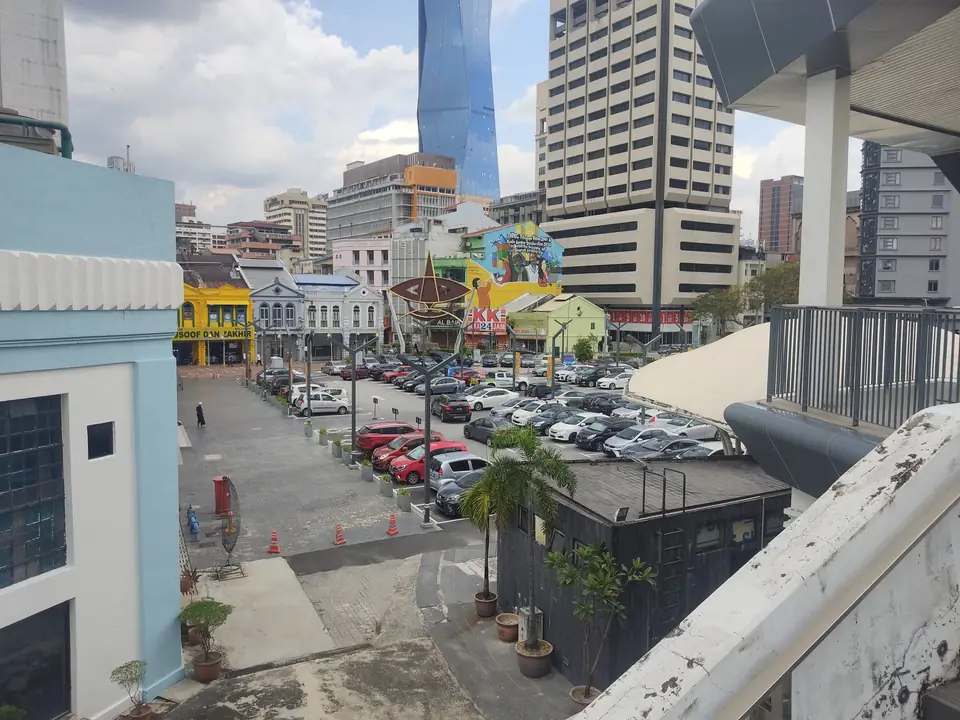
Beside the market, the old alley Lorong Kasturi has been Kasturi Walk since February 2011, a covered pedestrian gallery with 55 kiosks and an investment of 8 million ringgit. It is presided over by three giant wau bulan, the Malay moon kites, of polycarbonate with a pewter finish, which rise like arches above the street.
Beneath the kites the pulse of a neighbourhood of comings and goings survives. In the 1960s people reached here on the number 55 Kuala Lumpur-Klang-Port Swettenham bus, which stopped at the Klang bus station beside the market, and in the fish section the sellers shouted prices such as “Kembong, lapan puluh sen!”, mackerel at eighty cents.
From the back alley of a fish market to a showcase of kites: on this stretch, the audio guide connects that coming and going of sixty years ago with the one that continues today among the kiosks.
The largest hall in Kuala Lumpur
Skylight of the central hall
Summary of this stop
Inside, the central aisle opens beneath a glazed strip about three metres wide that runs the 122 metres of the hall. The building’s 6,430 square feet of blue-green Colorex glass were chosen to let through 60% of the light and only 20% of the sun’s heat, and that filtered brightness has lit the interior since 1937. When finished, this was the largest single hall in Kuala Lumpur.
The hall was conceived for a hungry city. In December 1937 it had three electric cold rooms, for fish, pork and meat, and room for 175 fruit and vegetable stalls, 130 for fish, 36 for meat, 34 for pork and 21 for eggs, with 21 doors besides the main entrance.
Beneath that same light, in 1985, in the last months of the old wet market, the photographer Hari Ho portrayed the people who worked here face on. One of his portraits has no name: that of a boy sitting among jute sacks whom they called “Lorry Boy”. In the central hall, the audio guide tells who posed for Ho and why that boy remains an enigma more than thirty years later.
Saved by an office glut
Two-storey pavilions
Summary of this stop
On the Jalan Hang Kasturi side rise six two-storey pavilions that look like shophouses and traditional houses, joined by three bridges to the mezzanine of the restaurants. They are the trace of the conversion. The market moved in the late 1970s to the Selayang wholesale market because of traffic jams in the centre, and the empty building was marked for demolition for phase V of the Dayabumi complex, whose tower still peeks out behind it, from the bank of the Klang.
Who saved it and when is another disputed story. Some sources place the threat in the 1970s and attribute the rescue to a petition from the Malaysian Heritage Society; others tie it to Dayabumi, note that the 1983 campaign to turn it into a National Art Gallery failed and that it was the 1985 recession, with an excess of offices, that led the Government to keep it as a “Cultural Market”. The work, with the architect Chen Voon Fee, began in October 1985, and on 15 April 1986 the minister Rafidah Aziz inaugurated the new Pasar Seni, then painted baby blue and pink; the pink ended up changed to white.
Among batiks and souvenirs, one of the few artists of the first batch is still at his stall since 1987. In the pavilions, the audio guide closes the tour with his story and with the faces of Malaysian power that come from his brushes.