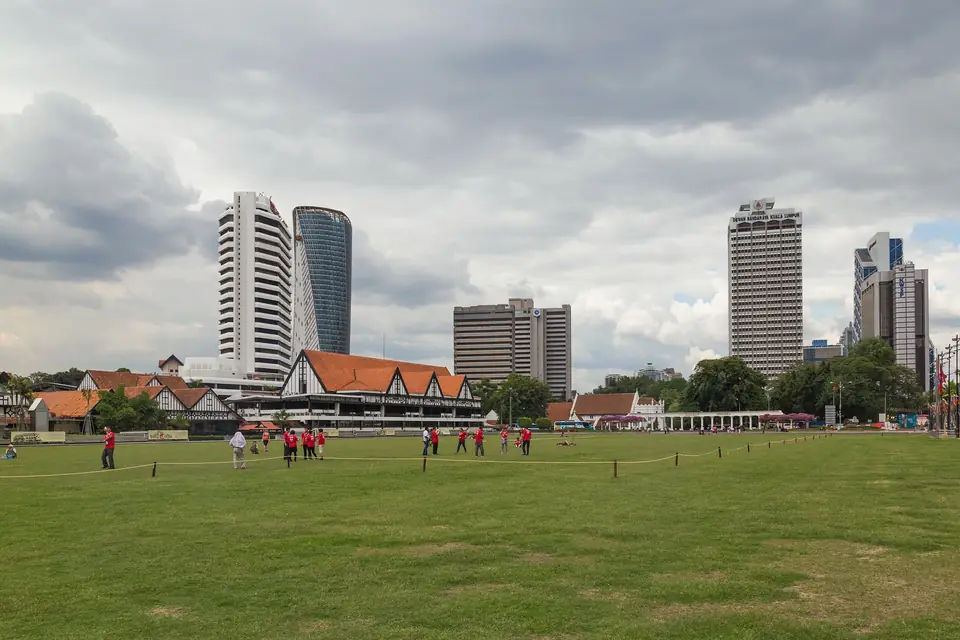
Independence square
Merdeka Square Audio Guide (Dataran Merdeka)
A former British cricket ground, ringed by buildings of colonial power, where at midnight in 1957 the Union Jack came down: today it is an expanse of lawn beneath a 95-metre flagpole that relives that night every year.
- 45 min of audio
- Independence history
Merdeka Square, Dataran Merdeka in Malay, began in 1882 as a swampy plot west of the Klang River that Frank Swettenham bought from Yap Ah Loy to drain as a police drill ground. In 1892 it became the cricket ground of the Selangor Club, and around it rose the clock tower of the Sultan Abdul Samad Building, the Tudor-style club and the neo-Gothic St Mary’s Cathedral. On the night of 30 to 31 August 1957 the flag of Malaya was raised here for the first time.
What looks like a stone square is in fact a lawn: that of the old Padang, rescued from concrete in the 1980s by two enthusiasts with wooden crates. The record-breaking flagpole that dominates the southern end did not witness independence, because it was raised in 1989, and beneath the grass hides a basement that a downpour flooded in under half an hour in 2003.
Highlights
- 95-metre flagpole — Self-supporting, raised in 1989 for the Commonwealth summit, beside the black marble plaque of the first flag raising
- Sultan Abdul Samad Building — The former Indo-Saracenic colonial secretariat of 1897, whose 40-metre clock tower struck midnight in 1957
- Royal Selangor Club — A Tudor building of 1910, nicknamed The Spotted Dog, with a Long Bar closed to women for 139 years
- Padang lawn — The old cricket ground, saved from concrete and reclaimed as a historic park in 1987
- Southern Victorian fountain — Two tiers with gargoyles at the corner of the old field, a setting for parades and protests
In the heart of colonial Kuala Lumpur opens a great expanse that is not stone but grass. It is Merdeka Square, Dataran Merdeka in Malay: “merdeka” means independence. To the east it is watched over by the clock tower of the Sultan Abdul Samad Building; to the west, by the Tudor façade of the Royal Selangor Club; to the north, by the neo-Gothic St Mary’s cathedral, the work of A. C. Norman in 1895, and to the south, by the former printing office of the colonial government, today KL City Gallery, with its “I ♥ KL” installation. Above it all, a flag flies from the top of a 95-metre flagpole.
The history of Merdeka Square begins in a swamp. In 1882 the British resident Frank Swettenham bought from Yap Ah Loy, at 50 dollars an acre, a waterlogged plot west of the Klang River; it was levelled and drained as a police drill ground, the Parade Ground. In 1892 the acting resident Ernest Birch, a cricket enthusiast, had it smoothed for cricket and other sports, and the Padang became the Selangor Club’s field. Around it grew the scenery of imperial power.
That playing field was the stage for the decisive night: at midnight on 30 to 31 August 1957 the British flag was lowered and the flag of Malaya raised for the first time before a crowd. The formal independence ceremony was held that same morning at Stadium Merdeka, not here. In 1987 the city council reclaimed the field and turned it into a historic park, inaugurated on 31 December 1989, and since then the square has been both a stage for national parades and for protests.
For what to see at Merdeka Square, the audio guide goes around the old Padang in five stops and 45 minutes, from the flagpole to the southern Victorian fountain. The thread that links them: a grass that was swamp, colonial cricket ground and disputed land, and that every year relives the midnight when it stopped being British.
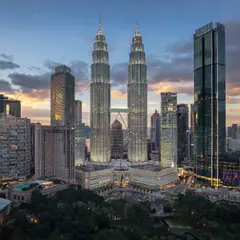
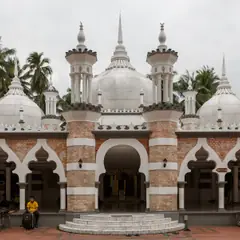
About 200 metres away, on the spit of land where the Gombak and the Klang meet, Masjid Jamek marks the confluence that gave the city its name; to the south, Central Market keeps its art deco hall of 1937, and about 2 km away rise the Petronas Twin Towers.
A 1989 flagpole for the midnight of 1957
95-metre flagpole and black marble plaque
Summary of this stop
At the southern end of the square rises the 95-metre flagpole, self-supporting, with the Jalur Gemilang at the top. It looks like the independence monument, but it did not witness it: it was raised as part of the square project, completed in nine months for the Commonwealth Heads of Government Meeting (CHOGM) of October 1989, the work of the developer Michael Low and his cousin, the architect Sandy Yap, who devised a system so the flag does not wind around the pole. Some tourist sources present it as the tallest in the world since 1957, something that does not fit its construction date; others describe it as the tallest in Asia or in the world only once completed.
The true place of history is on the ground, beside the flagpole: a round black marble plaque, flat and discreet, marking the spot where the flag of Malaya was first raised. The flag of Malaysia, with 14 stripes since 1963, later returned to this same square: here it received its official name, Jalur Gemilang, “Stripes of Glory”, in a ceremony presided over by Mahathir Mohamad on 31 August 1997.
That the last lowering of the Union Jack took place precisely here is held by most sources, although one account places it at Stadium Merdeka. Beside the marble disc, the audio guide tells which witnesses support each version and how many flagpoles there really were that night.
The clock tower and the anthem out of time
Sultan Abdul Samad Building
Summary of this stop
Across the lawn, to the east, stands the Sultan Abdul Samad Building, in Indo-Saracenic style, designed by A. C. Norman, R. A. J. Bidwell and A. B. Hubback and crowned by a 40-metre clock tower. In 1897 the offices of the British government of Selangor were moved there from Bukit Aman: that colonial secretariat looked straight onto the cricket ground.
Its clock marked the midnight of 1957. According to one account, it struck twelve, “God Save the Queen” played and the record of the Negaraku, the new anthem, started before the new flag went up and had to be stopped; the flag of Malaya would have replaced the Union Jack seven minutes after midnight, although another witness insists the British one came down at twelve sharp.
At that lowering, 100 young men stood in line holding the ceremonial rope. One of them, the teacher Mohd Yusuf A Latib, had come from Sabak Bernam by boat, bus and train. Facing the tower, the audio guide reconstructs that night minute by minute and the stumble with the anthem record.
Cricket, Dalmatians and a bar without women
Royal Selangor Club
Summary of this stop
West of the lawn, the half-timbered Tudor façade of the Royal Selangor Club recalls whose field this was. The club was founded in 1884, and its building was completed in January 1910; the north wing was added after the fire of 1970. It was nicknamed “The Spotted Dog”, and the most cited explanation is the two Dalmatians of its president, Harry Syers, often tied at the entrance, although others circulate: the dogs of the founder’s wife, an allusion to the mixed clientele of a pub, or a leopard so badly drawn on the emblem that it looked like a dog.
Behind those windows was the Long Bar, reputed to be the longest bar in Kuala Lumpur. From the club’s founding it was closed to women: the members came back sweaty from rugby on the Padang, and the women watched the matches from the veranda. The only fixed exception was New Year’s Day, until five in the afternoon, with the house cocktail, the Black Velvet: champagne with Guinness. In October 2023, an extraordinary meeting of about 200 members voted to end the rule after 139 years.
From the same club, its memoirs say, came customs that were even stranger. Facing the Tudor façade, the audio guide tells where this grass comes from and what life was like for the British who played on it.
The lawn saved in wooden crates
Lawn of the old Padang
Summary of this stop
In the centre of the expanse one walks on the lawn of the old Padang, today Bermuda grass: a national square of grass and not of stone. The Selangor Club occupied it under a temporary licence and used it almost daily for cricket, rugby, hockey and football, until in 1987 the Kuala Lumpur City Hall reclaimed it; in exchange, the club received land at Bukit Kiara, 5.5 kilometres away, and the field became a historic park with elements inspired by Trafalgar Square.
In the 1980s, faced with the plan to cover the field in concrete, Hamin Derus, “Alang”, and Victor Chin turned up one Sunday with two witnesses, the press and two wooden crates, and carried off turf from the Padang when the workers had already lifted half of it. The press christened them the “Padang romantics”.
Beneath that grass lies another square: the underground car park, still in use, and the basement of the former Plaza Putra, with two cinemas, a theatre and restaurants. In June 2003 a three-hour downpour flooded it in under 30 minutes, and traders and customers had about ten minutes to get out. In the middle of the lawn, the audio guide goes down into that basement and into the legend told by those who worked in its theatre.
Parades, barriers and a midnight that returns
Southern Victorian fountain
Summary of this stop
Near the flagpole, at the corner of the old Padang, a two-tier Victorian fountain with gargoyles adds the last colonial accent. Some sources identify it as the Cop’s Fountain and others as the Queen Victoria Fountain, both dated 1897. Since 1957 the square has been the usual site of the Independence Day parade, every 31 August in front of the Sultan Abdul Samad Building, and since 3 February 2025 the city council also holds a monthly raising of the Jalur Gemilang with a band and a mounted unit.
The same expanse has also been disputed ground. On 28 April 2012, tens of thousands of Bersih 3.0 demonstrators, dressed in yellow, marched toward the square, fenced off by order of a magistrate; around 3:00 pm a small group broke the barrier and the police responded with tear gas and water cannon until 7:00 pm. In 2014 the Court of Appeal overturned that order for exceeding the magistrate’s authority.
Every night of 30 August, thousands of people wait here for midnight: when the clock strikes twelve, a city council team raises the giant Jalur Gemilang and everyone sings the Negaraku together. Beside the fountain, the audio guide closes the tour with that ritual and with the official who, for twenty years, scarcely took his eyes off his flag.