Kuala Lumpur’s Chinatown
Petaling Street Audio Guide (Jalan Petaling)
A street opened as a road to the tin mines, named in Cantonese after a starch factory that barely lasted a year and covered today by a green roof of stalls, with pioneers’ temples and a cinema that burned three times in the shadow of Merdeka 118.
- 60 min of audio
- Chinatown and street market
Jalan Petaling is one of Kuala Lumpur’s first streets: it led to the Petaling tin mines and owes its name to a tree whose wood resisted termites. Yap Ah Loy, the city’s third Kapitan Cina, included it among the great roads he proposed to the British resident Frank Swettenham, and after the fire and flood of 1881 Kuala Lumpur was rebuilt in brick and tile, with shophouses with a “five-foot way” in the southern Chinese manner.
Its Chinese name, Chee Cheong Kai, “starch factory street”, recalls a tapioca mill that opened around 1880 and closed almost at once. Since 2003 a green roof nicknamed the “Green Dragon” has covered the pedestrian roadway, and beneath the bustle of stalls and haggling appear the founders’ temple, a restored alley and a clan headquarters that looks like a temple, with Merdeka 118 in the background.
Highlights
- Sin Sze Si Ya Temple — The pioneers’ shrine, rebuilt in 1881-1883 and a National Heritage site since 2020
- Green Dragon roof — The 2003 green roof over the pedestrian street, with a great Chinese arch at each end
- Kwai Chai Hong — An alley restored in 2019 with a red bridge, six murals and a century-old street lamp
- REXKL — The former Rex cinema of 1947, which burned three times and is now a cultural centre
- Chan She Shu Yuen — A clan ancestral hall completed in 1906, with Merdeka 118 behind it
Beneath a long green roof, among knock-off handbags, roast duck and haggling, runs one of Kuala Lumpur’s oldest streets. It is Petaling Street, officially Jalan Petaling, the market street of Chinatown. It began as a road to the Petaling tin mines and takes its name from Kampung Petaling, a village itself named after the petaling tree, whose termite-resistant wood served for house posts and which is now believed extinct in the area.
The history of Petaling Street is that of the tin city. Yap Ah Loy, Kuala Lumpur’s third Kapitan Cina, proposed to Frank Swettenham spending 20,000 dollars on the three great roads that linked the city with the mines: Jalan Ampang, Jalan Pudu and Jalan Petaling. In 1881 a fire and then a flood razed the wood-and-atap buildings; Swettenham then imposed brick and tile, and Yap bought the Brickfields land to make the bricks with which to rebuild the city. Popular memory places here the founding heart of Chinatown, although the first core was centred on Market Square and High Street, higher and less prone to flooding.
The architecture of Petaling Street stems from that reconstruction: brick shophouses with continuous arcades, the “five-foot way” of southern China, some still with signs of vanished businesses. In 2003 an 11-million-ringgit facelift added two great Chinese arches, a green roof over the whole roadway, nicknamed the “Green Dragon”, and full pedestrianisation.
For what to see at Petaling Street, the audio guide covers it from north to south in six stops and 60 minutes: a goldsmiths’ junction, the pioneers’ temple, the market, a restored alley, a cinema that burned three times and a clan hall in the shadow of Merdeka 118. Beneath the bustle the whole city is still written, layer by layer: its founders and its ghosts, its fires and its vices.
About 300 metres away, Central Market was the great provisions market of the tin city; a little further north, Masjid Jamek marks the muddy confluence where Kuala Lumpur was born, and every Thaipusam a procession with a silver chariot sets out from the city to Batu Caves.
Five street lamps on the goldsmiths’ wedge
Five-lamp junction
Summary of this stop
At the northern end, Jalan Petaling meets High Street, today Jalan Tun H.S. Lee, and Pudu Street, today Lebuh Pudu, at a wedge-shaped junction. It was known as the Triangle, and the Chinese called it Ng Jee Dang, “five street lamps”, after the lights installed to give brightness and security to an area of goldsmiths and pawnshops.
The junction is a good starting point for reading the tin city. The road to the Petaling mines passed by here, one of the roads Yap Ah Loy asked the British for alongside those of Ampang and Pudu, and it keeps the name of a tree that no longer grows in the area.
Beside the junction, the audio guide explains why gold traders and moneylenders chose precisely this wedge and what role those five street lamps played in the neighbourhood.
The beheaded chief who advised Yap Ah Loy
Sin Sze Si Ya Temple
Summary of this stop
A few steps away, hidden behind the shophouses of Lebuh Pudu, appears Sin Sze Si Ya Temple, the spiritual heart of the pioneers. In 1864 Yap Ah Loy brought from Rasah the spirit tablet of his former chief, the Kapitan Seng Meng Lee, executed in 1860. The temple was built in 1875 on a plot behind Yap’s house, rebuilt between 1881 and 1883 after the fire and flood, and in 2020 was declared a National Heritage site.
The figures on the altar are not characters from a distant myth. According to tradition, Seng Meng Lee lost a battle in the Sungai Ujong tin-tax war and was beheaded beside a stream; it is said that white blood flowed from his neck and that this sign turned him into a god. Beside him is venerated Chung Piang Lai, Yap’s general known as “the Ever-Victorious General”.
The most unsettling part comes next: the man who built Kuala Lumpur claimed that the dead man remained at his side. Before the main altar, the audio guide tells how, according to tradition, the spirit of the beheaded chief guided the founder, and the curious rite with which families begin the Chinese New Year here.
A starch factory that lasted a year
Green Dragon roof
Summary of this stop
Beneath the Green Dragon roof, the light turns greenish and the market squeezes between stalls, shops and arcades. The street’s Cantonese name, Chee Cheong Kai, means “starch factory street”: after the Selangor civil war, with the mines flooded, Yap Ah Loy set up a large tapioca mill here, with the participation of Sultan Abdul Samad. It opened around 1880 and, by the most cited version, closed the following year; sources do not entirely agree on the dates, but the name has outlived the factory by more than a century.
The market of imitations is not just a façade either. On 30 October 2025, inspectors from the Ministry of Domestic Trade searched four warehouses on the street and seized about 5,000 counterfeits valued at 700,000 ringgit; one of the premises, on a second floor, was divided into seven closed little rooms.
Amid the noise of the market one also hears a voice that has outlived its owner. In the middle of the street, the audio guide reveals who that call belongs to and why one stall still sells with it.
The street lamp that survived the alley of the little devils
Kwai Chai Hong
Summary of this stop
Between Jalan Petaling and Lorong Panggung opens Kwai Chai Hong, the “alley of the little devils”, inaugurated in April 2019 after restoring 10 shophouses. A red bridge of wood recovered from the works crosses it, and on its walls are six murals by five artists about life in the 1960s. Nobody has documented the origin of the name: some versions speak of naughty children, others of gamblers, opium smokers and drunks, and another of a gang whose boss called his men “little ghosts”.
The alley’s most modest object is perhaps the most valuable: a century-old street lamp, the only one believed to survive from the first that arrived with electricity in the early 20th century.
The restoration also opens the door to a less kind past. On the bridge, the audio guide takes up the street’s most persistent and quietest trade, one that, according to documented tradition, began with the city’s own founder and that no raid has managed to erase.
The film that was cut on 13 May
REXKL
Summary of this stop
On Jalan Sultan stands, detached, the former Rex cinema, opened in 1947 with a Streamline Moderne design by James Robert Vethavanam. It burned in 1972, was rebuilt in 1976 with more than a thousand seats, burned again in 2002 and once more in 2007, when it was operating as a hostel. Since 2019 it has been the REXKL cultural centre, which keeps its ash-grey walls and its mosaic staircase.
On the afternoon of 13 May 1969, Johan Fernandez was watching “Rachel, Rachel” here when the screening was cut off with the word “Darurat”, emergency, and an armed mob blocked the exit. In the riots of those days, the nearby Chin Woo stadium took in some 1,500 refugees.
Facing the façade, the audio guide reconstructs what happened that afternoon at the cinema’s exit and how walls that survived three fires still hold the memory of that day.
The coffin street beneath Merdeka 118
Chan She Shu Yuen Clan Ancestral Hall
Summary of this stop
At the southern end, the tip the Chinese knew as “Coffin Street” for its coffin shops, a temple façade with grey tiles appears. It is not a temple, but the Chan She Shu Yuen ancestral hall, headquarters of the association of the Chan, Tan and Chin surnames, founded in 1896. It copies the mother hall in Canton and was completed in 1906, after several delays.
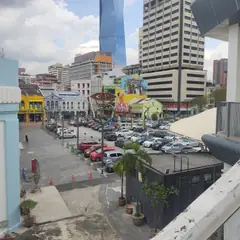
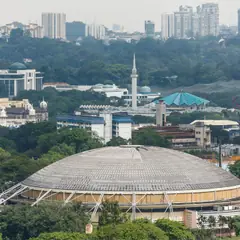
Looking south, behind the Kuan Yin temple and the hill of the Chin Woo stadium, Merdeka 118, 678.9 metres tall, peeks out. Its story is tied to the street’s: the Chin Woo athletic association, in financial trouble, had to sell a 4.5-acre plot in the 1970s, and on it Permodalan Nasional Berhad built the Warisan Merdeka project.
The tour ends on this contrast: the city of the pioneers facing that of the 21st century. Before the clan hall, the audio guide closes with what the ground on which the tower now grows cost the community.