Emblem of Kuala Lumpur
Petronas Twin Towers Audio Guide (Menara Berkembar Petronas)
Twin towers with an Islamic star plan, raced up by a Japanese team and a Korean team on a former colonial racecourse, which in 1998 took the title of world’s tallest building out of the United States for the first time.
- 90 min of audio
- Record-breaking skyscrapers
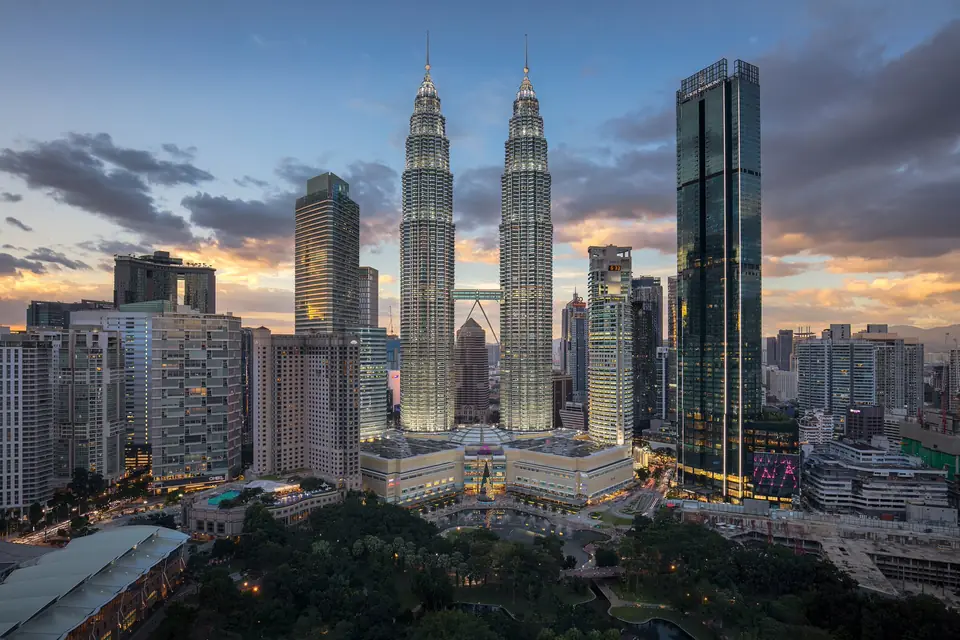
The Petronas Towers, or Menara Berkembar Petronas, have stood since 1999 on the plot that for almost a century was occupied by the Selangor Turf Club racecourse. César Pelli drew each shaft from the Rub el Hizb, the eight-pointed Islamic star, to convince Mahathir Mohamad that the building spoke of Malaysia. At 451.9 metres to the tip of their pinnacles, they were the tallest building in the world from 1998 until Taipei 101 arrived.
They look identical, but they were rivals: Tower 1 was built by a Japanese consortium and Tower 2 by a South Korean one, in a race whose prize was the bridge that now joins them. That two-storey Skybridge, at 170 metres, is not fixed to either tower: it slides as they sway. And the record that crowned them is still debated, because the spires decided it.
Highlights
- Star-shaped shaft — The Rub el Hizb plan, with alternating points and lobes, stretched up 88 floors of stainless steel and glass
- Skybridge — A two-storey bridge at 170 metres, 58.4 m long and 750 tonnes, that slides without being fixed to either tower
- Floor 86 observation deck — About 370 metres up in Tower 2, facing the neighbouring tower’s pinnacle
- Pinnacles — Spires of about 46 metres that decided the 1998 height record against the Sears Tower
- KLCC Park and Lake Symphony — A Roberto Burle Marx garden on the former racecourse, with transplanted trees and a water-and-light show
From the bridge over the KLCC Park lake, the two steel spires fill the frame. They are the Petronas Towers, in Malay Menara Berkembar Petronas, although in Malaysia many simply call them Menara KLCC, after the Kuala Lumpur City Centre they belong to: the name of the whole district ended up attached to its two buildings. On 15 April 1998, at 451.9 metres to the tip of their pinnacles, the Council on Tall Buildings declared them the tallest building in the world, the first outside the United States to hold that title.
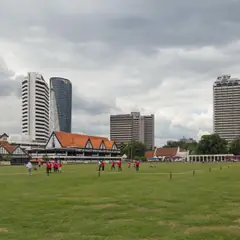
The history of the Petronas Towers begins on a racetrack. From 1896 and for almost a century, this plot on Ampang Road was the racecourse of the Selangor Turf Club; in 1988 it was sold for the KLCC project and the club moved to Serdang. Soundings later showed that the planned site lay on the edge of a rock step, and the towers were shifted 61 metres. Each rests on 104 piles between 60 and 114 metres deep, according to the most precise figure, and on a slab 4.6 metres thick poured without interruption over 54 hours.
The architecture of the Petronas Towers is the work of the Argentine-American César Pelli, who had to convince Prime Minister Mahathir Mohamad that the design answered to Malaysia. His reply was an eight-pointed Islamic star turned into a skyscraper and a skin of 33,000 stainless-steel panels and 55,000 glass ones that he compared to “multifaceted diamonds shining in the sun”. Mahathir inaugurated them on 31 August 1999, on the 42nd Independence Day.
For what to see at the Petronas Towers, the audio guide covers them in four stops and 90 minutes: from the lake to the foot of the shafts and, with a ticket, to the Skybridge on floor 41 and the observation deck on floor 86. The thread that links them: a young country’s bet on showing itself to the world, raced up by two rivals and crowned with a disputed record.
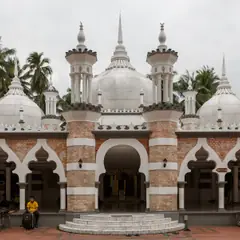
The independent Malaysia these towers celebrate was born about 2 km away, in Merdeka Square, and the same idea of translating Islamic art into a modern language guides the folded roof of the National Mosque of Malaysia.
A colonial racecourse beneath the lake
Lake Symphony
Summary of this stop
The classic postcard is framed from the raised bridge over Lake Symphony, a 10,000 m² artificial lake with fountains and a night show of water, light and music. Around it spreads KLCC Park, the work of the Brazilian landscape architect Roberto Burle Marx: 1,900 native trees and 66 species of palm were planted there to attract birds, and 23 mature trees were transplanted from the old racecourse. Some of the trees that now shade the paths once watched horses run.
The towers reflected in the water were inaugurated on the same day Petronas turned 25 and Malaysia celebrated its Independence. The one on the left, seen from the park, is Tower 1, occupied entirely by Petronas and its subsidiaries; the one on the right, Tower 2, rents its offices to other companies. At the base, the Suria KLCC shopping centre houses the Dewan Filharmonik Petronas concert hall, and within the park stands the As Syakirin mosque, with room for 12,000 worshippers.
This lake is also the stage for a living tradition: New Year’s Eve at the foot of the towers, with fireworks against the two spires and a light show on their façades. Beside the water, the audio guide tells what coincidence links that midnight with a Hollywood film shot in these very towers.
Eight-pointed star, Japan-Korea race
Star-shaped tower shaft
Summary of this stop
At the foot of the towers, head tipped back, the profile of each shaft reveals its origin. It starts from the Rub el Hizb, the eight-pointed Islamic star formed by two overlapping squares turned 45 degrees; Pelli added circular sectors in the inner angles to gain office space, and the result is the scalloped shaft of alternating points and lobes that rises in stepped setbacks. The steel sunshades filter the intense equatorial light and make the façade change in brightness with the hour.
The twin towers were, in fact, two opposed building sites. To meet the six-year deadline set by the Government, Tower 1 was awarded to a Japanese consortium led by Hazama and Tower 2 to a South Korean one led by Samsung C&T with Kukdong. The first to finish would win the contract for the bridge, and the Koreans won it despite having started a month later.
The race had its scares. A batch of concrete that failed the strength test halted the work, at a cost of 700,000 dollars a day, and forced three concrete plants to be set up on the site itself. At the foot of Tower 2, the audio guide reveals what the engineers discovered on reaching floor 72 and how they corrected it without stopping the race.
A bridge that does not touch the towers
Skybridge
Summary of this stop
At 170 metres above the ground, on floors 41 and 42, the two-storey Skybridge crosses the void between the towers: 58.4 metres long and 750 tonnes that are not fixed to either of them. The bridge slides in and out as the towers sway and rests on a two-legged arch of 51 metres bolted to floor 29. It was assembled on the ground and hoisted in three days in July 1995.
Since 2010 the visit has required a ticket, with a quota of about a thousand people a day. The public only steps onto floor 41, because floor 42 is reserved for tenants. The bridge was also conceived as an escape route from one tower to the other, but on 12 September 2001, the day after the fall of the Twin Towers in New York, a bomb threat forced thousands of people to be evacuated and showed that it was no use if both had to be emptied at once; since then the plan calls for using the lifts, successfully rehearsed in 2005.
In 1995, with the towers still under construction, Pelli explained his design by quoting Lao Tzu and spoke of “a portal to the sky, a gateway to infinity”. On the bridge, the audio guide reveals which part of the towers their architect considered the true building, and it was not the one that measures 452 metres.
A record won by the spires
Floor 86 observation deck
Summary of this stop
On floor 86 of Tower 2, at about 370 metres, the observation deck faces the pinnacle of the neighbouring tower. Those steel spires of about 46 metres were what decided the 1998 record: the council’s rule counted pinnacles as architecture and excluded antennas. Chicago’s Sears Tower reached 527 metres with antennas and its highest occupiable floors stood 46 metres above those of the Petronas Towers, and the decision was very badly received there; a schoolboy even wrote to the council asking it to give the title back. They lost it to Taipei 101 in 2003 or 2004, depending on which milestone is taken as the reference.
The summit also has its own chronicle of daring. The French climber Alain Robert was arrested on floor 60 in 1997 and again in 2007, on the other tower, with a Malaysian flag in his hand; on 1 September 2009 he topped Tower 2 bare-handed in under two hours and was fined 2,000 ringgit for trespassing. Months before the inauguration, in 1999, the Austrian skydiver Felix Baumgartner jumped from a window-cleaning crane on the towers.
In 1998 the towers were also the set of Entrapment, with Sean Connery and Catherine Zeta-Jones, and the Malaysian Government lent Twentieth Century Fox even a SWAT police team. The result enraged Mahathir, who feared that the world would see in them “grandiose and useless monuments”. Facing the neighbouring pinnacle, the audio guide closes the tour with the film trick that provoked that anger.