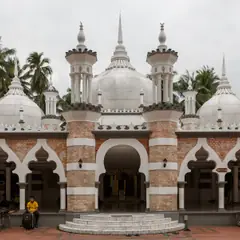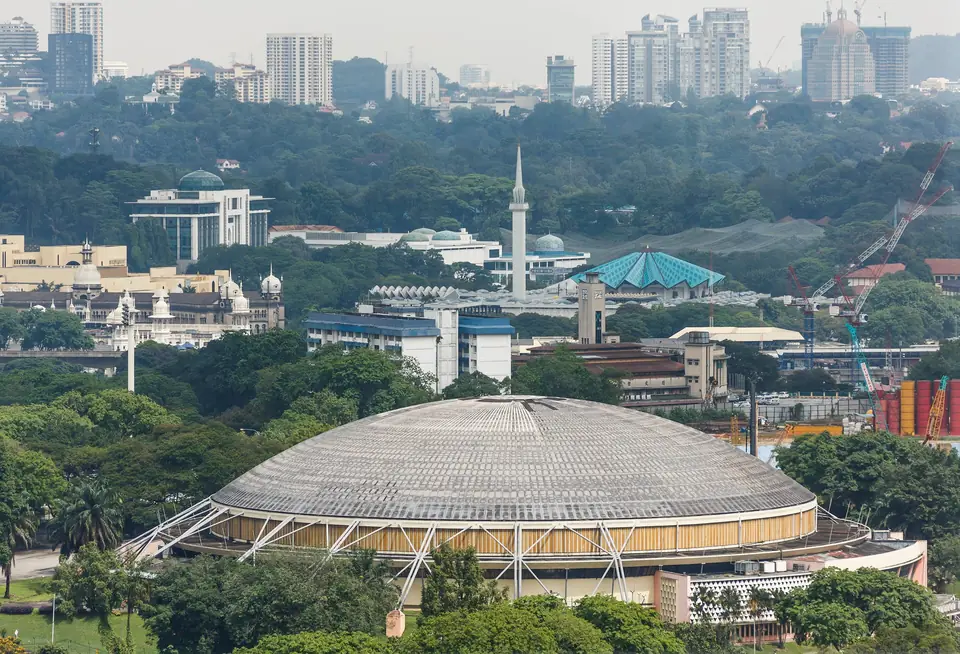
National mosque of 1965
National Mosque of Malaysia Audio Guide (Masjid Negara)
Newly independent Malaysia wanted a mosque without a dome: a real umbrella of folded concrete, a 73-metre minaret closed like another umbrella and a building paid for with donations from every religion, in thanksgiving for a bloodless independence.
- 40 min of audio
- Modern Malay architecture
Masjid Negara grew out of a proposal of July 1957, a month before independence, and opened on 27 August 1965 before almost 10,000 people. It was designed in the Public Works Department by the young Baharuddin Abu Kassim, with Ikmal Hisham Albakri and the Briton Howard Ashley: a roof of folded plates in a 16-point star, a minaret conceived as an alif and a prayer hall raised like a kampung house on stilts. It was the country’s largest mosque until 1988.
Where 15,000 worshippers now fit there once stood an evangelical chapel of 1922, a Masonic lodge and a military club. The blue and green roof was pink until 1987, and the esplanade that hosts state funerals also served, in 1998, as the starting point for the largest opposition rally in three decades.
Highlights
- 16-point umbrella roof — Folded concrete plates that evoke the umbrella of Malay royalty, pink until 1987 and today blue and green
- 73-metre minaret — A closed umbrella in the middle of a pool, conceived as an alif and announced in 1963 as the tallest structure in Kuala Lumpur
- Gallery of 48 umbrellas — A courtyard of small concrete umbrellas among pools, fountains and terrazzo and aluminium screens
- Prayer hall and mihrab — A replica of the circle of verses of Istanbul’s Blue Mosque and a 4.3 m mihrab of Moroccan zellij
- Makam Pahlawan — The star-shaped mausoleum where Malaysian prime ministers rest, the latest buried in 2025
Beside Kuala Lumpur’s old railway station, amid 13 acres of gardens, a mosque refuses to have a dome. It is Masjid Negara, the National Mosque of Malaysia, and its silhouette is recognisable from afar: a great roof folded like an open umbrella and, beside it, a minaret topped like a closed umbrella. On 30 July 1957, a month before independence, the Federal Executive Council proposed building a national mosque as a symbol of the new nation.
The history of Masjid Negara begins with a rejected name. On 5 March 1958 the chief ministers of the eleven states wanted to dedicate it to the prime minister, Tunku Abdul Rahman; he declined the honour and called it the “national mosque” in thanksgiving for an independence won without bloodshed. The work was paid for with federal and state money and with the country’s first national collection, open to all races and religions: among the first donors were the Brunei government, with 25,000 dollars, and the Shaw Foundation, with 26,000, and public donations totalled 3 million. The site, a hollow that had to be filled and piled, raised the final cost to about 10 million Malayan dollars, when the planned maximum was 6.
The architecture of Masjid Negara is the work of a young architect of the Public Works Department, Baharuddin Abu Kassim, who rejected the bulbous domes and Mughal style of the colonial era. The third Yang di-Pertuan Agong, Tuanku Syed Putra of Perlis, inaugurated it on 27 August 1965, and the complex was declared a heritage property on 6 July 2007. It is still in daily use: in 2024 it received 299,076 visitors, making it the second most visited mosque in Malaysia.
For what to see at Masjid Negara, the audio guide covers it in four stops and 40 minutes, from the minaret to the prime ministers’ mausoleum. The thread that links them: a mosque without a dome that is at once a house of prayer, a political square and the pantheon of a young nation.
Its counterpoint is Masjid Jamek, the Mughal mosque of 1909 at the confluence of the rivers; the same search for a modern Islamic architecture reappears in the star plan of the Petronas Twin Towers, and on the outskirts Batu Caves gathers the Tamil Hindu community around Murugan.
An umbrella minaret and a rejected name
Umbrella minaret and fountain pool
Summary of this stop
Facing the fountain pool rises the minaret, a tower of about 73 metres topped like a folded umbrella. At the foundation-stone ceremony, on 27 February 1963, the deputy prime minister Tun Abdul Razak announced it as the tallest structure in Kuala Lumpur and presented it as an alif, the first letter of the name of Allah. Sources do not entirely agree on the height: most give 240 feet, and some raise the figure to 75 metres.
The ground around it holds another story. Before the mosque, the site was occupied by two official residences, the headquarters of the Railway Services Commission, a Masonic lodge, the NAAFI Galloway club and the Venning Road Brethren Gospel Hall, an evangelical chapel opened there in 1922. The government acquired them around 1961-1962 and the congregation received in exchange a plot on Jalan Imbi, where it inaugurated a new chapel on 28 July 1962.
The mosque raised in thanksgiving for a bloodless independence was also the setting for an episode nobody had foreseen: on the afternoon of 20 September 1998, a politician dismissed eighteen days earlier spoke here before a crowd that ended up marching to Merdeka Square. Facing the minaret, the audio guide tells who he was, what happened with some ice cubes and how that night ended.
Forty-eight umbrellas against a dome
Gallery of 48 concrete umbrellas
Summary of this stop
Before the prayer hall opens a great gallery with 48 small concrete umbrellas, flanked by pools and fountains, with small domes of blue mosaic above the veranda and terrazzo and aluminium screens with arabesque motifs. It all answers to a single idea: that of the umbrella that escorts Malay royalty, repeated in the great roof of folded plates in a 16-point star, able to cover the wide span of the hall and to shed tropical rain outward.
That idea had to survive a prime minister. The project went through an international competition that was discarded, then a national one, and ended up in the hands of the Public Works Department, where Baharuddin Abu Kassim, born in 1929 in the coastal village of Jeram, in Selangor, led the design. When he presented the model, Tunku Abdul Rahman asked where the dome was and said he did not like it that way. Even so, the mosque without a dome was the one that was built. Not even the number of folds is a closed matter: many sources read in the 16 points the 11 states of 1965 and the 5 pillars of Islam, whereas the architect himself, in a 2015 interview, spoke of 18 folded plates and explained the form without that symbolism.
The gallery is also where a small ritual begins: whoever does not come to pray enters by the visitors’ door, where robes and scarves are lent free of charge. Among the 48 umbrellas, the audio guide tells the 2024 anecdote in which that borrowed robe ended with the national mosque apologising in public.
The pink hall and the roof that was pink
Prayer hall and zellij mihrab
Summary of this stop
The prayer hall is on the first floor, raised above the street like a kampung house on stilts, an express idea of the architect. From its gallery one sees the great calligraphic circle that hangs beneath the centre of the roof: an aluminium-panel replica of the Quranic verses that ring the great dome of Istanbul’s Blue Mosque, among the 16 terrazzo-clad pillars that hold up the roof. At the far end, the mihrab, a 4.3-metre arch with thuluth calligraphy, muqarnas at the top and dark blue zellij mosaic made by ceramists from Morocco.
So much colour arrived late. For a quarter of a century the mosque was a sober structure, and its umbrella roof shone with a glass mosaic of a pink tone until the great renovation of 1987, which covered it with today’s blue and green tesserae; the small domes of the galleries also went from pink to blue. The mihrab, moreover, was not always an arch: it used to be rectangular.
The change was requested by the prime minister Mahathir Mohamad, and the commission went back to the same Baharuddin. At the threshold of the hall, the audio guide reveals what the architect did when he found that nobody in Malaysia could make the mosaics for him.
The prime ministers’ pantheon
Makam Pahlawan
Summary of this stop
The tour ends before the Makam Pahlawan, the Heroes’ Mausoleum, built beside the mosque between 1963 and 1965: a white star-shaped roof whose points almost touch the ground, surrounded by a pool, with the Malaysian coat of arms in the centre of the floor and golden roses in the centre of the dome. Prime ministers such as Abdul Razak Hussein (1976), Hussein Onn (1990) and Abdullah Ahmad Badawi, buried in April 2025 after prayers at Masjid Negara, which remains the setting for state funerals, rest there.
One absence stands out: Tunku Abdul Rahman, the man who named the mosque, is not here but in Alor Setar, by his own wish.
These pools also hold an episode that links two presidents of the United States: Lyndon B. Johnson, who in 1966 made the first visit to Malaysia by a sitting American president, and Barack Obama, whom in 2014 a man who had already been present the first time received here. Facing the mausoleum, the audio guide closes the tour with the story of that witness and of what Obama asked him.