Historic mosque
Masjid Jamek Audio Guide (Masjid Jamek Sultan Abdul Samad)
A red-and-white striped mosque planted on the spit of land where the Gombak meets the Klang: the muddy confluence that gave Kuala Lumpur its name, on what was the city’s first Muslim cemetery.
- 30 min of audio
- Colonial Mughal architecture
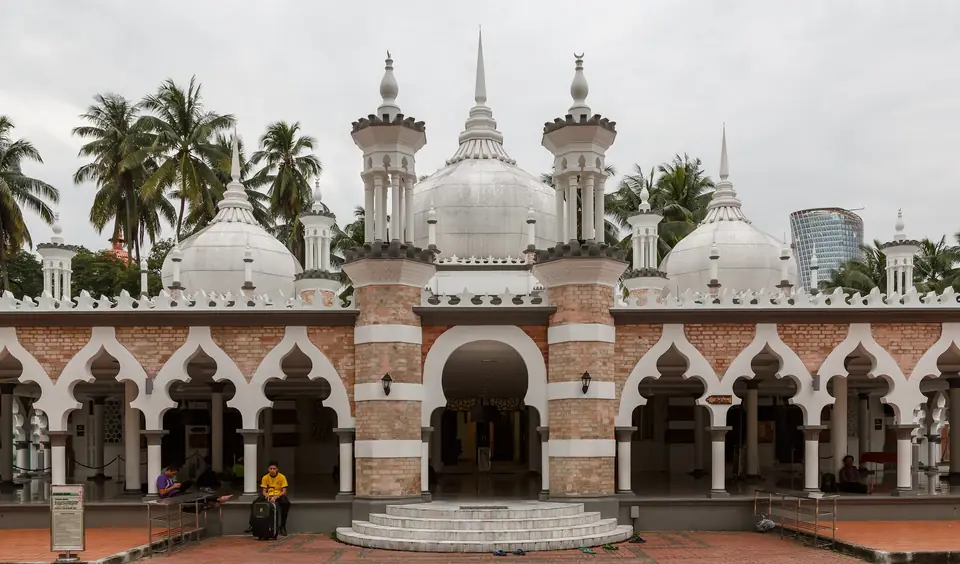
Masjid Jamek was inaugurated on 23 December 1909 with gun salutes and beneath a canopy of yellow silk, the work of the British architect Arthur Benison Hubback. It replaced the Java Street mosque, demolished to widen the road, and was Kuala Lumpur’s main mosque, the one for the Friday prayers of colonial officials, until the Masjid Negara opened. Its minarets of pink brick and white plaster and its three onion-shaped domes are the portrait of the Mughal style Hubback brought to the city.
Beneath its grounds there are more layers than meet the eye: the graves that were moved to build it, a riverside stairway that concrete buried and that reappeared in 2014, and more than 45 gravestones unearthed when building the neighbouring fountain. In 2017 it changed its name, and its courtyard, designed for the officials of the empire, is today a refuge and dining room for the homeless of the centre.
Highlights
- Confluence point — The place where the Gombak enters the Klang and which gives the city its name, today lit in blue with a fountain and a mist walkway
- Riverside stairway — Hubback’s steps for sampans and ablutions, buried by a concrete wall and recovered in 2014, 80% intact
- Blood-and-bandage minarets — Two towers of about 26.8 m with stripes of pink brick and white plaster and cast-iron stairs brought from England
- Three white domes — Onion-shaped wooden domes, the central one 21.3 m; one collapsed in the rain in 1993 and was rebuilt
- 1908 foundation stone — White Ipoh marble with a Jawi inscription; the nine coins buried beneath it never turned up
Where the Gombak River mixes with the Klang, on a triangle of land ringed by brown water, rise two red-and-white striped towers and three onion-shaped domes. It is Masjid Jamek, since 2017 Masjid Jamek Sultan Abdul Samad, and it occupies exactly the place that gave the city its name: Kuala Lumpur means “muddy confluence” in Malay. To this spot, the highest point on the Klang that boats with supplies could reach, Chinese tin miners made their way in 1857 on the road to Ampang.
The history of Masjid Jamek begins over a cemetery. That triangle was the city’s first Muslim cemetery, labelled “Malay Cemetery” on the map of 1889, and its graves were moved to Jalan Ampang so that building could begin. On 23 March 1908 the Sultan of Selangor Alaeddin Sulaiman Shah laid the foundation stone, and on 23 December 1909 he inaugurated the mosque beneath a canopy of yellow silk, with salutes from Police Hill and a guard of 50 policemen. It was built by the contractor Towkay Ang Seng with funds from the Federated Malay States government, the sultan and a collection among the Malay members of the State Council; the exact cost varies by source, around the 33,000 dollars the sultan had announced.
The architecture of Masjid Jamek bears the signature of Arthur Benison Hubback, a Briton who was not at the inauguration because he was on leave in England. It is usually presented as the oldest mosque in Kuala Lumpur, although it was not the first: there were at least two others before it, and what can be said is that it is the oldest still standing. It was the city’s main mosque until the opening of the Masjid Negara, in 1965 according to some sources and in 1967 according to others.
For what to see at Masjid Jamek, the audio guide covers it in four stops and 30 minutes, from the river walk to the entrance of the prayer hall. The thread that links them: a mosque that rises, literally, over the origin of the city, over a cemetery and over layers of water, concrete and names.
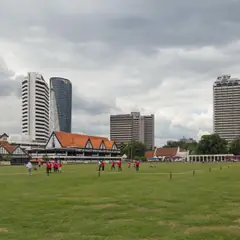
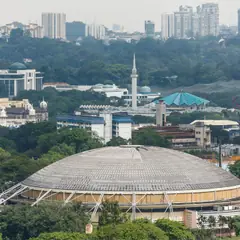
About 200 metres away, Merdeka Square is the former cricket ground where the Union Jack came down in 1957; to the south, Petaling Street extends the tin mining city, and the National Mosque of Malaysia answered this Mughal mosque in 1965 with a roof without a dome.
The muddy confluence that named the city
Confluence of the Gombak and the Klang
Summary of this stop
From the Lebuh Pasar Besar bridge or from the River of Life viewpoint one sees the confluence point, the apex of the triangle where the Gombak enters the Klang. That slow water is the origin of everything: navigation ended here and the mines’ supplies were landed here. Yet by the Malay rule of naming the kuala after the river that flows in, the site should be called Kuala Gombak, and the origin of the name that finally prevailed is still disputed.
In August 2017 the confluence was dressed in blue with the Kolam Biru (Blue Pool), the first phase of the River of Life: a musical fountain, blue lighting and a riverside walkway, the Blue Corridor, with 1,551 mist nozzles. At the same time the Jambatan Sultan Abdul Samad footbridge to Dataran Merdeka was opened.
The river, mind you, reminds everyone from time to time who is in charge. On 10 June 2007, after two hours of torrential rain, the mosque floor was almost a metre under water, the flood swept cars into the grounds and brought down a side wall; it was not the first time. Facing the point, the audio guide tells which hypotheses compete to explain that “lumpur” and how many times the river has entered the mosque.
A stairway buried over forgotten graves
Hubback’s riverside stairway
Summary of this stop
Some steps go down from the grounds toward the water. Hubback drew this riverside stairway as a landing for sampans and a place for ablutions, but the concrete wall raised during the light rail construction buried almost all of it. The River of Life works brought it to light in 2014, 80% intact.
Beneath those steps lies the earth of Kuala Lumpur’s first Muslim cemetery. Between December 2015 and March 2016, workers building the fountain beside the mosque unearthed more than 45 gravestones of granite, marble and sandstone, some with Jawi inscriptions and one with an Aceh-style lotus-flower finial.
Their age is not settled: some placed them in the 18th century and others linked them to the Malay settlers who founded the city around 1857, and their discovery set conservationists against the authorities over the works schedule. Before the stairway, the audio guide reveals what was asked to be done with the subsoil and what the city council decided.
Blood and bandage: towers with scars
Masjid Jamek Sultan Abdul Samad
Summary of this stop
Between the two main minarets, 88 feet (about 26.8 metres) tall, the pattern leaps to the eye: alternating bands of exposed pink brick and white plaster that people nickname blood and bandage. Inside, cast-iron spiral stairs made in England by the St. Pancras Ironworks climb, and at the top they are crowned by kiosks or chatris. Above the prayer hall rise three domes of wood covered in bituminous cloth painted white; the central one reaches 70 feet (21.3 metres).
The stripes live alongside real wounds. In 1941 a Japanese bombing struck the mosque, caused considerable damage and killed three worshippers, although the day usually cited does not fit the chronology of the war in Malaya. In the 1984 renovation the minaret nearest the river had to be underpinned because it was already leaning, and the courtyard, originally open, was covered with a roof; in 1993 one of the domes collapsed in heavy rain and was rebuilt. In the added wings the brick is a different colour, and what dates from 1909 can be told at a glance.
Hubback’s friends called him “Trilby”, after the hat he almost always wore, and his Mughal-flavoured buildings ended up known as the Trilby Touch. Between the towers, the audio guide tells which international magazine published the mosque in 1912 and which other building of his, according to the imam himself, is the only one that resembles it.
Lost coins, a new name and a dining room
Foundation stone and 2017 plaque
Summary of this stop
Beside the entrance to the prayer hall, set into a column, is the foundation stone: white Ipoh marble with a Jawi inscription that calls Hubback “Engineer”. The sultan laid it with a silver trowel after depositing beneath it nine new coins, three sovereigns and six dollars. The stone was later moved, and nobody knows what became of the coins. Even the Islamic date it records is transcribed differently depending on the source.
On the other side of the entrance, a plaque recalls the change of name. On 23 June 2017 the Sultan of Selangor Sharafuddin Idris Shah renamed it Masjid Jamek Sultan Abdul Samad, in honour of his ancestor, the fourth Sultan of Selangor, because it was built on Selangor soil, although Kuala Lumpur had separated as a federal territory in 1974. Not everyone applauded. And the old name survives at the elevated light rail station next to the grounds.
The mosque of the colonial officials has ended up nicknamed “the vagrants’ mosque”: the homeless of the centre find refuge in its grounds, in 2017 its imam counted close to 300 on an ordinary day, and in July 2019 the king came in person to hand out bags of food. At the entrance of the prayer hall, the audio guide closes with the story of that dining room and of the time the city tried to ban it.