District of geiko and teahouses
Gion District Audio Guide
Lattices, lanterns and water beside the teahouses: Gion seems frozen in time and is exactly the opposite, a district that has been lost, remade and defended again and again, most recently by its own residents.
- 60 min of audio
- Protected historic district
The Gion District was born in the Kan'ei era (1624-1645) as a group of tea stalls for pilgrims before the gate of the Gion shrine, today's Yasaka, when the governor of Kyoto authorised women to serve. In 1732 official permission for teahouses arrived and its six inner quarters opened. At the end of the Edo period it had some 500 ochaya and more than 1,000 geiko, maiko and licensed prostitutes; today Gion Kōbu has 79 geiko and maiko registered.
Gion's most famous teahouse bears a name given to it by a play. It was called Yorozuya, and the 1748 piece on the 47 rōnin split its character 万 in two, 一 and 力, to rename it. After the play's success, the real house adopted the fiction's name: Ichiriki. Its dark red noren still arranges the two characters so that they form the original again.
Highlights
- Nishi-rōmon — the vermilion gate of Yasaka to which the district owes its origin
- Tatsumi-bashi bridge — Gion's most photographed corner, paid for by its residents
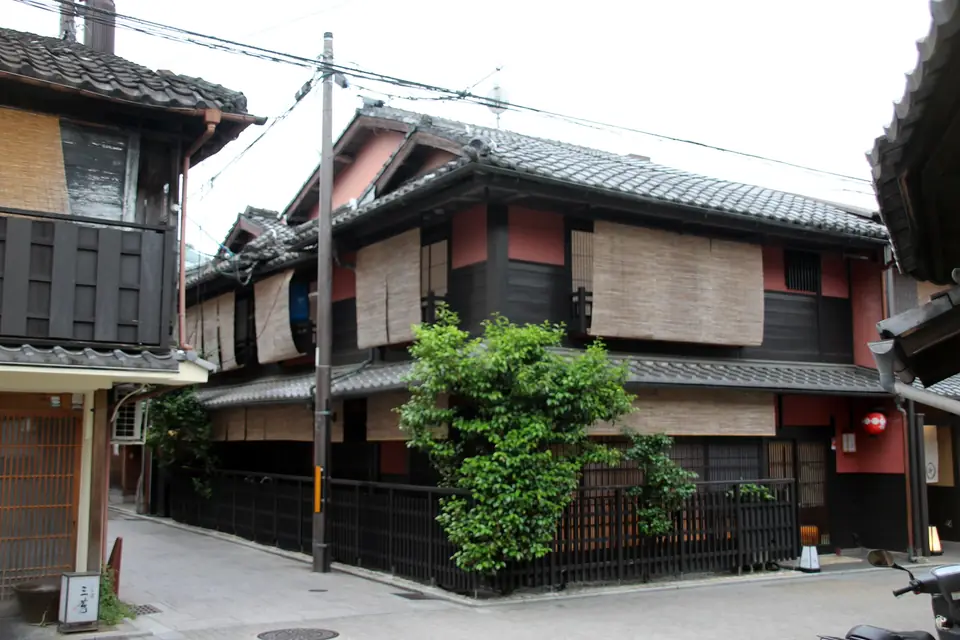
- Shinbashi-dōri — ochaya facades protected since 1976 over tram paving stones
- Ichiriki-tei — the teahouse renamed by a play of 1748
- Gion Kōbu Kaburenjō — the theatre of the Miyako Odori, on Hanamikōji
The history of Gion has a borrowed name. The district is called so after the shrine at whose gates it was born, which until the Meiji era was Gion-sha because it venerated Gozu Tennō, guardian of the Jetavana, the Indian monastery where the Buddha preached, called Gion Shōja in Japanese. With the separation of Shinto and Buddhism the shrine was renamed Yasaka, and the district kept the Buddhist name. There is no unanimity on its origin either: some sources place it in the Sengoku period and others in the tea stalls of the Kan’ei era, already in the Edo period.
Gion has several times been close to disappearing. When the capital moved to Tokyo it went into decline, and in 1872 the owner of the Ichiriki founded the Gion Kōbu association and devised the Miyako Odori, which celebrated their 150th edition in 2024. War pulled down an entire bank of the Shirakawa, and between 1955 and 1975 offices, bars and sex venues replaced the old houses until the residents made a stand. Today paved streets without cables, lanterns with strung rice dumplings and alleys with private-street signs tell that story to whoever can read them.
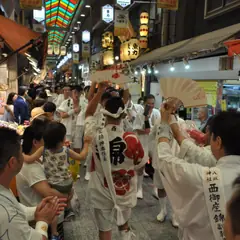
What to see in Gion also includes its calendar. Every 13 December, at the Kotohajime, geiko and maiko go round the teahouses and visit their teachers with a greeting heard only on these dates. The Gion Matsuri, born, it is said, from a ceremony against plague in the year 869, sends out every 24 July a procession with floats of geiko and maiko to the Yasaka shrine. And Tanizaki Jun’ichirō passed along these streets, who gave the great dance master Inoue Yachiyo IV a song with an impossible commission, to dance it without getting down from the carriage, which took her almost ten years to solve.
The audio guide covers the district in five stops, from the Yasaka gate to the dance theatre of Hanamikōji, with documented narration checked against historical sources that explains who saved each corner and why Gion asks to be looked at without being invaded.
To the south, the slopes of Higashiyama climb to Kiyomizu-dera, and to the west, across the Kamo river, lies Nishiki Market, whose association has carried since 1947 one of the Yasaka shrine’s palanquins in the Gion Matsuri.
The vermilion gate that is not the main one
Nishi-rōmon of Yasaka Shrine
Summary of this stop
Shijō avenue ends in the east at the Nishi-rōmon, the west gate of the Yasaka shrine: two vermilion storeys above a flight of steps, the busiest entrance and the one that faces the district. It is not, however, the main one, which is the south gate.
At its feet everything began. In the Kan’ei era, tea stalls for pilgrims were set up before this gate, and when the governor of Kyoto Itakura Shigemune allowed women to serve them, that cluster of teahouses beside the shrine came to be called Gion-machi.
The relationship between district and shrine is still alive each summer. The Gion Matsuri, which according to tradition was born some 1,150 years ago to halt epidemics, climbs every 24 July to this staircase with a procession of about a thousand people, parasol floats, carts with geiko and maiko and children who dance the heron dance. What happens on reaching the top is told in front of the gate.
A bridge, a tanuki and tram paving stones
Tatsumi-bashi
Summary of this stop
At the crossing of Shirakawa-minami-dōri and Shinbashi-dōri, the Tatsumi-bashi bridge crosses the Shirakawa with 7.5 metres of paving and a wooden railing. It is one of Gion’s most photographed views and a work of the neighbours: in 1829 residents paid for it as a wooden bridge, later it was earthen and in 1957 it was remade in steel. The paving stones of Shinbashi-dōri, a street of about 400 metres lined with ochaya, are those of Kyoto’s old municipal tram, reused.
On the facades, the lanterns bear an emblem of dango, strung rice dumplings, created in 1732 when the district received official permission for its teahouses. Gion Kōbu and Gion Higashi still use it.
Beside the bridge, the tiny shrine of Tatsumi Daimyōjin, surrounded by red posts with the names of artists, receives the prayers of geiko and maiko who want to progress in the arts. It has foxes on both sides, but popular belief says its god is another animal, and the story of why the residents gave it a home is the most mischievous part of the walk.
The bank that war pulled down
Kanikakuni stele
Summary of this stop
The cherry-tree walk on the north bank of the Shirakawa is an absence. During the Second World War the whole row of houses on this bank was pulled down as a firebreak, including Isoda Taka’s Daitomo ochaya; opposite, only the south bank keeps teahouses leaning over the water.
Beside the walk, a stone stele of Kurama erected on 8 November 1955 for the 70th birthday of the poet Yoshii Isamu bears his most famous tanka: he longs for Gion even when asleep, because the water runs beneath his pillow. The poem is associated with the Daitomo, and every year geiko and maiko offer it white chrysanthemums. On the other side, the Shinbashi row survived for another reason: the residents of Motoyoshi-chō pressed the City Council until in 1976 the area was declared a protected district.
On this bank also began a friendship of more than thirty years between Isoda Taka and the novelist Tanizaki Jun’ichirō. How it ended, in the same year as the house, is told at the stele.
The Ichiriki, renamed by a play
Ichiriki-tei
Summary of this stop
On the southeast corner of Shijō and Hanamikōji runs the long Bengal-red wall of the Ichiriki-tei, which is entered by invitation only. Its name is a play on characters: the house was called Yorozuya, and the play Kanadehon Chūshingura, of 1748, split the 万 of its name into 一 and 力. The real house adopted the fiction’s name.
Whether the leader of the 47 rōnin, Ōishi Kuranosuke, really frequented the Ichiriki is another matter: some sources tell it as history, others attribute those nights of feigned drunkenness to fictions, starting with the play itself, which changed names and characters. The entrance, in any case, is not where it was: in 1912 a renovation forbade opening ochaya on both sides of Shijō, and the Ichiriki moved it to Hanamikōji.
From this house also came the man who rescued the district when the capital left for Tokyo. What Sugiura Jirōemon invented in 1872, and why it is still on stage, is the key to this stop.
Living dance on temple land
Gion Kōbu Kaburenjō
Summary of this stop
Hanamikōji, south of Shijō, is a paved street without overhead cables since 2001, between ochaya facades with lattices and bamboo blinds. At its end it is closed off by the north gate of Kennin-ji, and the view sums up the history: this stretch was land of the Zen temple, and at the start of Meiji the laws on the separation of cults and on confiscation took it away. The space filled with teahouses.
Also at the end of the street is the Gion Kōbu Kaburenjō, a Japanese-style theatre of 1913 with 928 seats, home of the Miyako Odori every April. It closed in 2016 for seismic reinforcement, reopened in February 2023 and that year dance returned after seven years away. Between 1955 and 1975 there were some 150 ochaya and 600 geiko and maiko; today Gion Kōbu has 79 registered.
At the mouth of the side alleys, signs forbid photos and entry because they are private streets, with notice of a 10,000-yen fine whose legal force is unclear. The narration closes here, with the question of how to visit a district that is still inhabited.