Castle of the Tokugawa
Nijo Castle Audio Guide (Nijō-jō)
The stage the Tokugawa built to show themselves off before the emperor was the same one where, 264 years later, the last shogun handed power back to him. In between, chirping floors, tigers painted on gold and a tower struck by lightning.
- 90 min of audio
- UNESCO World Heritage
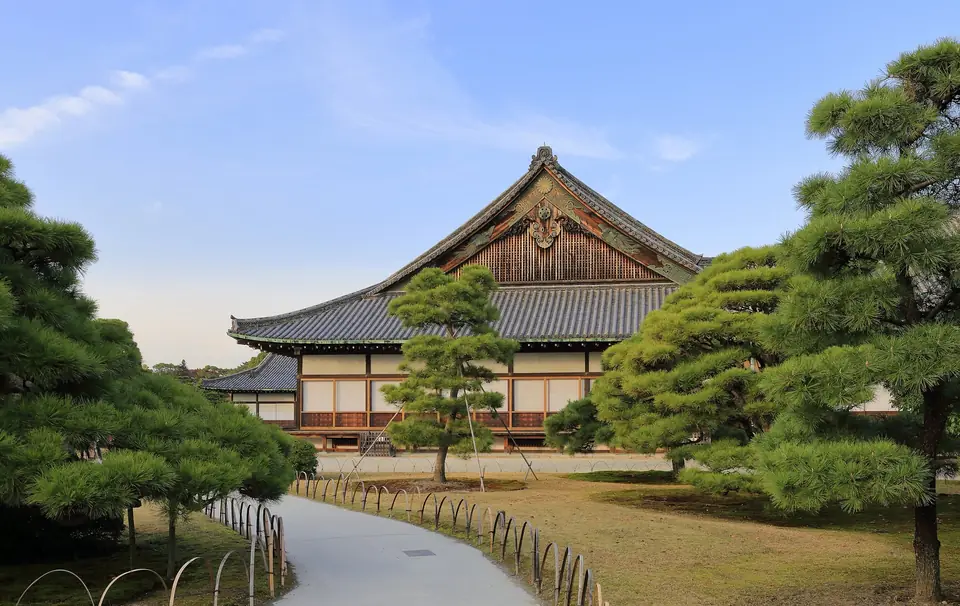
Nijō Castle is a flatland castle that Tokugawa Ieyasu raised in 1603 in the heart of Kyoto to protect the imperial palace and to lodge in when he visited the city. Its Ninomaru palace, a National Treasure, is the only palace complex left in a Japanese castle: six buildings staggered diagonally, 33 rooms, more than 800 tatami mats and some 3,600 wall paintings from the Kanō workshop. Since 1994 it has been part of the World Heritage Historic Monuments of Ancient Kyoto.
The corridors of the Ninomaru chirp underfoot, and the most repeated explanation, an alarm against intruders, is under discussion: the castle's official website considers it mistaken and attributes the song to the rubbing of clamps and nails, while other sources maintain that the sound was sought on purpose. In the great Ōhiroma hall, on 13 October 1867, the last shogun, Tokugawa Yoshinobu, gathered the vassals of 40 domains before announcing that he was returning power to the emperor.
Highlights
- Higashi Ōte-mon — the gate that was lowered to one storey for the imperial visit of 1626
- Karamon — polychrome carvings of cranes, pines and Chinese lions restored in 2013
- Uguisubari corridors — the nightingale floors that chirp at every step
- Ōhiroma — the hall where the end of the shogunate was staged in 1867
- Tenshudai — the stone base of the tower destroyed by lightning in 1750
The history of Nijō Castle is that of a political showcase. Tokugawa Ieyasu entered it, just finished, on 12 March 1603, weeks after being named shogun; the work had been decided and begun in 1601, and the World Heritage file dates it to 1603, the year of its completion. It was not born to withstand sieges, but so that Tokugawa power would have a home within sight of the imperial palace.
For a few decades the castle lived its splendour: the visit of Toyotomi Hideyori in 1611, that of Emperor Go-Mizunoo in 1626, with new paintings directed by the young Kanō Tan’yū. Afterwards, following Tokugawa Iemitsu’s stay in 1634, no shogun lodged here again until 1863, and the castle entered almost 230 years of decline. Lightning destroyed the tower in 1750 and the great fire of 1788 took the inner palace. In 1884 it became an imperial villa, and the chrysanthemum of the Imperial House covered the Tokugawa hollyhock wherever it could. In 1939 it was ceded to the city of Kyoto, which opened it to the public on 11 February 1940.
What to see at Nijō Castle also includes details that slip by in a hurry: the guardhouse of 1663, sole survivor of nine; the openwork hinoki panels about 35 centimetres thick that separate the rooms of the Ōhiroma, with a different motif on each face; the Minami-mon gate, built in 1915 for the enthronement of Emperor Taishō; and the Honmaru palace, former palace of the imperial branch Katsura-no-miya moved here between 1893 and 1894, which reopened in September 2024 after 18 years closed. In the great hall, doors with red tassels hide a small room that everybody calls “the warriors’ hiding place”, although another reading sees in it a simple storeroom.
The audio guide covers the castle in six stops, from the main gate to the base of the vanished tower, with documented narration checked against historical sources that follows the whole arc of the shogunate: from its presentation before the emperor to its resignation on the same stage.
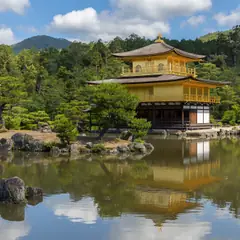
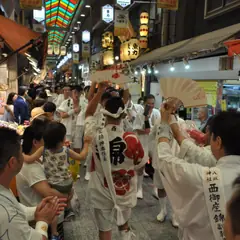
Two centuries before the Tokugawa, another shogun, Ashikaga Yoshimitsu, had built to the northwest of the city the villa from which the Golden Pavilion grew. And in the very centre of Kyoto, southeast of the castle, Nishiki Market received its privilege in 1615, in the heart of the Tokugawa era.
The gate that bowed before the emperor
Higashi Ōte-mon
Summary of this stop
The visit begins before the Higashi Ōte-mon, a two-storey gate over the outer moat facing Horikawa street. Its height has a catch: for the imperial visit of 1626 it was lowered to a single storey, so that nobody could look down on the emperor from above, and the two-storey gate seen today was built in 1662.
The gesture sums up the castle’s meaning. Ieyasu raised it in 1603 to protect Kyoto’s imperial palace and to lodge in on his visits to the city, and in it two logics coexisted: that of the warrior who commands and that of the subject who bows. Beside the entrance survives a guardhouse of 1663, the only one of the nine it had, and who occupied it and in what shifts is part of what the narration tells on the threshold.
Karamon: the youth who came from Osaka
Karamon
Summary of this stop
The Karamon gives access to the Ninomaru: four pillars, a cypress-bark roof with curved gables and polychrome carvings of cranes, pine, bamboo, plum and Chinese lions, restored in 2013. At the back appears the diagonal facade of the only palace left in a Japanese castle, those of Edo, Osaka and Nagoya having vanished. On the entrance porch, chrysanthemum emblems recall that in 1884 the Imperial House took over the castle and erased the Tokugawa hollyhock wherever it could.
On 28 March 1611, Ieyasu, aged 69, received Toyotomi Hideyori here, aged 17, heir of Hideyoshi, who had not left Osaka castle for 12 years. The meeting lasted some two hours, and who visited whom was the real message.
From that day a legend was born that all Japan came to believe, that of the “poisoned manjū”: General Katō Kiyomasa, who never left his young lord’s side and died three months later, was said to have swallowed the little cake meant for Hideyori. Kabuki made it famous in 1890, and the dates dismantle it. Why, and how, is told before the Karamon.
Golden tigers and chirping floors
Tiger rooms of the Tozamurai
Summary of this stop
Inside the Ninomaru, the floor answers. The uguisubari corridors, the “nightingale floors”, chirp at every step because metal clamps rub against the nails of the beams holding up the boards. Whether that was sought as an alarm is an open question: the official website denies it, an academic glossary maintains that from the early 17th century techniques were developed to produce that sound on purpose, and other sources leave it in doubt.
The first rooms, those of the Tozamurai, were antechambers for the daimyō: tigers and leopards among bamboo on a gold ground. The palace keeps some 3,600 wall paintings, 1,016 of them Important Cultural Properties since 1982; since 1972 the originals, which flake easily, have been replaced by hand-painted copies and kept in museum conditions.
Those beasts hide, according to popular belief, an error of zoology: their painters worked from pelts, never having seen a live tiger. What they believed about the leopard, and how it shows on the walls, is the surprise of this stop.
The hall where the shogunate ended
Ōhiroma
Summary of this stop
The Ōhiroma is the great audience hall. The shogun sat facing south in the raised room, with his alcove, his shelves and the ornamental door with red tassels, and the feudal lords looked at him from below. In the rear room can be seen the great pine with a hawk of the Matsutaka-zu, attributed by tradition to Kanō Tan’yū and, according to research by the castle itself in 2019, to Kanō Sanraku.
Today mannequins recreate the scene of 13 October 1867: Tokugawa Yoshinobu, the last shogun, consulted the senior vassals of 40 domains here. The next day he announced that he was returning political power to the emperor, the Taisei Hōkan, and the court accepted it on the 15th. A famous painting places the scene in another room, the Kuroshoin, while the official website places it in the Ōhiroma.
The dais built to dominate ended up serving to surrender. What it means to stand before that platform, and the weight of that moment, is the centre of the narration.
A garden for a vanished palace
Ninomaru garden
Summary of this stop
The Ninomaru garden surrounds a pond with Hōrai island in the centre, crane and tortoise islands, a waterfall and banks of powerful rocks. It is designed to be seen from the Ōhiroma, the Kuroshoin and a palace that no longer exists: the one raised for the imperial visit, of which only the southern lawn remains.
That visit was a spectacle. In September 1626, Go-Mizunoo spent five days here as the guest of Hidetada and Iemitsu, with a retinue of some 9,000 people and 540 horses so long that its head reached the castle when its tail had not yet left the imperial palace, about 2.6 kilometres away. An open-air nō stage was even set up, south of the Ōhiroma.
There occurred the tensest episode of the walk: an actor who went blank before the emperor and the shogun in the middle of a text with a political warning included. Who took the blame, and with what words, is told beside the pond, before the long silence of almost 230 years without a shogun.
The tower struck by lightning
Tenshudai
Summary of this stop
At the southwest corner of the Honmaru, the tenshudai is a stone platform you can climb and from which you see the inner enclosure and the city. Up there the main thing is missing: the five-storey tower that lightning destroyed in 1750 and that was never rebuilt. Its origin is not clear either: it is said that the one of 1626 came from Fushimi castle, and that the first, older one came from Kōriyama’s.
Something unique happened on that tower. In 1626 Go-Mizunoo climbed it twice, arriving from the Ninomaru along the tatami-covered upper floor of a two-level wooden bridge, never touching the ground; he is regarded as the only emperor to have climbed a castle’s tower. The bridge passed through the Yagura-mon gate, with copper-clad leaves.
The great fire of 1788 burned the inner palace, and in its place the palace of the Katsura-no-miya was moved in the late 19th century. How the shoguns’ castle ended up full of imperial palaces, and then open to anyone, is the close of the narration.