Zen villa of the shogun Yoshimitsu
Golden Pavilion Audio Guide (Kinkaku-ji)
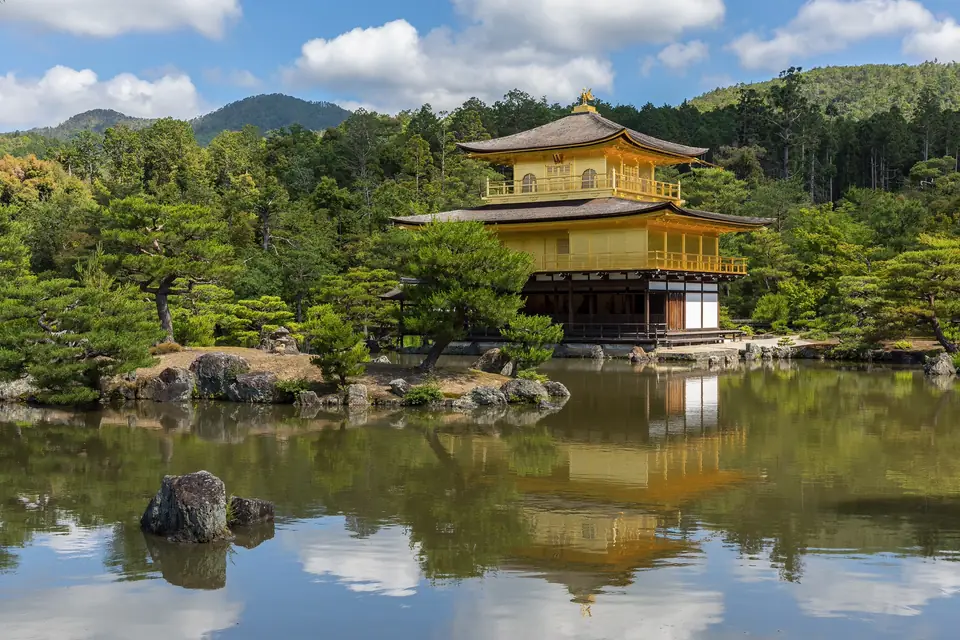
Kyoto's most photographed building dates from 1955: the original was burned by a 21-year-old monk who wanted to die with it. What is truly old here is the water that reflects it.
- 45 min of audio
- Zen strolling garden
The Golden Pavilion was born as the reliquary hall of the retirement villa of Ashikaga Yoshimitsu, the shogun who in 1397 bought an old Saionji estate and built the Kitayama-dono, a residence on the scale of an imperial palace from which he went on governing. Its architecture layers three worlds: a first floor of ungilded wood in palace style, a second of samurai residence and a third of Chinese Zen temple, 12.5 metres topped by a phoenix. When the shogun's widow died, the villa was dismantled and became the Zen temple Rokuon-ji.
Around 3 in the morning of 2 July 1950, Hayashi Shōken, a 21-year-old apprentice monk, piled up his futon, mosquito net, clothes, books and straw before the statue of Yoshimitsu and set them alight. He knew the alarm had been broken for days. The pavilion, a National Treasure, burned entirely. The roof's phoenix was saved because it had been taken down earlier, and the gold that now shines over the pond comes from a 1987 restoration with some 20 kilos of gold leaf.
Highlights
- Kyōko-chi pond — the only thing that survives of the Saionji garden of 1224
- Golden Pavilion — three styles layered and a phoenix at 12.5 m high
- Sōsei landing — the ground floor where the 1950 fire started
- 1987 restoration — 200,000 sheets of gold, some 20 kg in all
- Fudō-dō — the small hall that was spared in the Ōnin War
The story of the Golden Pavilion begins two centuries before the gold. Around 1220 the noble Saionji Kintsune obtained this land in exchange for a fief in Owari, and in 1224 he consecrated a family temple and a villa here; a year later the poet Fujiwara Teika was enchanted by a 45-foot waterfall and a pond blue as lapis lazuli. In 1397 Ashikaga Yoshimitsu, who three years earlier had ceded the post of shogun to his nine-year-old son, bought the ruined estate and built the Kitayama-dono.
After the death of his widow in 1419, the residential buildings were dismantled and given to other temples, and the villa became the Zen temple Rokuon-ji, around 1420 according to some sources and in 1422 according to the World Heritage file. The reliquary hall survived the Ōnin War, although some guides claim the opposite, and served as a model for Ashikaga Yoshimasa, Yoshimitsu’s grandson, for the Kannon pavilion of his Higashiyama villa, today’s Silver Pavilion. In the 17th century the abbot Hōrin Jōshō straightened it when it began to lean and commissioned the Sekkatei tea pavilion for the retired emperor Go-Mizunoo.
What to see at the Golden Pavilion goes beyond the postcard. In the woodland garden wait the Ryūmon waterfall with its carp stone, the Ginga-sen spring from which, it is said, Yoshimitsu drew the water for his tea, a boat-shaped pine that tradition attributes to his hand and the Anmintaku pond, where visitors throw coins into a tiny bowl before the mound of the white snake, messenger of the goddess Benzaiten. A tower honours Jōzō, the 10th-century monk who, according to legend, straightened the Yasaka pagoda in one night. And on a small bridge, two low bamboo fences woven differently gave a name to a whole style: the Kinkakuji-gaki.
The 1950 fire quickly became art: a scroll by Kawabata Ryūshi painted two months later, Mishima Yukio’s novel of 1956, Ichikawa Kon’s film and Mizukami Tsutomu’s book, who met the arsonist in person. Mishima’s version changes the ending. The audio guide covers the garden in five stops, from the pond to the Fudō-dō, with documented narration checked against historical sources that tells what really happened that night.
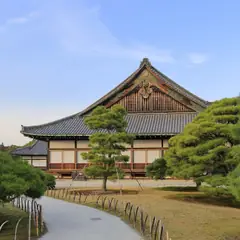
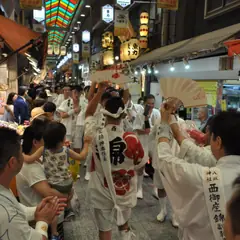
If the Golden Pavilion comes from an Ashikaga shogun, Nijo Castle is the showcase of the Tokugawa, the shoguns who governed two centuries later. In the very centre, about 5 kilometres in a straight line, Nishiki Market shows the Kyoto of the shopkeepers.
A pond older than the gold
Kyōko-chi pond
Summary of this stop
From the south shore of the Kyōko-chi, a pond of some 6,600 square metres with Mount Kinugasa as borrowed scenery, the pavilion appears doubled in the water. That reflection is the image everybody comes looking for, and the oldest part of it is the water: of the Saionji constructions of 1224 only the pond survives.
The building reads from the bottom up. The first floor, Hossui-in, is of ungilded wood in the shinden-zukuri palace style; the second, Chōon-dō, in samurai residence style; the third, Kukkyōchō, in Chinese Zen temple style. Above, the pyramidal shingle roof and the phoenix. The completion of the reliquary hall is dated around 1399, and what that layering of styles meant in the mind of a shogun is the narration’s first clue.
The garden from which Yoshimitsu ruled
Ashihara-jima island
Summary of this stop
Facing Ashihara-jima island, the largest in the pond, with its pines, stones with proper names appear and a row of four rocks representing anchored boats. It is the garden of a parallel court. The Kitayama-dono had the scale of an imperial palace, and from here Yoshimitsu went on governing after retiring and received the envoys of Ming China.
In 1408 he entertained Emperor Go-Komatsu at this villa with a great banquet, the imperial visit known as Kitayama gyōkō. He died that same year, aged 51, in this residence.
His ambition took the form of a tower. When lightning destroyed in 1403 the seven-storey pagoda of Shōkoku-ji, of about 109 metres, he raised another of similar scale here, the Kitayama Daitō. What happened to that second pagoda, and why no trace of it remains, is told in front of the island.
The early morning the National Treasure burned
Sōsei landing
Summary of this stop
On the west side of the first floor, the Sōsei, a small landing with a gabled roof, juts out over the water. Right there, on the ungilded floor, it all began. In the early morning of 2 July 1950, Hayashi Shōken lit the bonfire with his own belongings before the statue of Yoshimitsu; around 3:40 the roof fell in. Figures vary by source: some give him 21 years and place the fire around 3:00, others 22 years and 2:30.
The gilded bronze phoenix and the Kukkyōchō plaque, calligraphed by Emperor Go-Komatsu, had been taken down earlier and were saved; a copy burned atop the pavilion. Hayashi was sentenced to seven years and died of tuberculosis in 1956; his mother took her own life the day after the fire.
Behind the pavilion rises Mount Hidari Daimonji. The arsonist fled there, and what he said afterwards about why he climbed, and why he came down, is the darkest episode of the walk.
A beam-turned-vase that decided the gold
North face of the pavilion
Summary of this stop
Behind the pavilion, beside the Ginga-sen and Ganka-sui springs, you see the north face of the building rebuilt between 1952 and 1955 with some 30 million yen of public subsidy and donations from all over Japan, following the plans of the 1904-1906 dismantling. The inauguration was on 10 October 1955.
That gold has a disputed story. Before the fire only the third floor kept gold leaf, and the second was gilded entirely in 1955 because of a single salvaged piece: a section of corner beam removed in the Meiji restoration and turned into a flower vase, which had gold. The historian Miyakami Shigetaka objects that it would be strange for only the most exposed piece to preserve the gilding. Ten years later the gold was already flaking, and between 1986 and 1987 a restoration costing some 740 million yen used about 200,000 sheets of gold five times as thick and 1.5 tonnes of lacquer.
To pay for the reconstruction, the abbot Murakami Jikai did something few would expect of the head of Kyoto’s most celebrated temple. Who the only journalist was who saw him in those days, and what he became, is told beside the water.
The hall that survived every fire
Fudō-dō
Summary of this stop
Beside the exit, the Fudō-dō is the oldest building in the grounds, rebuilt in the Tenshō era, and keeps a stone Fudō Myōō attributed to Kōbō Daishi that is shown only on 3 February and 16 August. In the Ōnin War the temple suffered damage, but the pavilion, the Fudō-dō and the Goma-dō were spared; in 1485 the shogun Yoshimasa found the garden without most of its maples, felled during the war.
The close has to do with who keeps the place alive. After losing its domains in the Meiji anti-Buddhist persecution, the temple opened the garden and the pavilion to paying visitors for the first time in 1894, on the occasion of a great trade fair in Osaka. That is how the tourist visit began that still sustains it today, and the narration ends by recalling what part of that history each ticket carries.