Hall of the thousand Kannon
Sanjusangendo Audio Guide
Almost 120 metres of wooden hall and 1,001 gilded Kannon, no two faces alike. Beneath its eaves, Edo-period archers shot for a day and a night for the title of best in the country, and arrows are still stuck between the rafters.
- 45 min of audio
- Kamakura-period Buddhist sculpture
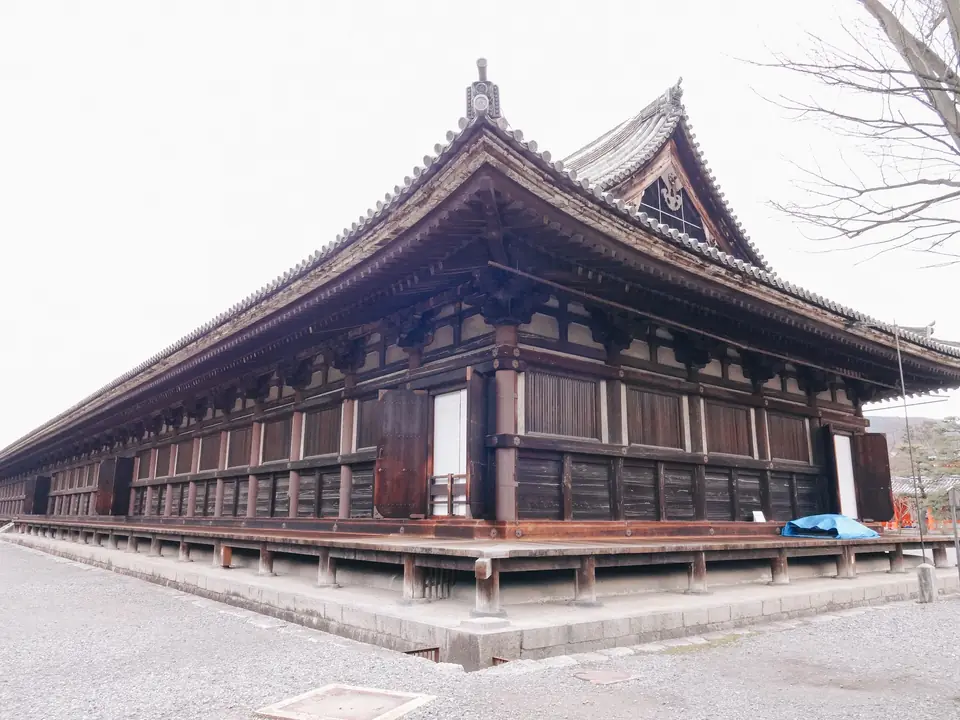
Sanjūsangendō, whose official name is Rengeō-in, was completed in 1164 by order of the retired emperor Go-Shirakawa and with money from Taira no Kiyomori. The great fire of 1249 razed the original temple, and the hall that still stands is the reconstruction of 1266: 118.2 metres long and 16.4 wide, the longest historic wooden hall in Japan. Inside, ten tiers on each side of Tankei's seated Kannon hold 1,000 standing Kannon, plus one behind the central image.
Its name means “hall of the 33 bays”, but from the courtyard you count 35 between columns on the long sides: the 33 are those of the inner chamber that holds the images. The count usually used to explain its 120 metres does not hold either. And beneath the floor, a 2016 excavation found alternating layers of sand and clay, the same seismic-isolation principle as the rubber layers of modern buildings.
Highlights
- The 1,001 Kannon — 124 saved from the fire of 1249 and no two faces alike
- Tankei's seated Kannon — finished in 1254, when the sculptor was 82
- Fūjin and Raijin — the oldest sculptures of the gods of wind and thunder
- West eave — 120 m of archery with arrows still wedged between the rafters
- Taikō-bei wall — the trace of Hideyoshi and his vanished Great Buddha
The story of Sanjūsangendō, according to its most famous legend, begins with a migraine. Go-Shirakawa had suffered headaches for years and, in dreams, learned that in a previous life he had been a monk of Kumano whose skull lay at the bottom of a river, with a willow sprouting from an eye socket: each time the wind moved the tree, the emperor’s head ached. According to tradition, he placed the skull inside a thousand-armed Kannon and used the willow’s wood for the beams, and the pain vanished. Another version turns the willow into a woman who faded away as the axe fell, and in 1760 that story rose to the puppet theatre.
The documented facts are less fantastic and no less dramatic. The temple was completed in 1164, although the exact date equals January 1165, within a temple-and-palace complex of more than 14 hectares between the Kamo river and the Higashiyama hills; whether the work is attributed to Go-Shirakawa or to Kiyomori, who paid for it, depends on the source. It burned in 1249, was rebuilt in 1266, and in 1595 Toyotomi Hideyoshi incorporated it into the grounds of his Great Buddha.
What to see at Sanjūsangendō also depends on the calendar. In mid-January, in the willow rite, monks sprinkle the faithful with water blessed against headaches, and that same day the Ōmato Taikai is held beside the west facade, heir to the old archery contests. Every 3 March, for the 33 of the name, the Shuntōe allows the hall to be seen from a raised platform, end to end; in 2025 it was also the setting of a date agreed 33 years earlier by the illustrator Miura Jun and the writer Itō Seikō, who showed up at 15:33 before some 2,000 people. Popular tradition also places, without proof, a duel of Miyamoto Musashi in 1604 on the temple’s outskirts.
The audio guide covers the temple in five stops, from the corridor of the thousand Kannon to the pond garden, with documented narration checked against historical sources about a hall that saved its images from fire, watched its giant neighbour burn and served as the shooting range of a whole era.
Up the slope, on the same Higashiyama hills, rises Kiyomizu-dera, another survivor of Kyoto’s fires, and further south, Fushimi Inari Shrine keeps a great gate also attributed to Hideyoshi.
Fūjin and a thousand faces looking back
Fūjin and tiers of the 1,001 Kannon
Summary of this stop
The visit begins barefoot at the north end of the corridor, beside Fūjin, the god of wind, with his sack on his back. At the other end waits Raijin, the god of thunder, surrounded by drums. They date from the Kamakura-period reconstruction and are the oldest sculptures of these gods in Japan; since a restoration around 1934 they had been swapped, and in July 2018 they returned, with the 28 guardians of the front row, to the placement believed to be original.
Behind rise the tiers: ten on each side, with 50 gilded figures of about 166 centimetres in each. They are not serial copies. Of the 1,001 Kannon, 124 date from the foundation and were saved from the fire of 1249, 876 are from the reconstruction and only one, number 32, was added in the Muromachi period. In 2006 inscriptions had been identified on 504 of them, signed by workshops of Nara and Kyoto; the “Unkei” signature on number 510 is considered false and later.
In Kyoto it is said that among those thousand faces there is always one that resembles the viewer and another that resembles the person one most wishes to see again. How they are sought, and what is found, is part of what the narration proposes in the corridor.
Tankei at 82 and the lost colours
Tankei's seated Kannon
Summary of this stop
At the centre of the hall, the seated eleven-headed, forty-two-armed Kannon measures 334.8 centimetres without pedestal or halo, and more than seven metres with them. Master Tankei began it in 1251 and finished it in 1254, at the age of 82, according to the pedestal’s inscription. On its openwork halo appear the 33 forms of Kannon, and the original canopy and pedestal are preserved.
The hall, which today looks like bare wood, was once covered in colour. In the 1930 restoration, when the bases of some decorative mirrors were removed from the beams, polychrome drawings appeared, and in the dark corners of the framework remnants of lotuses and clouds remain. The original exterior was vermilion. The thousand standing Kannon, for their part, took 45 years to restore, from 1973 to 2017; in 2018 they were declared a National Treasure and the 1,001 figures were brought together again.
Over the central image, a coffered ceiling; over the rest, beams and rafters in view. Why the legend of the emperor with the migraine makes one look at those beams differently is told before Tankei’s Kannon.
Hideyoshi’s wall and the Buddha that burned
Taikō-bei wall
Summary of this stop
Outside the hall, on the south edge, runs the Taikō-bei, an earthen wall with a small roof, and rises the Great South Gate, both from the Toyotomi era. They are what remains of a greater ambition: in 1595 Hideyoshi integrated Sanjūsangendō into the grounds of his Great Buddha of Hōkō-ji, and his son Hideyori raised the south gate in 1600 and a west gate in 1601 that is today the Nandaimon of the Tō-ji temple. On the eave tiles lotuses, the tomoe motif and the Toyotomi emblem alternate.
The hall had already survived one disaster. The great fire of 1249 razed the original temple, with its five-storey pagoda, and the retired emperor Go-Saga rebuilt only the main hall, finished in 1266.
In 1798 another fire came, this time to the neighbour. Lightning set fire to the Great Buddha of Hōkō-ji, the largest wooden building in the country, which burned for two days. What a Kyoto children’s song still tells of that fire, and of the hall that was left standing, is the close of this stop.
Arrows stuck beneath the archers’ eave
West eave of the Tōshiya
Summary of this stop
On the west side, an outer gallery of about 121 metres from end to end was the stage of the Tōshiya: archers shot from south to north, along some 120 metres, without touching the eave. The columns bear iron plates from the early Edo period, fitted to protect them from arrow strikes, and arrows from those contests are still wedged between the rafters. Inside the hall a bow used in them is displayed.
The origin of the contest is disputed, but the first recorded mark is from 1606: Asaoka Heibei passed 51 arrows of 100. The houses of Owari and Kishū later contested the record. Hoshino Kanzaemon passed 8,000 in 1669, and in 1686 Wasa Daihachirō, of Kishū, passed 8,133 of 13,053 in a day and a night, a mark never surpassed.
That night in 1686 something happened that tradition tells in detail: the rival champion approached the young man who was about to take his record. What he did, and how Wasa’s life ended, is told beneath the eave, where every January archers return in kimono and hakama to shoot at 60 metres.
Thirty-five bays for a hall of 33
East pond garden
Summary of this stop
From the east pond garden, designed in 1961 by Nakane Kinsaku for the 770th anniversary of Go-Shirakawa’s death and renovated in 2021 by his grandchildren, the long facade can be counted: 35 bays come out, not 33, and at the centre there is a seven-bay porch added around 1649-1651. The 33 of the name correspond to the inner chamber.
The popular count of the 120 metres, 33 bays of about 3.6 metres, fails on both figures: the visible bays are 35, they are not all the same size and they follow no traditional system, although the result almost coincides with the length of the eave.
The garden returns the visit to its origin, to the founding emperor and Kiyomori’s money, and to a practical question: how a hall so long and narrow has withstood centuries of earthquakes. The answer lies underground, and the narration reveals it as a farewell.