Kyoto's kitchen
Nishiki Market Audio Guide (Nishiki Ichiba)
A covered alley 390 metres long and barely three to five wide that exists because of cold water beneath the paving and several generations of shopkeepers who saved it each time it was about to close, the first time thanks to a painter.
- 45 min of audio
- Historic food market
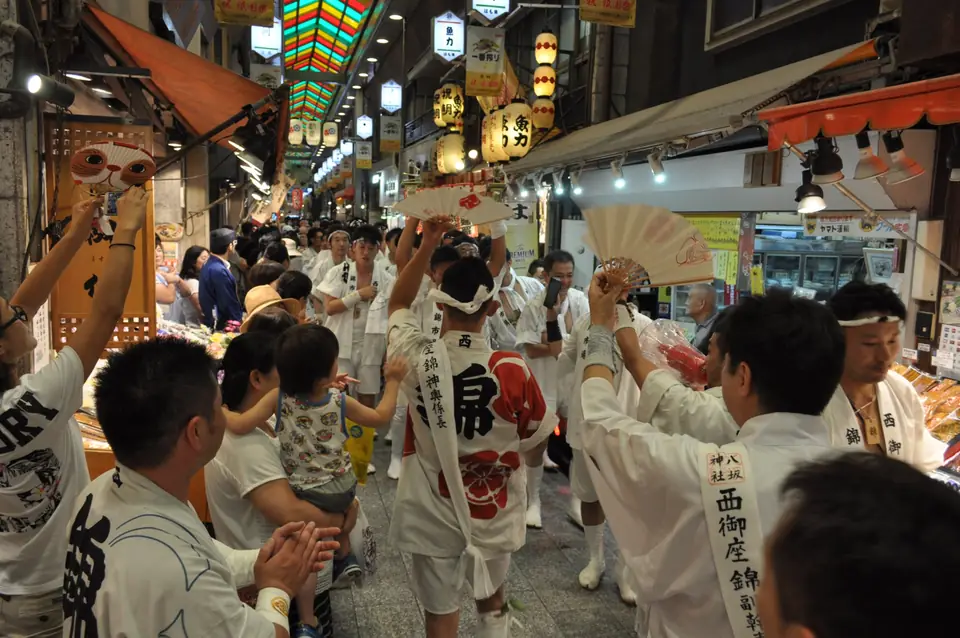
Nishiki Market is a street of about 390 metres, 3.3 to 5 metres wide, between Takakura and Teramachi, under a red, yellow and green arcade finished in 1993 without a single pillar in the roadway. A record of 1311 already notes fishmongers on Nishiki-kōji, and in 1615 the Tokugawa shogunate designated it one of Kyoto's three privileged fresh-fish markets. The reason lay underground: water that stays between 15 and 18 °C all year and that each shop kept in its own well, turned into a fridge.
In 1772 the vegetable market was ordered to close because its licence had burned in the fire of 1755. The rival wholesalers of Gojō offered silver to keep it closed. The painter Itō Jakuchū, born in a vegetable warehouse on this very street, refused to reopen only his own district, mobilised three farming villages and in 1774 won legalisation. The story was written by descendants of his family, and an Edo official devised the strategy: the hero had help.
Highlights
- Jakuchū's birthplace — the shopkeeper painter who saved the market in 1774
- Fishmongers — hamo, guji and Lake Biwa fish over cold groundwater
- Aritsugu — a sword forge from 1560 with more than 400 types of knife
- Torii of 1935 — with the ends of the lintel embedded in the buildings
- Nishiki Tenmangū — the Nishiki water spout and a robot lion that gives the oracle
The story of Nishiki Market begins with an unappetising name. According to tradition, in the Heian period the street was called Gusoku-kōji, the name degenerated into Kuso-kōji, “dung alley”, and in 1054 Emperor Go-Reizei renamed it Nishiki-kōji, “brocade alley”. Other versions explain the change by symmetry with Ayanokōji street, and there is not even agreement on what the original gusoku was: armour for some, utensils for others.
Its age is disputed too. It is repeated that the market is some 1,300 years old, but the merchants’ association itself presents that figure as an estimate without reliable documents. What is on record is an entry of 1311 with fishmongers from Yodo changing money in the street, and the privilege of 1615. After the Meiji Restoration the guilds were abolished and by about 1883 only seven large shops remained; in 1927 Japan’s first central wholesale market opened in Kyoto and many moved. In 1928 the Kin’eikai association added greengrocers, butchers and grocers and relaunched Nishiki as the “kitchen of Kyoto”.
What to see at Nishiki Market includes those who live it. Yubakichi, founded in 1790, is the only shop that still makes yuba by hand in its back room. At Yamaichi, one of the oldest shops, bōdara, dried cod hard as a stick that all of Kyoto buys in late December for the New Year menu, is still rehydrated with groundwater, and in its yard remains a well with an offering to the god of wells. The first fish of the season is called “hashiri”, “the run”, and according to the explanation that circulates in the market, among others, it is for the porters who brought it running from the Katsura river. In July, some neighbours stop eating cucumber during the Gion Matsuri, and since 1947 the Nishiki association has carried one of the Yasaka shrine’s palanquins in that festival.
The audio guide covers the market from west to east in four stops, from Jakuchū’s birth corner to the Nishiki Tenmangū shrine, with documented narration checked against historical sources that explains why this crowded corridor is not here by chance.
To the east, across the Kamo river, you reach the Gion District, to whose Yasaka shrine the Nishiki association has carried one of the Gion Matsuri palanquins since 1947. To the west, also in the centre, lies Nijo Castle, and further off, to the northwest and some 5 kilometres in a straight line, the Golden Pavilion.
The birth corner of the shopkeeper painter
Jakuchū birthplace monument
Summary of this stop
At the west entrance, on the corner with Takakura, a monument marks the site of Masuya, the vegetable wholesaler where Itō Jakuchū was born in 1716. From there starts the tunnel of colour: the pillarless arcade of 1993 and the paving redone since 1984, along some 390 metres. Reproductions of Jakuchū’s works decorate the metal shutters of several shops, more visible when the businesses are closed.
The painter is here for more than having been born on the street. In December 1771, the Kyoto magistracy demanded that the market’s districts justify since when they had held a licence; the document had burned in the great fire of 1755, and on 15 January 1772 the vegetable market was ordered to close.
What followed was a two-year fight with rival wholesalers, pieces of silver and farming villages, which the family account attributes to Jakuchū and in which an Edo official, Nakai Seidayū, played a key role. How it was resolved, and at what price, is what the narration tells at the corner.
Cold water beneath the fish paving
Fishmongers with hamo and Biwa fish
Summary of this stop
In the fishmongers’ stretch line up hamo, guji, sasa-garei, grilled mackerel and freshwater fish from Lake Biwa; in July, white hamo opened out on the counters. That such a fish market exists in a city with no sea has a concrete explanation: Nishiki’s water, which stays between 15 and 18 °C all year.
Each shop had an oriido, a well one could descend into that served as a fridge for fresh goods. That is why the fishmongers were already here in 1311, and why in 1615 the shogunate chose Nishiki as one of Kyoto’s three privileged fish markets.
The market’s tradition adds a nuance that says much about the value of water: each shop had two wells, one for business and one for the home, and they were not worth the same. What they were called, and why, is explained among the counters.
Swordsmith’s knives and an averted closure
Aritsugu
Summary of this stop
In the Kajiya-chō stretch, the old blacksmiths’ district, the Aritsugu knife shop displays more than 400 types of knife. It was founded in 1560 as a sword forge and switched to kitchen utensils in the Meiji era, when swords lost their customers.
That conversion is the whole market’s. With guild privileges abolished after the Meiji Restoration, competition left Nishiki with seven large shops around 1883; the 1927 opening of Japan’s first central wholesale market took many others, and in 1928 the association reinvented it as a market for every kind of food.
The most serious danger came after the war, with the country rationed and queues to buy anything edible. The occupation’s campaign against the black market confused Nishiki with one of them. How its shopkeepers defended it, petition after petition, is the episode heard in front of the knives.
A wedged torii and a spout for everyone
Nishiki Tenmangu
Summary of this stop
At the east end, between Teramachi and Shinkyōgoku, a torii of 1935 has the ends of its lintel set inside the buildings on both sides: the later parcelling measured the passage by the pillars alone, and the city grew around it. Behind is the Nishiki Tenmangū shrine, with a spout of Nishiki water pumped from some 30 metres deep where neighbours and visitors fill bottles freely. Since 1965, after the water ran short in the Shōwa era, a communal well system distributes it to each shop.
At the shrine also waits an uncommon oracle: robot shishi-dance lions that move when someone approaches and hand out the fortune slip to the rhythm of gagaku music. Who designed them, and from what trade he came to the shrine, is part of the close.
Before returning to the market, keep in mind the multilingual signs: since 2018 the association asks people not to eat while walking and to do so in front of or inside the shop where they buy. The rule is a request, not a prohibition with a fine, however much has been said to the contrary, and behind it is the debate on what Nishiki should be like in the coming years.