Temple of Pure Water
Kiyomizu-dera Audio Guide
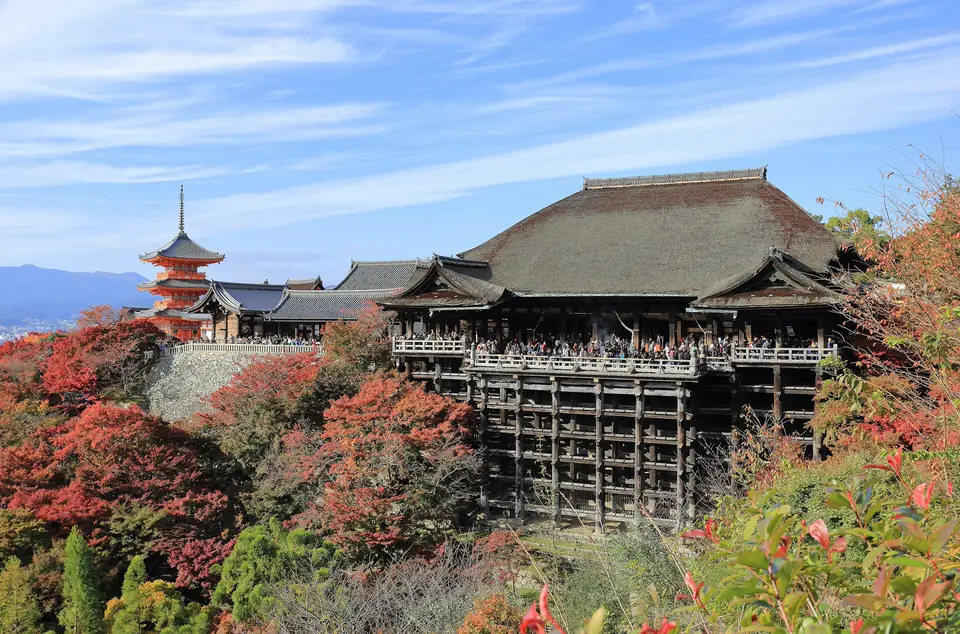
Kyoto's most photographed wooden balcony does not look at the city: it is a dance altar turned toward a hidden god, held up without a single nail 13 metres above a ravine from which for a century and a half people jumped out of faith.
- 75 min of audio
- Nail-free kakezukuri architecture
Kiyomizu-dera, the temple of “pure water”, dates its founding to 778 beside the Otowa waterfall, where the monk Kenshin carved an image of Kannon. Between 1063 and 1629 the complex burned at least nine times, and almost everything seen today dates from the 1630s: the Hondō, a National Treasure, was rebuilt in 1633 by order of the shōgun Tokugawa Iemitsu. Its projecting stage rests on keyaki pillars more than 400 years old, joined to beams by nail-free joinery, the kakezukuri technique.
Between 1694 and 1864, the diary of the Jōju-in recorded 235 jumps from the stage, attempts included, with 34 dead and an 85.4% survival rate. They were not desperate people: they were vows to Kannon to cure an illness or fulfil a wish. Kyoto prefecture banned them in 1872 and fenced the railing, but the image survived in the language, which associates this stage with great leaps into the void.
Highlights
- Niōmon — the red gate of about 14 m that survived the great fire of 1629
- Hondō stage — 166 hinoki planks some 13 m above the ravine
- Keyaki pillars — a forest of beams joined without a single nail
- Okuno-in — the terrace from which the stage is seen in profile
- Otowa waterfall — the three streams of the spring that gave the temple its name
The story of Kiyomizu-dera begins with water. The temple dates its founding to 778, when the monk Kenshin, later called Enchin, carved an image of Kannon beside the spring on Mount Otowa, and from that spring comes the name: “pure water”. The date has nuances. The UNESCO nomination dossier prefers 780, the year the hermitage became a private temple, and the National Diet Library considers the exact year unknown.
The architecture of Kiyomizu-dera is that of a survivor. The complex burned at least nine times between 1063 and 1629; the Ōnin War destroyed it in 1469 and the reconstruction was entrusted to an itinerant fundraiser, Gan’ami. Of the great fire of 1629 only the Niōmon gate and the Uma-todome stable, both from the late 15th century, and the bell tower of 1607 were saved. The rest, including the Hondō with its great cypress-bark roof renewed from 2017, dates from the 1630s.
Stories pile up around the main route. On the slope that climbs from the Niōmon to the Jōju-in crowd the “thousand stone buddhas”, almost all Jizō, which devout neighbours carried up here in the early years of Meiji to save them from the anti-Buddhist campaign; even today someone changes their bibs. On either side of the hidden Kannon of the Hondō wait, in shrines opened only every 33 years, a Jizō with sword and armour and a Bishamon, to whom the temple chronicle attributes its founder’s victory over the Emishi of the north. According to legend, a blue dragon, an incarnation of Kannon, comes down every night to drink from the waterfall, and three afternoons a year an 18-metre dragon processes through the shopping streets. Gesshō, a monk of the Jōju-in, threw himself into the sea with Saigō Takamori in 1858, and since 1995 the temple has proclaimed the Kanji of the Year every 12 December.
The audio guide covers the temple in five stops, from the red gate to the waterfall, with documented narration checked against historical sources that explains what the balcony in the photos really is and why everything was born from the water drunk at the end.
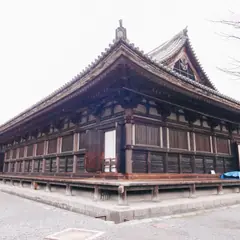
Downhill, the streets of Higashiyama lead north to the Gion District and the gate of the Yasaka shrine, and at the foot of the hills, beside the Kamo river, stands another great wooden hall, Sanjusangendo. Further south, about 3 kilometres in a straight line, Fushimi Inari Shrine occupies a whole mountain.
The red gate the fire spared
Niōmon
Summary of this stop
At the top of the climb waits the Niōmon, a two-storey gate lacquered in vermilion, about 14 metres high, rebuilt around 1500 after the Ōnin War and guarded by Niō guardians on both sides. To its right, the Uma-todome, a low, plain building where pilgrims tied their horses. The two share an uncommon merit: they survived the fire of 1629, which took almost everything else.
That contrast organises the visit. The intact gate belongs to a temple that burned at least nine times in five centuries, and which after the destruction of 1469 was raised with the collections of the fundraiser Gan’ami, whose residence gave rise to the Jōju-in.
The slope by which visitors arrive also has its history. Sannenzaka, paved between wooden machiya, owes its name to the road to the Koyasu-no-tō, the three-storey childbirth pagoda, rebuilt in 1500 and moved in 1911; until the Middle Ages it was the main access to the temple. What that changes in the way of looking at the climb is told in front of the gate.
The setting sun, a hunter and a doe
Saimon
Summary of this stop
Higher up, the Saimon gate, from 1633, serves as a ritual viewpoint for the setting sun, and behind it rises the vermilion pagoda of about 31 metres, rebuilt in 1632 and with its polychromy restored in 1987. Both belong to the great reconstruction ordered by the shōgun Tokugawa Iemitsu, the same one that raised the Hondō in 1633.
Here fits the foundation tale, a tradition documented by the temple itself. Guided by a dream, Kenshin found beside the spring Gyōei, a hermit dressed in white who claimed to be 200 years old, who gave him a sacred log to carve a Kannon and vanished eastward: the old man, Kenshin understood, was Kannon himself. Two years later the warrior Sakanoue no Tamuramaro arrived to hunt a deer whose blood was to cure his wife, and the monk reproached him for the sin of killing.
The hunter ended up building the temple with his wife. According to tradition, a small stone stupa north of the bell tower, the Shikama-zuka, marks the place where he buried with honours the pregnant doe he had shot. How one goes from a hunt to one of the most visited temples in Japan is what the narration unfolds in front of the Saimon.
A balcony that turns its back on Kyoto
Kiyomizu stage
Summary of this stop
The Hondō stage is a platform of 166 hinoki planks and some 200 square metres projecting over the slope, about 13 metres above the stones of the ravine. The planks were replaced in the great Heisei restoration and last between 25 and 30 years. Everybody photographs it as a viewpoint, but it was born as an offering platform: gagaku, nō, kyōgen and kabuki have been performed on it with their backs to the landscape, facing the inner sanctuary where the eleven-faced, thousand-armed image of Kannon is kept hidden.
Its first written appearance is almost a circus act. A 12th-century text tells that the noble Fujiwara no Narimichi, called “god of the ball” for his mastery of kemari, walked the railing there and back keeping the ball in the air.
At the entrance wait the 90-kilo iron staff and iron geta attributed to Benkei, the warrior monk. Popular imagery places his duel with the young Yoshitsune on the Gojō bridge, but the Gikeiki, the medieval chronicle of Yoshitsune, puts it on this stage, and other versions combine both places. What those iron pieces really are, and from what period, is one of the surprises of this stop.
Thirteen metres of void and a vow
Okuno-in
Summary of this stop
From the terrace of the Okuno-in, a small pavilion of 1633 also built on a cantilever, the stage appears in profile, with Kyoto behind and, below, the grid of keyaki pillars joined by horizontal beams. The temple’s website speaks of 18 pillars beneath the stage, the largest about 12 metres long and 2 in circumference; other sources count 139 beneath the whole projecting part of the Hondō. Not one has a single nail.
That height has memory. The Jōju-in diary recorded between 1694 and 1864 a total of 235 jumps, attempts included; the figure counts twice a woman who jumped on two occasions and survived both, and the record has gaps. They were vows to Kannon, and Kyoto prefecture banned them in 1872.
One of those jumps has a name and a date: at dawn on 8 February 1834, Ōe Shuntetsu, a 23-year-old apprentice physician from the Nakatsu domain, leapt with a single wish, to be a good doctor. He fell about 12 metres. How the story ended is told while looking at the drop.
Three streams and a single wish
Otowa waterfall
Summary of this stop
At the foot of the Okuno-in cliff falls the Otowa waterfall, the spring that gave the temple its name and origin. There are three spouts, with names such as Konjiki-sui, “golden water”, and Enmei-sui, “life-prolonging water”, and before them queues form to collect the water with long-handled ladles and purify the six senses.
In the queue almost everyone takes it for granted, as a popular belief, that each stream grants one thing, studies, love or long life, and that drinking from all three cancels the luck out of greed. The temple never divided them like that, and its abbot proposes another reading of the water that has little to do with choosing.
On the way back toward the Niōmon, a stele of 1994 honours Aterui and More, “the heroes of the northern sky”, the chieftains defeated by Sakanoue no Tamuramaro, raised for the 1,200th anniversary of Heian-kyō. Why the victor’s temple pays homage to the vanquished is the close of the narration.