Fishing village
Henningsvær Audio Guide
A handful of treeless rock islets facing the Vestfjord, which a single man bought whole in 1842 and which had no road without a ferry until 1983. They call it the Venice of Lofoten, but Henningsvær still hangs cod to dry between its art galleries.
- 60 min of audio
- Cod fishing and coastal heritage
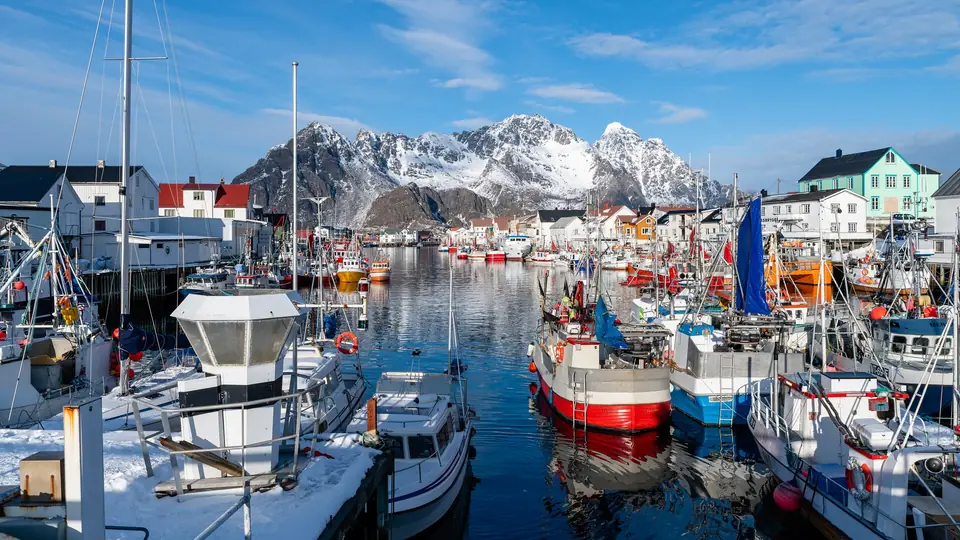
The history of Henningsvær is the history of cod. During the Lofoten winter fishery up to 10,000 fishermen came to be gathered here, and in the post-war years the village housed a quarter of the roughly 20,000 in the whole archipelago, with some 60 fish-receiving plants at its peak. The mole of 1934 joined the islands of Heimøya and Hellandsøya and turned the strait into a sheltered harbour, ringed by warehouses on stilts and wooden drying racks.
The old factories tell of a second life. Engelskmannsbrygga, built by an English pharmaceutical company to produce cod-liver oil, was blown up by British commandos in 1941 and today is a ceramics, glass and photography workshop; a 1950s caviar factory has become KaviarFactory, where Ai Weiwei, Marina Abramović and Yoko Ono have exhibited. And at the southern end, a football pitch levelled on the rock looks out over the sea among hanging cod.
Highlights
- The fishing village Henrik Drejer bought whole in 1842 for 6,000 speciedaler
- Cod drying racks full from March to June, with the fish bound for Italy and the heads for Nigeria
- Engelskmannsbrygga, a cod-liver oil factory blown up in 1941 and now a craft workshop
- KaviarFactory, a former caviar factory turned contemporary art space
- Henningsvær Stadion, a football pitch on the rock ringed by sea and drying racks
The history of Henningsvær begins long before its name. In a peat bog beside the village turned up one of the oldest skis in Norway, radiocarbon-dated to about 2,000 years old, while the place name, made of the male name Henning and vær, “fishing village”, is first recorded in writing in 1567. In the first Norwegian census, of 1769, only 4 permanent residents lived here; in 1875 there were 235, and around 1950 the village reached its peak with 994 registered inhabitants, against 517 in 2025. Anyone wondering what to see in Henningsvær finds a fishing village still active, spread over flat islets, with warehouses on stilts and a mountain that, according to the saga of the Nordland coast, is a petrified troll king. On 14 October 2022 the State protected it as a cultural environment of national value, with a curious condition: that it stays in use. The audio guide walks it on foot from the arrival bridges to the football pitch at the southern end, passing the square, the church and the harbour breakwater.
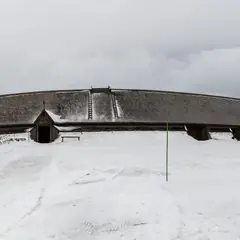
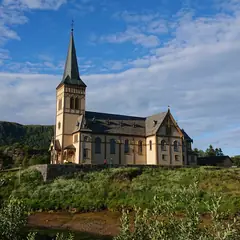
Vågan Church, in neighbouring Kabelvåg, was built for those same winter fishermen; Nusfjord keeps another almost intact harbour of rorbuer and drying racks, and in Reine the other British raid of 1941, the Christmas one, is remembered.
The last bridge, the end of isolation
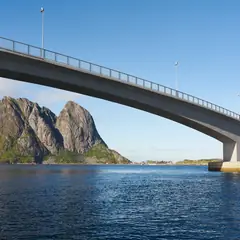
Henningsvær bru
Summary of this stop
At the bridgehead, on Heimøya, ends a journey that for centuries could only be made by sea. Until 1960 Henningsvær’s only link with the outside was the boat to Kabelvåg and Svolvær; that year road 816 reached Festvåg, in 1963 a ferry began to run, and in 1983 Håkon Kyllingmark opened the two single-lane prestressed-concrete bridges that hop from islet to islet: the Engøysundet one, 194 metres, and the Henningsvær one, 257 metres with a main span of 150.
The isolation had a very specific flavour too. Electricity arrived in 1922 and, a few years later, a drinking-water pipe from Austvågøya; before that, islanders rowed across the strait to buy water from “Vass-Lovise”, Lovise of the water, who made a living selling it to them.
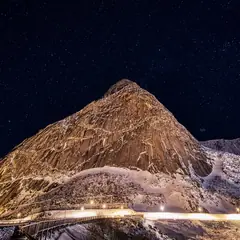
Behind the village rises Vågakallen, 943 metres high, with a small natural rock cross on the summit interpreted as a little man carrying a pair of oars. Tradition obliged the skårunge, the boy going to the fishery for the first time around the age of 14, to take off his cap before the mountain, and it was the veterans who demanded it. Why that peak deserved so much respect is explained by the narration beside the bridge, with a saga of jealousy, pursuits and a May dawn.
Engelskmannsbrygga, from oil to dynamite
Engelskmannsbrygga
Summary of this stop
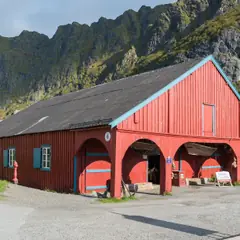
In the village square stands Engelskmannsbrygga, “the Englishman’s quay”, built in the early 20th century by an English pharmaceutical company to produce medicinal cod-liver oil. Since 1997 it has been a craft workshop and gallery, founded by the ceramicist Cecilie Haaland, the photographer John Stenersen and the glassmaker Kari Malmberg, with the ceramics, blown glass and photography in view.
The building holds a war wound. On 4 March 1941, during the Allied raid on Lofoten known as Operation Claymore, the British commandos of No. 3 Commando blew up the fish-oil plant. Several young men from Henningsvær left with them for Britain to enlist, and the German occupiers responded by sending their relatives to the Grini prison camp.
A short detour from the main street leads to another converted factory: KaviarFactory, a 1950s brick-and-concrete hall where caviar was produced, which the collectors Venke and Rolf Hoff rehabilitated in 2013 as a contemporary art space. Bjarne Melgaard, Ai Weiwei, Marina Abramović and Yoko Ono have passed through it, and in 2020 it received the Nordnorsk arkitekturpris. In this square the audio guide tells how a village goes from oil to dynamite and from dynamite to art without ceasing to smell of fish.
The white church on Drejer’s plot
Henningsvær kirke
Summary of this stop
On a small rise on Heimøya, beside the mole and surrounded by drying racks, stands Henningsvær Church: white timber, rectangular plan, about 250 seats and a design by the architect Odd Storm. Sources do not entirely agree on its date, because one tourist fact sheet speaks of 1852; according to the others, that year the first chapel was built, demolished in 1974, and the present church was raised on the same plot.
The land for that chapel had a peculiar price: it was donated by Jens Henrik Klæboe Dreyer in exchange for having his own chair in the church. Behind it appears an even more surprising story. In 1842 Henrik Drejer, whose surname is also written Drejher, bought the entire fishing village for 6,000 speciedaler and provided it with an infirmary, a fishing doctor, a chapel and a fishing lighthouse that opened in 1857 and was replaced by a beacon in 1935. Whether the chapel’s donor and the village’s owner were the same person is something the sources do not clarify.
Drejer died without heirs in 1882, and the province of Nordland bought Henningsvær so that it would not pass into foreign hands. What it meant to live in a village that had an owner, in the years when it went from a handful of residents to several hundred, is discovered by listening to the narration in front of the church.
The mole that sheltered ten thousand fishermen
Mole between Heimøya and Hellandsøya
Summary of this stop
From the mole that closes the harbour to the south you take in the whole inner harbour: quays, warehouses on stilts and boats reflected in the water, with Vågakallen in the background. This breakwater, finished in 1934 between Heimøya and Hellandsøya, sheltered the harbour from south-westerly gales and joined by land the two halves of the village, which for a long time was one of Lofoten’s dominant fish-receiving ports.
In the winter fishery up to 10,000 fishermen came to be gathered here, and in the post-war years a quarter of the roughly 20,000 in all Lofoten were lodged in Henningsvær. The village had some 60 fish-receiving plants; a few remain today. That narrow entrance also holds the memory of the Lofotstormen, the north-westerly storm that on Sunday 11 February 1849 caught thousands of fishermen in open boats in the middle of the Vestfjord. The dead have been put at between 300 and 500, although the highest figure, from the book Judge Hans H. S. Schulze published in 1865, is considered probably exaggerated.
A fisherman who had set out from Stamsund told years later how his boat managed to get into Henningsvær a hundred fathoms from the rocks, and what the skipper had to do to achieve it is saved for the narration on the mole. Since 2022 the whole has been protected as a cultural environment of national value, exteriors only and under the principle of “protection through use”, so that it remains a place of housing, fishing, trade and tourism.
Football on the rock, among cod
Henningsvær Stadion
Summary of this stop
At the southern end of Hellandsøya appears the village’s most unexpected image: Henningsvær Stadion, an artificial-turf pitch made by levelling bare rock, with sea on three sides, floodlights and no stands. The strip of asphalt around it serves as stand and car park for some 500 people, and the cod drying racks that ring it stop the balls before they end up in the water. UEFA chose it from 13 places for its #PlayAnywhere campaign, filmed with Ada Hegerberg and Liv Cooke.
Those wooden drying racks are not decoration. Dried cod is still Henningsvær’s main export: the fish is shipped to Italy and the heads to Nigeria, and between March and June the hjeller fill with cod, the heads hung on strings. The rest of the year, the triangular structures stand empty on the rocks.
Every winter, during the skrei fishery, a ritual that no brochure advertises is repeated: the village children cut cod tongues beside the fish factory in the harbour, a custom older than anyone remembers, and keep the money. Some have paid for their bunad, the Norwegian national costume, that way. The unwritten rules of that children’s trade, and why no adult may lend a hand, are revealed by the audio guide at the end of the route.