Viking archaeology
Lofotr Viking Museum Audio Guide (Lofotr Vikingmuseum)
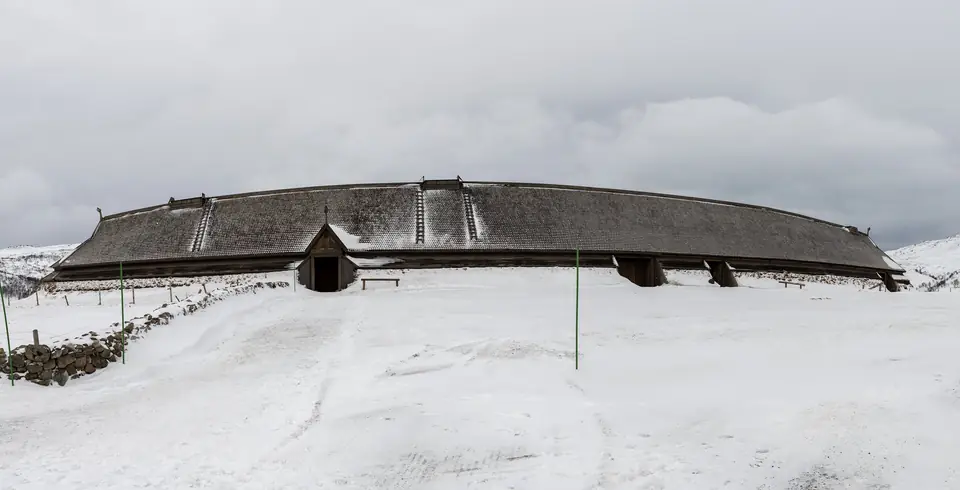
On a knoll in Borg, a farmer who ploughed deeper than usual uncovered the largest known house of the Viking Age. Today it rises again at full size, 83 metres of timber and turf, beside the outline of the original.
- 90 min of audio
- Viking chieftain's house and harbour
In 1981 Frik Harald Bjerkli noticed the soil was especially black in his field at Borg, and in the furrows glass beads and fragments of a jug from France about a thousand years old turned up. The University of Tromsø already suspected that this parish had a great manorial farm, because the church was built here in the Middle Ages. The Scandinavian excavations of 1986 to 1989 confirmed a chieftain's house: 83 metres long, about 700 square metres and an outer turf wall 1.5 metres thick. The museum was born of that work, and King Harald opened it in June 1995.
What is strange about Borg is how it ended. Around the year 900, according to the most recent dating, the house was abandoned after its posts were carefully taken down and removed, like someone taking their home elsewhere. One hypothesis, without direct proof, links its last chieftain to Olaf tvennumbrúni, the settler who according to the Landnámabók moved from Lofoten to Iceland at the time of the settlement.
Highlights
- The largest known house of the Viking Age, rebuilt at full size: 83 metres of timber and turf
- The only known feasting hall of the Norwegian Viking period, with the chieftain's seat of honour
- Five gullgubber, gold foil figures of a couple, found beside the chieftain's seat
- Tating ware from the Rhine area and a gold pointer with six counterparts found in England
- The ship “Lofotr”, a full-scale copy of the 9th-century Gokstad ship, in the Viking harbour
The story of the Lofotr Viking Museum begins with a plough. In 1981 the farmer Frik Harald Bjerkli worked his field at Borg, on the island of Vestvågøy, deeper than usual, and the earth came up black; the amateur archaeologist Kåre Ringstad gathered in the furrows glass beads and pieces of a French jug about a thousand years old. The University of Tromsø, which had been surveying the island since the 1970s, thus had confirmation of what it suspected: a settlement of the late Iron Age and the Viking period (some sources place in 1983 the moment the chieftain’s house came to light). A joint Scandinavian project excavated the site between 1986 and 1989, and in June 1995 King Harald cut the ribbon before 1,500 guests; in the first week probably more than 5,000 visitors came through. Anyone looking for what to see at the Lofotr Viking Museum finds an open-air route that goes from the display cases of the finds to the outline of the original house, enters the full-scale reconstruction and ends at a harbour with a ship that sails. The audio guide, researched and fact-checked against sources, follows that order and fits together the story of the Lofotr Vikingmuseum piece by piece.
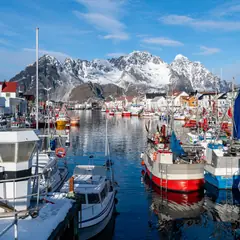
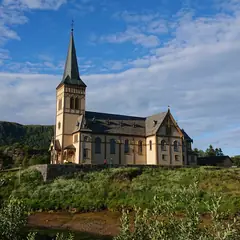
Two centuries after Borg was abandoned, King Øystein had the first church in Lofoten built in Kabelvåg, where Vågan Church stands today; very close by, Henningsvær shows how the cod archipelago lived afterwards.
A black furrow with glass from France
Glassgården display cases
Summary of this stop
The walk starts at Glassgården, the entrance building, where the finds from Borg are displayed: gullgubber, fragments of imported glass and pottery, beads, brooches and a weaving sword of whalebone, plus the 12-minute film “Drømmen om Borg”. Among the pieces are fragments of Tating ware, from the Rhine area, decorated with tin foil; in Norway that type has turned up only here and in the market of Kaupang. And a “gullpeker”, a gold pointer: of the seven known, six were found in England and the seventh on this Lofoten knoll.
The tiny gold foils hold another enigma. One of them would have a twin struck from the same die at Aska, near Vadstena in southern Sweden, seat of a dynasty of petty kings with their own hall on an artificial platform. What these embracing couples represent remains debated: for some, princely weddings; for others, the sacred union of the god Freyr with the giantess Gerd, from whom the kings of the time claimed divine descent. Which hypothesis gains weight when you look at the foil up close is something the narration saves for in front of the display case.
Eighty-three metres marked in the grass
Outline of the excavated house
Summary of this stop
Beside the reconstruction, the plan of the excavated house is still drawn on the ground, with wall lines and wooden posts placed where the originals stood. It is the most direct way to measure the scale: in the 6th century a 67-metre longhouse was raised here, and at the start of the Viking Age it was rebuilt and lengthened to 83, with about 700 square metres. It was of timber, protected by a second outer turf wall 1.5 metres thick, and is considered the largest known house of the Viking Age, although sources do not entirely agree on its measurements.
The clue that brought archaeologists to this spot was not the house but the church. The University of Tromsø assumed the parish of Borg had had a great manorial farm because the church was built here in the Middle Ages, and Borge church is still in view from the museum. How that suspicion fits with what appeared under the plough is better understood walking the outline with the audio guide.
The seat of the only feasting hall
Feasting hall seat
Summary of this stop
Inside the reconstructed chieftain’s house, the work of Boarch arkitekter (Gisle Jakhelln), the central hall keeps the seat of honour, the great carved pillars and walls covered in sheep and reindeer skins. The original house was divided into five rooms under one roof: dwelling, byre and feasting hall. The two largest were the byre, with room for 50 cows, and this hall, the only one of its kind known in the Norwegian Viking period.
The chieftain’s power had an exact corner. In the north corner of the hall five gullgubber turned up, gold foils stamped with a man-and-woman couple, beside the structures interpreted as the lord’s seat. Why the gold was precisely there, and what it said about whoever sat on that bench, is one of the pieces the narration unveils in front of the seat.
A house taken down post by post
Hearths of the chieftain's house
Summary of this stop
In the hall open fires burn where lamb stew is cooked; in the original house, two long hearths warmed and lit the feast. All that ended in an unusual way. Around the year 900, according to Inger Storli’s dating (other sources say 950), the house was abandoned after its posts were carefully taken down and removed: there was no fire or ruin, but an orderly move.
Where those posts went is only a hypothesis. Storli proposes that the chieftain loaded them onto his ship and emigrated to Iceland because of the conflicts of the unification of the Norwegian kingdom, and some identify him with Olaf tvennumbrúni, “Olaf Split-Brow”, who according to the tradition recorded in the Landnámabók moved from Lofoten to Iceland and took the district of Skeið. The saga credits him with enormous strength and, after his death, a family tragedy with a widow, a suitor and a son who kills at a crossroads and celebrates it in verse as an offering to Odin. How that revenge ends is told beside the fire.
A lynx and a wolf at the jetty
Viking harbour and the Lofotr ship
Summary of this stop
The route goes down to the Viking harbour, by the water, with its boathouse (naust) and archery and axe-throwing activities. There lies the “Lofotr”, a full-scale reconstruction of the 9th-century Gokstad ship, which has won several regattas; the museum has a second, smaller ship. Around it, the landscape is considered almost the same as in Viking times and is kept up in part by Nordland horses and cattle, feral sheep and wild boar. Every August, since 2004, the Lofotr Vikingfestival fills this jetty with market, forge and competitions.
The names of the two ships hide a small enigma. “Lofotr” was the old name of the island of Vestvågøya before it passed to the whole archipelago, and the small ship is called Vargfotr, like neighbouring Flakstadøya. The traditional explanation reads in them a lynx’s paw and a wolf’s paw, but the etymology remains disputed among philologists, and the audio guide closes the walk with the other readings that have been proposed for the name Lofoten.