The Lofoten cathedral
Vågan Church Audio Guide (Vågan kirke)
The largest church in northern Norway was not made for the village around it, but for the thousands of fishermen who filled the bay of Kabelvåg each winter. It arrived in pieces from Trøndelag in 1898 and its story is still scattered across other islands and other churches.
- 30 min of audio
- Neo-Gothic timber architecture
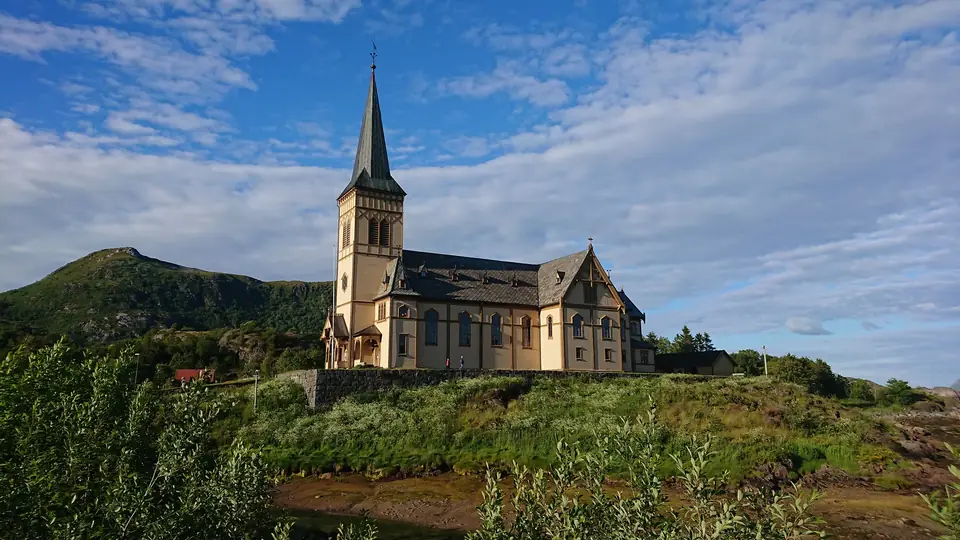
In the bay of Kabelvåg, where King Øystein Magnusson had the first church in Lofoten built in the early 12th century beside huts for fishermen, a Neo-Gothic hulk of ochre timber has stood since 1898. It was designed by the Danish-born architect Carl Julius Bergstrøm, who died the same year it was consecrated, and it was first assembled in Trøndelag, marked piece by piece and shipped north to be raised again here.
Its size answers a very specific calculation: during the winter fishery the parish reached 6,000 people, and at the inauguration more than 3,000 fitted inside without it seeming crowded. In 1929 a bishop said from the pulpit that he felt as if in a cathedral, and the nickname Lofotkatedralen stuck for ever, although it has never been more than a parish church.
Highlights
- 1898 timber church prefabricated in Trøndelag and assembled piece by piece in Kabelvåg
- Nicknamed Lofotkatedralen since 1929, when some 2,000 people filled the nave
- Ochre yellow walls and brown details, the original colours restored in 1985
- Gethsemane altarpiece of around 1860 on the high altar and Frederick II's Bible of 1589
- Gallery of portraits of priests with pieces from the 16th century
From the sea, the first thing Kabelvåg announces is not a house or a quay but an ochre tower with a spire. Vågan Church (Vågan kirke), consecrated on 9 October 1898, is the largest in northern Norway and occupies a bay that has been tied to a church for centuries: here King Øystein Magnusson founded the first in Lofoten, on a date that sources place between 1103 and 1130. The story of Vågan Church is that of a building out of all proportion to a small village, designed for the thousands of fishermen of the winter season, and anyone looking for what to see in it finds a nave of slender columns and pointed arches, an altar with pieces inherited from earlier churches and a portrait gallery that begins in the 16th century. The audio guide covers the place in four stops, from the road to the high altar, with narration researched and fact-checked against historical sources.
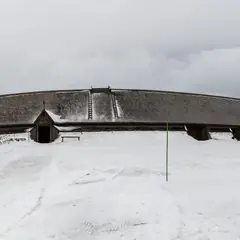
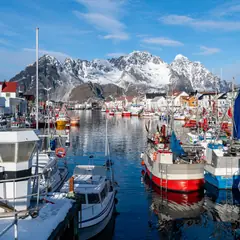
The fishermen it was built for lived in villages like Henningsvær, a few kilometres away, and the history of Lofoten before Øystein’s first church is told in Borg, in the Lofotr Viking Museum.
Kjerkvågen, the church bay
Vågan kirke
Summary of this stop
In front of the church, beside the E10, the landscape explains the name of the place. The saga of Håkon Håkonsson already called it Kirkjuvagum in 1224, “the church bay”, and the very name Kabelvåg possibly comes from “kapell”, chapel, plus “våg”, bay. Since Øystein Magnusson had the church and the first rorbuer for the fishermen built together, temple and fishery have gone hand in hand on this shore.
Vågan, the medieval Vágar, was the first place in the world north of the Arctic Circle with an urban-type core. From here dried cod, tørrfisk, set out for a Catholic Europe that needed fish for its many periods of fasting. The tower that now dominates the bay still works as a navigation mark.
The saga, according to a documented tradition, also puts blood in this harbour. In 1139, the pretender Sigurd Slembe and Magnus the Blind came down the coast in two Sami boats sewn with deer sinew, so light that no ship could catch them, and on reaching Vágar they committed a crime that the narration saves for this spot, facing the bay.
A kit cathedral that came from Trøndelag
West tower and entrance door
Summary of this stop
Beneath the west tower, the timber tells its own journey. The church was first raised in Trøndelag, probably in Levanger, with logs from the timber firm Jacob Digre of Trondheim; every piece was marked, taken down and shipped north to be assembled in Kabelvåg. The work cost 62,500 kroner, not counting the plot or the furnishings. The architecture of Vågan Church is Neo-Gothic, in a cruciform plan, with short, wide arms by the chancel and a long nave running towards the tower.
The building rests on a plinth of natural stone, on a small rise beside the sea. Its ochre yellow walls with brown bands and details are those of 1898, recovered in 1985. Above the crossing, however, something is missing: Carl Julius Bergstrøm drew a tall, slender turret there that was never built, and his design foresaw more pinnacles and spires than were executed.
In front of the church stands the statue of Hans Egede, chaplain of Vågan between 1707 and 1718. As he himself told it, it was here that the idea came to him to go to Greenland in search of the descendants of the old Norse colony, and in 1721 he sailed there until he founded Godthåb, present-day Nuuk. How a fishermen’s rectory ended up at the origin of a capital, and why his twin statues have become a target of the colonial debate, is what the audio guide tells at the foot of the tower.
A nave for six thousand fishermen
Central nave and galleries
Summary of this stop
Inside, the central nave is separated from the side aisles by tall, slender timber columns joined by pointed arches, with galleries above. That spaciousness has an explanation. A crown prince’s resolution of 1895 required the parish church to hold a third of the parish’s inhabitants, and during the winter fishery Vågan reached 6,000 people. A dispensation was granted for the seasonal variation and the church ended up with about 1,200 seats, a figure that sources now lower to around 1,000.
At the opening in 1898, the newspaper Lofotposten wrote that more than 3,000 people fitted inside without it seeming crowded. On 9 May 1929, during an ordination of priests, some 2,000 people filled the nave, 800 of them standing, according to the later estimate of Bishop Eivind Berggrav himself, who said from the pulpit, drenched in sweat, that he felt like in a cathedral. From that, according to the most widespread version, comes the nickname Lofotkatedralen; other sources attribute it simply to its being the largest timber building in northern Norway.
Today it is a veikirke, a road church: in summer it opens to any visitor with a 50-kroner entry that pays for the building’s upkeep, and it hosts concerts, including chamber-music festivals. What timber does to sound in a nave of this size is one of the keys the narration reveals at the back of the church, under the gallery.
The altar of the scattered churches
Gethsemane altarpiece on the high altar
Summary of this stop
Before the high altar, almost nothing was born in 1898. The Gethsemane altarpiece was painted around 1860 by Fredrik Nikolai Jensen, parish priest of Bø in Vesterålen, trained as a painter in Düsseldorf; it was in the old church and in 1948 replaced the original altarpiece, which now hangs on a side wall. The church also keeps King Frederick II’s Bible of 1589, chandeliers and candlesticks of the 17th century and a baptismal font of the 18th, along with a collection of portraits that is rare in size and quality.
The earlier churches did not disappear entirely either. The 1898 church was built on a new plot, about 200 metres east of the previous one; the cruciform church of 1798 remained standing across the road until the summer of 1900, when it was demolished and its timber sold by weight, although its pulpit canopy ended up in the church of Svolvær. And a Vågan church of the 18th century is still in use on the island of Værøy, where it was moved in pieces in 1799, according to the most cited date, after a storm had wrecked the island’s church.
With it travelled, according to a documented tradition, a treasure far older than the church itself. What it was, where it came from to Kabelvåg and why the most valuable part of Vågan’s furnishings is today on an island at the end of Lofoten is the closing the audio guide keeps for the altar.