Fishing village museum
Norwegian Fishing Village Museum Audio Guide (Norsk Fiskeværsmuseum)
In Å, the one-letter village where the E10 ends, a 19th-century fiskevær still stands whole: shop, bakery, master's house, boat shed and cod-liver oil boiler. All its pieces formed a single machine, driven by cod and by the debt of those who went out to fish it.
- 75 min of audio
- Lofoten fishing and 19th-century houses
The væreier Johan Ellingsen arrived in Å in 1843 and built his fiskevær here; from then on several generations of Ellingsens owned and ran it, with the land and nearly all the buildings in the merchant's hands. They lodged the fishermen, sold them provisions and aquavit, bought the catch and exported the fish. The complex, with houses protected since 1969 and the rest of the village under a preservation order, has been a museum since 1987 and officially opened in June 1988.
Wealth could be read in the paint. In the 19th century white was expensive and red and ochre cheap, so the façades facing the sea are white and the rear ones red. Behind that pleasant face ran the system of the nessekonger, the kings of the headland: the indebted fisherman had to return to Å every season and could not change merchant while he owed money, something that lasted well into the post-war years.
Highlights
- The merchant's shop of 1843, now the museum reception
- The Gammelgården bakery, with a wood-fired oven that bakes 100 loaves in one batch
- Swiss-style main house where five generations of Ellingsens lived
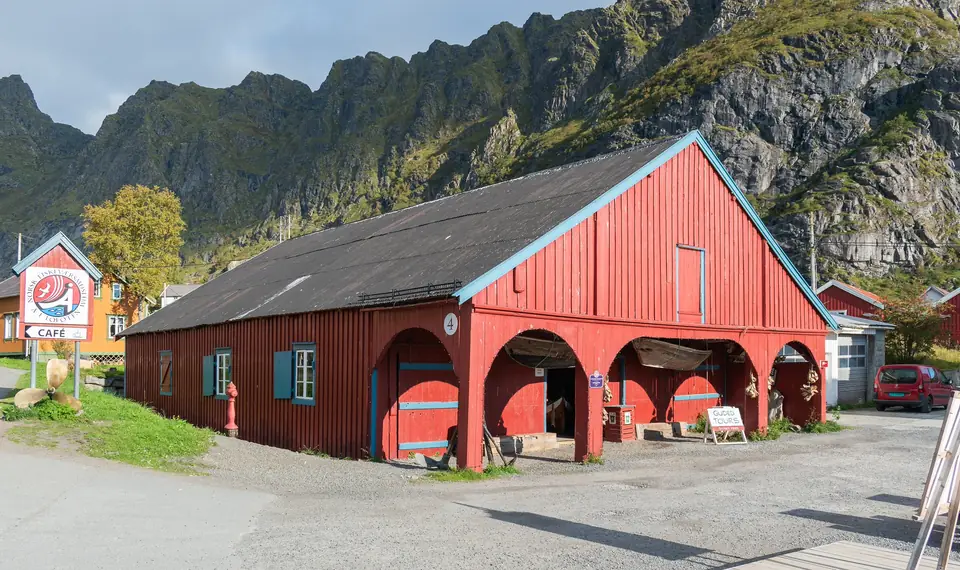
- The great naust of 1844 with Nordland boats, åttringer and fembøringer
- Trandamperi of 1850 with a cod-liver oil boiler brought from Hopen
The Norsk Fiskeværsmuseum is not a building with display cases but a whole fishing village turned into a museum. It was founded on 3 July 1987 by the Moskenes History and Museum Society, the municipality of Moskenes and Sigurd Harald Ellingsen; it officially opened in June 1988 and has received public funding since 1990. The story of the Norsk Fiskeværsmuseum begins in 1843, when the væreier Johan Ellingsen arrived in Å (one source moves the family’s ownership back to 1842), and stretches to the late 1990s, when Å ceased to be an active fiskevær. Anyone wondering what to see at the Norsk Fiskeværsmuseum finds a shop, a bakery that still bakes, the masters’ house, a shed full of boats and a cod-liver oil boiler by the sea: pieces the audio guide fits together to show how a whole village lived off cod and debt.
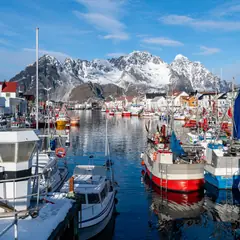
To round off the visit, Reine shows, a few kilometres away, another fiskevær with a væreier, and from neighbouring Reinebringen you take in that whole landscape; further north, Nusfjord keeps almost intact a village that also had a single owner.
The 1843 shop at the end of the E10
Norsk Fiskeværsmuseum
Summary of this stop
The route begins where the road ends. The E10, which comes all the way from Luleå in Sweden, dies in this village whose name is an old Scandinavian word meaning “river” and also the last letter of the Norwegian alphabet. Together with the French village of Y, places called Å are listed in the Guinness book as the shortest names in the world, and the sign announcing arrival often disappears into some traveller’s luggage.
The way in is the merchant’s old shop, from 1843, now the museum reception. From here the Ellingsens governed the fiskevær: they owned the land and almost all the buildings, and several generations of the family ran it. What exactly it meant to buy at this counter, and why a fisherman’s whole year was decided here, is revealed by listening to the narration on the threshold.
A hundred loaves for Å’s rowers
Gammelgården bakery oven
Summary of this stop
Gammelgården, a long log house with a slate roof, was built in 1844 in the Trøndelag and Nordland style. It burned in 1888 and was rebuilt in late Empire style (an architecture guide writes 1988, a date that everything suggests is a misprint). During the fishing season it housed workers who came from elsewhere along with the servants, and today it is protected by Riksantikvaren.
In its rear wing burns the great stone-and-brick oven, able to bake 100 loaves in one batch. It was the bread of the hundreds of fishermen who rowed out from Å; several sources date oven and building to 1844, although the museum’s own fact sheet speaks of a wood-fired oven from 1878. From mid-May to October, heated with birch wood, it bakes bread and cinnamon buns again in view of the public, and the audio guide explains what the size of that batch says about the size of the fishery.
The headland king’s white façade
Main house courtyard and Øvergården
Summary of this stop
In the courtyard stand the main house, built in 1864 and extended in length and height from 1896 with its Swiss-style decoration, and the long Øvergården, raised in the early 1870s for Christen Peder Ellingsen, with rococo-style paned windows. Around 1900 the main house had a cook, a maid, a nanny and several servants, and five generations of Ellingsens have lived in it. Behind, on a terrace, peek out the remains of the family garden.
The architecture of the Norsk Fiskeværsmuseum teaches you to read wealth in paint. In the 19th century white was expensive and red and ochre cheap: the façades facing the sea are white, and the backs of Øvergården and Gammelgården and the provisions store, older than 1886 and with its meal bell still in its turret, are painted red.
Under that façade the system of the nessekonger was sustained. The Ellingsens lodged the fishermen, sold them provisions and aquavit, bought the catch and exported the fish; whoever fell into debt had to return to Å every season and could not change merchant while he owed money. How that chain worked, which lasted well into the post-war years, is told in front of the white house.
Nordland boats hung under the roof
Great Nordland boat naust
Summary of this stop
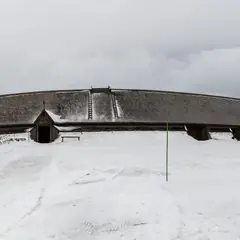
The great naust, the boat shed of 1844, kept the boats of local and visiting fishermen between seasons. The small Nordland boats were hoisted under the roof; the åttringer and fembøringer, too big, stayed on the floor. Today it gathers four-, six- and eight-oared boats, a motorised Nordland boat from around 1915, fishing gear and a net-tanning vat.
Those open rowing-and-sailing boats ruled the Lofoten sea until about 1915, when the engine arrived, and the whole wealth of the village depended on them. Among its beams fits the documented tradition of the draug, the spirit of a drowned man without burial in Christian ground, dressed as a fisherman, sometimes with a tuft of seaweed for a head and rowing in half a boat. Hearing his cry foretold storm and death; what was done when he called someone by name is left for the narration under the naust’s roof.
Oil boiler facing the Moskstraumen
Trandamperi by the sea
Summary of this stop
By the sea stands the trandamperi, the cod-liver oil boiler. The building dates from 1850, although the original factory is gone: the complete installation seen today was brought from Hopen, on the island of Austvågøy, and the label of Europe’s oldest fish-oil factory that sometimes goes with it has no independent support. The oil was used for lamps, paint and tanning hides; the oil sjøhus beside the naust is still in use to demonstrate the old use of the liver, and the museum makes oil paint that is still used on old houses along the coast.
In front, between Å and the island of Mosken, runs the Moskstraumen, the original maelstrom. Olaus Magnus drew it in his Carta Marina of 1539, and in the 17th and 18th centuries it was claimed that the water slipped down an underground tunnel to the Gulf of Bothnia. On Jonas Ramus’s description Edgar Allan Poe wrote “A Descent into the Maelström” in 1841, and Jules Verne had Captain Nemo’s Nautilus end up there.
Å remained an active fiskevær until the late 1990s. A few rorbuer are still occupied by fishermen during the Lofoten season, from January to April, and most are rented to tourists. The audio guide closes the route here, with the whirlpool that half a continent imagined swallowing ships starting right in front of the cabins.