Historic fishing village
Nusfjord Audio Guide
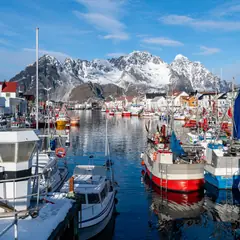
Red rorbuer on stilts and ochre warehouses wedged into a narrow fjord on Flakstadøya: Nusfjord looks like an untouched postcard, but it is a village that always had an owner, that escaped the wrecking ball thanks to a bad fishing season and where an entrance fee is now charged.
- 60 min of audio
- Fishing heritage and timber architecture
Nusfjord is one of the best-preserved fiskevær in Lofoten. The væreier Hans Grøn Dahl arrived in 1836 and built practically the whole complex, and his family owned and ran the village until 2005. Of its 60 buildings, almost 50 belong to the owner, 12 are private homes and only 2 are public: the school and the bedehus that the fishermen themselves paid for in 1873. In 1975, European Architectural Heritage Year, it was one of Norway's three pilot projects for preserving timber-house environments.
Behind the picture there is a hard history. In 1905 some 1,500 fishermen from all along the coast worked from here, and those who could not afford a rorbu slept under their upturned boat. At one time more than 600,000 cod hung at once on the drying racks. There was no permanent road until 1967, and around the harbour basin no modern house has been built since the glory years: that is why the harbour looks almost as it did then.
Highlights
- A village of 60 buildings where almost 50 belong to a single owner
- Øvrebrygga, the ochre warehouse due to be pulled down in 1974 and saved by a poor fishing season
- The 1907 shop, still open, and the 1877 bakery that still bakes
- 34 red rorbuer on stilts, out of the 75 recorded by a 1888 insurance report
- One of Norway's three pilot timber conservation projects of 1975
The name sounds like pure landscape, but inside it carries a man: according to documented tradition, the first element of Nusfjord comes from the male name Knut, someone of whom nothing else is known. The rest of Nusfjord’s history is written down, and with proper names. In 1836 the væreier Hans Grøn Dahl arrived (other sources date the family’s ownership to 1847) and the village stayed in the Dahls’ hands for almost two centuries, until its sale in 2005. Along the way it was a hive of fishermen, came close to losing its tallest warehouse, joined in 1975 the three Norwegian pilot projects for preserving timber houses and ended up as both museum and lodging. Some websites present it as a UNESCO World Heritage Site, although several Norwegian sources deny it is on that list. Anyone looking for what to see in Nusfjord finds a narrow harbour basin surrounded by red rorbuer and ochre warehouses; the audio guide walks it from the quay to the south cove and the headland facing the open sea, reading in each façade who gave orders and who worked.
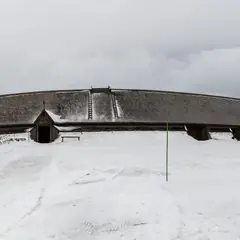
If the væreier system interests you, the Norwegian Fishing Village Museum in Å explains it piece by piece; Henningsvær keeps its cod drying racks in use, and in Borg, on the neighbouring island of Vestvågøy, the Lofotr Viking Museum takes the history of the islands back a thousand years.
A whole village with a single owner
Nusfjord
Summary of this stop
From the edge of the harbour basin, Nusfjord reads as a property. The village has 60 buildings and almost 50 belong to the owner of the fiskevær; 12 are private homes and only 2 are public. It was Lofoten’s typical model, in which the merchant owned the ground and nearly all the houses, and here it survives with unusual clarity.
One of those two public buildings is the bedehus, the religious meeting house the fishermen themselves paid for in 1873; the other is the school. In a village built almost entirely by one man since 1836, that small building paid out of their own pockets says a lot about who the others were. How power was shared out around the water is better understood by listening to the narration with the harbour in front of you.
Øvrebrygga, the warehouse saved by a bad catch
Øvrebrygga
Summary of this stop
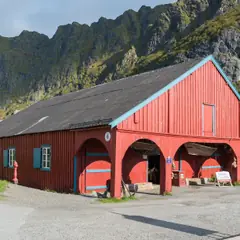
Facing the quay stands the row of ochre warehouses: Gammelbrygga, with Øvrebrygga right behind, Butikken in the middle with its sea-facing attic and loading hoist, and Storbrygga, from 1937, on the right. All are ochre yellow with white frames, while the rorbuer were painted red because it was the cheapest paint. The colour shows who was who.
Øvrebrygga, the tallest, with two and a half storeys and vertical boarding, was due to fall in 1974 to make room for a new processing plant. A poor fishing season stopped the plan, and the building was still standing when Nusfjord joined the 1975 pilot project, whose local priority was to keep the rorbuer, the kitchen and the shop warehouse intact. It was later modernised inside, with a concrete slab, steel beams and the body raised 40 cm for the forklift, hardly changing outside. Some claim the whole village was to be demolished; what is documented is the plan for this warehouse.
The 1907 shop where the owner watched the harbour
Old 1907 shop
Summary of this stop
The landhandel, the village shop of 1907, is still open and preserved as it was: buckets hanging from the ceiling, a long counter, display cases, enamel signs and an old cash register that asks the customer to claim their receipt. Today it serves as café, shop and reception for the complex. Next door, the bakery built in 1877 to give fresh bread to the fishermen in the rorbuer still bakes, and on the hillside stands the power station of 1905, the third oldest in northern Norway, which supplied the væreier’s house and part of the machinery.
According to local tradition, the shop’s first room was the væreier’s office: from there he had the harbour in view and watched at once the boats loaded with fish and the sales at the counter. In Dahlgården, the white house Hans Dahl had built in 1926, a chess table with an inscription leads as far as Liguria, one of the great markets for Norwegian dried cod. What that table tells is left for the narration.
Red rorbuer: from 75 cabins to 34
Red rorbuer of the south cove
Summary of this stop
In the small cove to the south, one-storey red rorbuer dip their wooden legs in the water. An insurance report of 1888 recorded 75 in Nusfjord; today 34 survive, each with one or two warehouses, and most are rented to tourists (the count varies according to which buildings are counted as a rorbu). Behind the postcard there was overcrowding: in 1905 some 1,500 fishermen worked from here, and those who could not afford a rorbu turned their boat over and sheltered underneath. In the golden age more than 600,000 skrei cod hung at once on the drying racks.
Cold was also a harvest. Before refrigerators, every January and February men climbed to the frozen mountain lakes, cut the ice in a grid with long saws and brought it down on horse-drawn sleds to the harbour’s ishus, where it lasted under sawdust until late summer. Where those saws are kept today is one of the details reserved for the route.
A village sold, almost fenced off and turned into a game
Wooden amphitheatre on the headland
Summary of this stop
The route ends at the wooden amphitheatre on the headland, a set of modern-shaped tiers designed by NTNU architecture students, between the harbour and the open sea. From there you take in the end of the story: in 2005, when Lofoten fishing shifted to the outer edge of the archipelago, the Dahls’ ownership ended and Nusfjord was sold and turned into a tourist complex, restored under the supervision of Riksantikvaren.
Its new owner, Nusfjord AS, proposed fencing it off with a 20 m long, 1.5 m high fence and charging 50 kroner to anyone who was not a resident. The protest invoked allemannsretten, the right of access to nature, and the fence was never built, while the 22 residents live with up to 50 tourist buses a day. And there is another Nusfjord that travels without moving: in 2017 the designer Uwe Rosenberg published a fishing board game with its name, with boats, a hundred fish and a council of elders, set on a forest-covered island of a kind not found on these rocky slopes. What that contrast says about the real village is best heard sitting on the tiers.