Fishing village
Reine Audio Guide
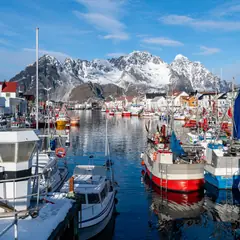
The red cabins on stilts at the foot of Reinebringen are the most repeated image of Lofoten, but behind the postcard lie a fishing station with an owner, a Christmas of 1941 that the village paid for alone, and cod that still hangs in the wind every winter.
- 60 min of audio
- Cod fishing and the Second World War
Reine has been a trading post since the 18th century and became the centre of local fishing, with its own fleet and facilities for processing and selling fish. Its name comes from Old Norse “rein”, a grassy edge or slope, the land as fishermen saw it from the sea. For generations the village had a master: the væreier, owner of the fiskevær and of the rorbuer, on whom the right to fish depended. The log church of 1890 and the red cabins of the harbour tell that story better than any sign.
On 26 December 1941, at six in the morning and in the middle of the polar night, 300 British commandos with Norwegian soldiers of Kompani Linge landed dressed in white and took Reine and Moskenes. They left after three days. As reprisal the Germans burned part of the village, and almost four decades later a magazine chose that same Reine as the most beautiful village in Norway.
Highlights
- Red rorbuer on stilts, the cabins that housed the skrei fishermen
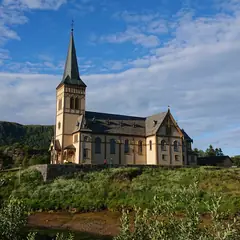
- Reine Church, of logs and white boarding, consecrated in 1891
- Setting of Operation Anklet, the commando raid of Christmas 1941
- The Tørrfisk fra Lofoten drying racks, the first Norwegian product with protected status in the EU
- Sakrisøy, where the Gylseth family has bought fish since 1889
Reine’s story begins long before the photograph. Until the 18th century its fiskevær was part of the Moskenes Gård farm; once separated it had its first væreier, with a tavern licence, and the trading post got going, in 1743 according to some sources and in 1775 according to others. In 1842 Erik Lund bought it, when Moskenes and Flakstad together had barely 1,000 inhabitants. From then on the village lived off the fishing of skrei, the cod that arrives each winter, off the power of those who owned the harbour and, in December 1941, off an Allied incursion whose price was paid by those who stayed. Anyone looking for what to see in Reine finds red cabins, a white church and bridges that hop from islet to islet; the story of Reine, of its timber architecture and of its cod fits together in the audio guide over five stops, from the village centre to the drying racks of Sakrisøy.
The view that went round the world is earned by climbing Reinebringen; a few kilometres away, in Å, the Norwegian Fishing Village Museum shows how a fiskevær with a master worked from the inside, and in Henningsvær lies the trace of the other British raid of 1941.
Beneath Reinebringen, the postcard village
Reine kultursenter
Summary of this stop
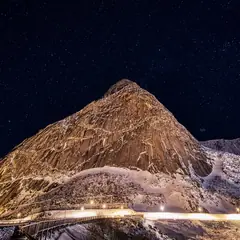
The route starts in front of the Reine kultursenter, the village’s former school, which now houses the Galleri Eva Harr and the work of Karl Erik Harr. Above it rises Reinebringen, 448 metres high, and from its summit was taken the photograph that made Reine the cover of brochures and books. In the late 1970s the weekly magazine Allers, Norway’s biggest by circulation, chose it as the country’s most beautiful village, just as it was coping with the fall in cod demand that began in the sixties.
Lofoten’s most repeated image belongs to a tiny place: capital of the municipality of Moskenes, Reine had 296 inhabitants on 0.28 km² in 2025, against 420 in 2000. That scale explains one of the village’s most curious anecdotes. In January 2015, in the depths of the Arctic winter, Coca-Cola chose Reine to present a new soft drink in Norway at an outdoor event that the brand itself dubbed its smallest launch, and how many neighbours came out to watch is a detail the narration keeps for this point.
The white church the væreier paid for
Reine kirke
Summary of this stop
In the centre of the village stands Reine Church, of logs and white boarding, with a long-nave plan and a small turret. It was built in 1890 to plans by Ole Scheistrøen of Namsos, and Bishop Johannes Nilsson Skaar consecrated it on 9 January 1891. It has about 250 seats, plenty for a village that was never big.
Its financing tells who was in charge here. It was paid for by the væreier H. Sverderup, the municipal council and the well-off residents: a monument to the 19th-century fishing boom largely funded by the lord of the fiskevær. Reine had been born as a trading post with an owner and passed from hand to hand like any property, and in front of the church the audio guide follows the trail of those owners, including a surname that some accounts link to a famous Arctic explorer, though no open source confirms it.
Red rorbuer: sleep here to be allowed to fish
Reine Rorbuer
Summary of this stop
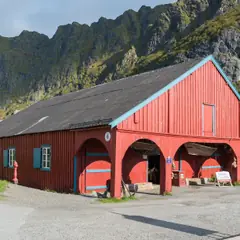
The harbour’s rorbuer, cabins painted red with one end resting on stilts over the water, housed the fishermen who arrived each winter for the skrei fishery, from January to mid-April. Today they make up the Reine Rorbuer hotel, and its restaurant, Gammelbua, occupies the timber building that was the village’s first grocery store.
Behind the colour lies a mechanism of power. From 1816 the law made Lofoten’s væreier inspectors of the fishery: each fiskevær received a stretch of sea, and the right to fish with net or longline was tied to ownership of the rorbuer. The law of 1857 stripped them of part of that power, but the fishermen’s dependence was not fully broken until the råfisklova of 1938. What renting a bunk in these cabins meant is explained in the narration, beside the water.
Christmas 1941: three days of freedom
Rorbuer quay facing the fjord
Summary of this stop
From the edge of the quay, facing the Reinefjorden, you take in the setting of Operation Anklet. At 06:00 on 26 December 1941, 300 British commandos with Norwegian soldiers of Kompani Linge landed in white camouflage suits and occupied Reine and Moskenes. The date was no accident: the German garrison was expected to be busy with Christmas. Nor did the sun rise, as it does not appear here between 10 December and 3 January.
Admiral L. H. K. Hamilton even thought of prolonging the stay, but on the 27th a bomb from a German seaplane fell near the cruiser HMS Arethusa and the force withdrew after about three days. With it, 266 Norwegian volunteers left for Britain (another source says 226). The Germans burned part of Reine in reprisal, although sources disagree on the extent of the destruction, and the population that stayed suffered harsh reprisals.
A documented tradition adds the human side: a stash of French chocolate and cigarettes handed out among the neighbours, requests to the British not to leave, and strong discontent among the Norwegian soldiers on receiving the order to withdraw. Why that order surprised so many is told on the same quay where they embarked.
Sakrisøy: cod in the wind with its own protected name
Sakrisøy
Summary of this stop
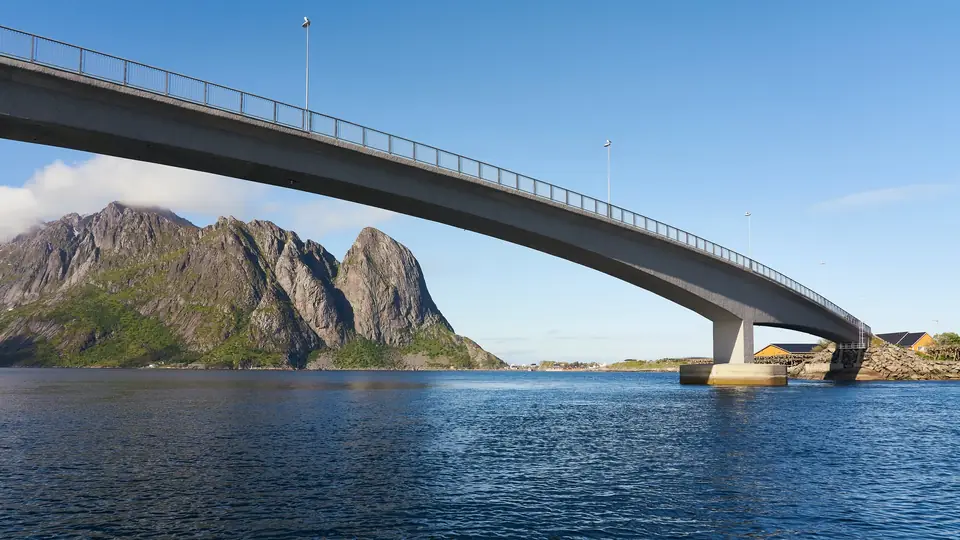
From 1963 a ferry linked Hamnøy with Reine; in 1981 it was replaced by the bridges of the E10, which cross the mouth of the Reinefjorden hopping over Hamnøya, Toppøya, Litl-Toppøya, Olenilsøya, Sakrisøya and Andøya. About 3 km from the village, on the islet of Sakrisøy, Sven Kornelius Gylseth bought the old trading post in 1889, and five generations later the family still buys fish there. Between Christmas and Easter, the stockfish drying racks cover most of the islet.
On those hjeller, log trestles beside the shore, the skrei spends two to four months drying in the open air. This is Tørrfisk fra Lofoten, with geographical protection in Norway since 2007 and, since April 2014, the first Norwegian product with protected designation in the European Union. Out of season the racks stand empty, like wooden skeletons facing the fjord.
Winter also brings a trade with rules of its own, a documented tradition: the tungeskjærere, children and teenagers who on the Lofoten quays cut the tongues out of cod heads to sell as a delicacy. Why adults are chased off the quay if they try to help, and where the emptied heads travel to, is what the audio guide saves for the end of the route.