UNESCO Memory of the World
Kuthodaw Pagoda Audio Guide
At the foot of Mandalay Hill, 729 white shrines each hold a marble slab inscribed on both faces with the Buddhist canon: a stone book written by King Mindon and which, after the looting, his subjects rewrote by hand, letter by letter.
- 45 min of audio
- Buddhist stone book
The Kuthodaw Pagoda, with the formal title Mahalawka Marazein, was born in 1857 together with Mandalay itself: it was one of seven buildings laid out at the same time as King Mindon's new capital. Around its 57-metre golden stupa, a copy of the Shwezigon at Nyaung-U, the 729 marble slabs of the Tipitaka, the Buddhist canon, are lined up in three concentric enclosures, engraved from 1860 and opened to the public in 1868. Since 2013 its inscriptions have been on UNESCO's Memory of the World register, Myanmar's first entry on that list.
The stone book has not come down intact. After the British annexation of 1885 troops were quartered in the compound, and when the Burmese recovered it in 1890 the 6,570 bronze bells, the gold of the letters and the precious stones of the finial were missing. Since the restoration of 1892, the inscriptions are read in black ink of shellac and soot, retouched by hand slab by slab by inkers who, to reach the last lines, work lying face down inside the shrine.
Highlights
- Golden central stupa — 57 metres, modelled on the Shwezigon at Nyaung-U, with its hti mounted in 1862
- 729 slabs of the Tipitaka — The Buddhist canon engraved in marble, spread over three concentric enclosures
- Slab 730 — The chronicle of how the work was made, in the southeast corner of the first enclosure
- Letters retouched by hand — Black ink of shellac and soot where there was once gold
- Star flower trees — Shade and offering flowers planted between the rows in 1892
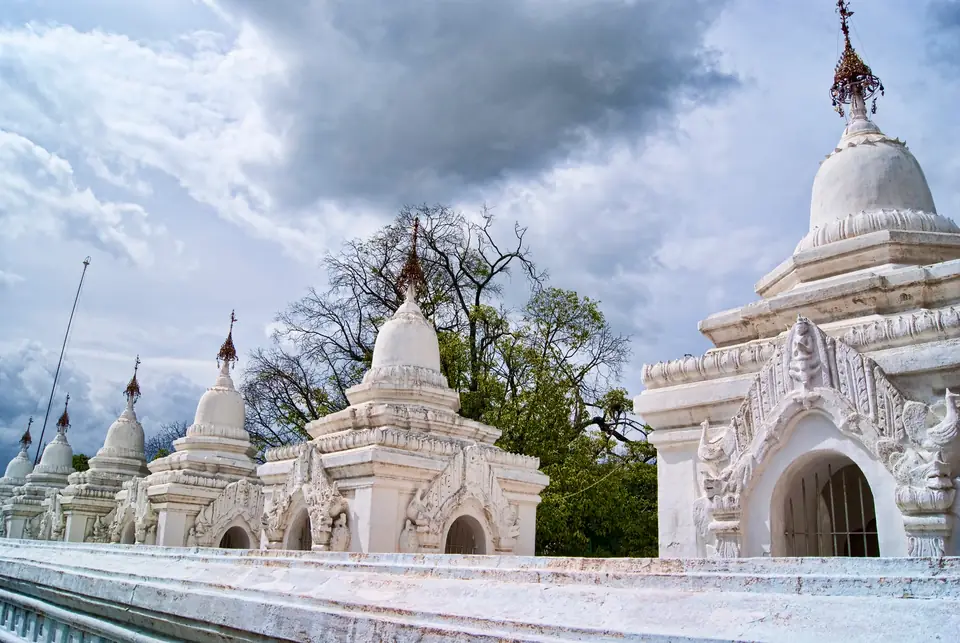
At the foot of Mandalay Hill, the Kuthodaw Pagoda (ကုသိုလ်တော်ဘုရား) is the golden stupa of King Mindon surrounded by 729 white shrines, each with a marble slab engraved on both faces. Together they contain the Tipitaka, the complete Buddhist canon. That is why it is known as “the world’s largest book”, a popular nickname and not an official record that comes from a very Burmese reckoning: each slab is a leaf. Stacked, they would form a tower as tall as a 20-storey building, so they were planted one by one over some 13 acres of ground; reading them all, eight hours a day without missing one, would take about a year and three months.
The history of the Kuthodaw Pagoda begins in 1857, when its foundation was laid out at the same time as the new capital’s, together with the moat, the Atumashi Monastery and the Thudhamma Hall. The engraving of the slabs began in 1860, the stupa received its finial in 1862 and the stones were opened to the public on 4 May 1868; in 1871, the Fifth Buddhist Council approved the text already engraved. Depending on which phase is taken, the foundation is dated to one or another of those years. Then came the British annexation of 1885, the looting, the restoration of 1892 by monks, members of the royal family and former officials of the king, and in 2013 the entry of its inscriptions into the UNESCO Memory of the World register. The earthquake of 28 March 2025 caused serious structural damage to the compound.
The architecture of the Kuthodaw Pagoda reads like an open book: at the centre, a 57-metre stupa modelled on the Shwezigon at Nyaung-U; around it, three rings of brick shrines shaped like Sinhalese reliquaries, the kyauksa gu or “inscription caves”. Very close by, at the neighbouring Sandamuni Pagoda, the hermit U Khandi engraved from 1913 the commentaries on the canon on some 1,770 more slabs, a second marble library beside the first.
To know what to see at the Kuthodaw Pagoda, the audio guide, documented and checked against historical sources, walks the compound in five stops and 45 minutes, from the south portico to the outer rows. The thread that binds them is one idea: this stone book was written by a king, but after the looting his subjects rewrote it, and every black letter, every white finial and every tree is a repair made by hand.
The compound lies at the foot of Mandalay Hill, and some 500 metres away the Shwenandaw Monastery preserves in teak the chamber where King Mindon himself died.
A 1914 gate paid for by the city
Covered south portico
Summary of this stop
The main entrance comes from the south, through a covered portico (saungdan) with teak doors carved with flowers, scrolls and devas, and paintings under the roof. In the outer enclosure, the southern iron gate is dated 1914: it replaced the carved wooden panels that soldiers had destroyed. The western one was paid for the following year by the zat pwè actor U Po Sein, and the northern and eastern ones by Mindon’s sons and grandsons in 1932. None of these gates is the original; all are donations made after the looting.
The scar has its story. After the British annexation of 1885, troops were quartered in the monasteries and pagodas at the foot of Mandalay Hill and the Burmese could not enter. Following a petition driven by the surveyor U Aung Ban, Queen Victoria ordered in 1890 that the troops be withdrawn from the religious compounds.
According to documented tradition, the first great food offering to the pagoda was not held inside, but on the open ground between the Atumashi Monastery and the Hman Kyaung, with the soldiers still nearby. What the city found on entering afterwards says a great deal about those years, and it is the first thing the audio guide tells under this portico.
A stupa laid out together with Mandalay
Kuthodaw Pagoda
Summary of this stop
At the foot of the south stairway, the central stupa rises 57 metres (188 feet), gilded above its terraces and with stairways guarded by mythical creatures. Its model is the Shwezigon Pagoda at Nyaung-U, beside Bagan, and its hti, the finial umbrella, was mounted on 19 July 1862.
The pagoda and the capital are twins. In 1857, the Kuthodaw, with the formal title Mahalawka Marazein, was one of seven buildings whose foundation was laid out at the same time as Mandalay’s: the city, the moat, this stupa, the great ordination hall, the Atumashi Monastery (Maha Atulawaiyan), the scripture library and the Thudhamma Hall.
According to documented tradition, while the stupa was being raised two monks arrived from Ceylon asking Mindon to settle a dispute over the ritual boundaries of an ordination hall, and from that dispute came a round trip across the ocean. What it brought back, and where it rests today, the audio guide reveals in front of the south stairway.
Slab 730, which tells how it was made
Slab 730 in the southeast corner
Summary of this stop
In the southeast corner of the first enclosure waits a slab that is not canon but chronicle: number 730, which tells how the work was made. From here the whole compound is understood as a single book: 729 slabs of the Tipitaka spread over three concentric rings, 42 in the inner one, 168 in the middle one and 519 in the outer one. The figure has nuances, because inventories also add slabs in Burmese, such as the three of donation accounts added in 1921 in the northeast corner.
The white marble was quarried at Mount Sagyin, 51 kilometres north of Mandalay, and arrived by river. The engraving began on 14 October 1860 in a large shed beside Mandalay Palace: a scribe took three days to copy both faces of a slab with a brush, and a stonecutter chiselled between 10 and 16 lines a day, depending on the sources. The letters were filled with gold ink, and all the stones were opened to the public on 4 May 1868.
The chronology is often told backwards. It is repeated that the slabs record the text of the Fifth Buddhist Council, but the council came afterwards: in 1871, 2,400 monks recited and examined the canon over five months and approved the text that was already engraved. In front of slab 730, the audio guide unpicks what the stone itself says about its making.
Black ink where there were golden letters
Marble slab with black letters
Summary of this stop
Inside any shrine of the central enclosure, the slab is sunk an elbow’s depth into the ground. A typical one is about 1.3 metres high by 1 wide, although measurements vary, and carries some 75 lines per face in round Burmese script, and its shrine measures about 3 metres. The letters are black, and they were not always.
When the compound was recovered in 1890, the shrines’ 6,570 bronze bells, nine on each, were missing, along with the gold of the letters, the precious stones of the hti and even the Italian marble tiles of the terraces; the bricks of the zayats had ended up in a military road. The 1892 restoration replaced the gold with an ink of shellac, paraffin-lamp soot and straw ash. The retouching is done by hand, slab by slab, at 5 kyats a slab in 1892: the inker works standing, kneeling, sitting and, for the last lines, lying face down inside the shrine.
The white stone finials that crown the shrines today are not the original ones either: the first were iron umbrellas with bells. According to documented tradition, the idea of the change was brought by Mobyè Sitkè, a general of the royal army, from a trip to India, and in 1892 each of the 729 stone htis had a donor. Who paid for them, and which names were engraved on them, is what the audio guide tells beside this slab.
Flowers for the Buddha between the rows
Star flower trees between the rows
Summary of this stop
Between the rows of the outer enclosure grow mature hkayei trees (Mimusops elengi), the star flower, beside some meze. According to documented tradition, they were planted in 1892 on the initiative of the same Mobyè Sitkè, in rows at regular distances, and a man named U Paw took charge of watering them for four or five years. Today families picnic in their shade, gather the fallen flowers to braid garlands and, at the entrance, neighbours and girls sell strings of small cream-coloured flowers threaded on bamboo strips to offer to the Buddha.
These shrines have played other roles. During the Second World War, refugees from Mandalay who could not flee to the countryside lived more than three years inside them, trusting that Buddhist compounds would not be bombed. In 1900, Philip H. Ripley, a Briton born in Burma and raised at Mindon’s court, published the text of the slabs in 38 volumes of some 400 pages, checking the proofs against the stones.
In 2013, the inscriptions entered UNESCO’s Memory of the World register; the magnitude 7.7 earthquake of 28 March 2025 caused serious structural damage to the compound, which an ICOMOS and UNESCO mission inspected in July of that year. Under the trees, the audio guide closes the tour with the conversation between an abbot and a general that explains why precisely this tree was chosen.