Burmese royal citadel
Mandalay Palace Audio Guide
A perfect square 2 km on each side, laid out with Buddhist numbers and ringed by a 64-metre moat, holds the replica of the last palace of the kings of Burma: the teak court that travelled between capitals, fell in 1885 and burned in 1945.
- 75 min of audio
- Rebuilt royal palace
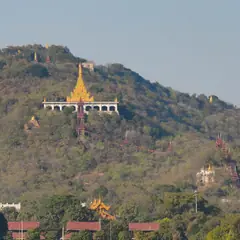
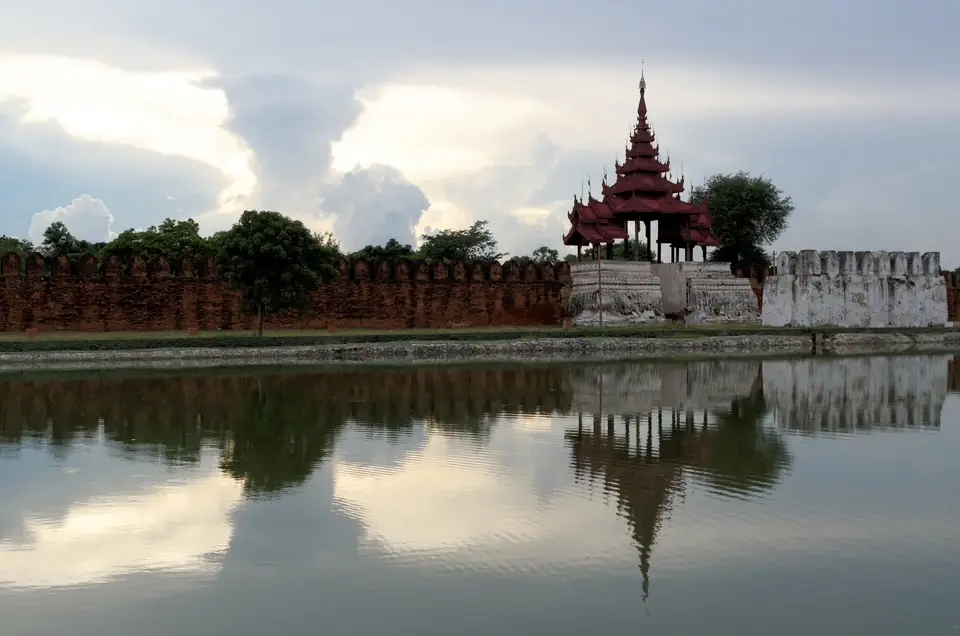
Mandalay Palace was the last residence of the Burmese monarchy. King Mindon built it between 1857 and 1859 by reusing the wooden palace of Amarapura, dismantled and carried by elephants to the foot of Mandalay Hill. It is surrounded by a 413-hectare citadel with four 2-km walls, 48 bastions crowned by gilded pyatthat, twelve gates each with its zodiac sign and a moat 64 metres wide. At the centre, the golden seven-tiered spire over the Lion Throne Hall marks the heart of the city.
Almost everything that gleams today is a copy. The teak palace was reduced to ashes on 17 March 1945, under Allied bombing aimed at the Japanese troops entrenched in the citadel, and what visitors walk through is the 1989-1991 reconstruction, faithful in design but made of concrete and corrugated sheet. The original Lion Throne is in Yangon, and the only great original structure to survive is a chamber that King Thibaw removed from the compound out of fear of his father's spirit.
Highlights
- Walls and moat — Four 2-km walls, 48 bastions with gilded pyatthat and a moat 64 metres wide
- Clock Tower — A gong, a drum and a brass water clock announced the hour to the city every three hours
- Royal Mint — Where Burma's first coin was struck in 1865, later a bakery for British troops
- Lion Throne pyatthat — A golden seven-tiered spire over the 1989-1991 reconstruction
- Watch Tower — 24 metres and seven tiers, with a view over the whole royal compound
In the exact centre of Mandalay, Mandalay Palace was the seat of the last two kings of Burma, Mindon and Thibaw. Mindon laid the first stone on 13 February 1857, and most sources date the work between June 1857 and 23 May 1859, although The Irrawaddy stretches it from 1856 to 1863. It did not start from scratch: the wooden complex was dismantled at Amarapura and travelled by elephant to the foot of Mandalay Hill, having already gone from Ava to Amarapura and back before Shwebo Min reassembled it at Amarapura in 1837.
The history of Mandalay Palace is a series of losses. On 28 November 1885, in the Third Anglo-Burmese War, British troops entered the palace and took the royal family prisoner; the compound was renamed Fort Dufferin. On 17 March 1945, after nine days of Japanese resistance inside the citadel, Allied bombing reduced the teak court to ashes. Reconstruction began in 1989 under the Department of Archaeology, and in 1991 the great pyatthat of the Lion Throne Hall was completed. And the magnitude 7.7 earthquake of 28 March 2025 brought down a large pagoda on the walls and tilted the towers over the moat; by March 2026 they had been straightened.
The architecture of Mandalay Palace is understood at the scale of a citadel: a 413-hectare compound closed by four 2-km walls, 48 bastions with gilded pyatthat every 169 metres, twelve gates and a moat 64 metres wide and 4.5 deep. Inside, on the palace platform, come the Great Audience Hall, the Glass Palace and the Watch Tower, among ceremonial towers, mausoleums and the Royal Mint. The compound is also still a military installation: the Burmese army’s Central Command keeps a large complex inside.
To know what to see at Mandalay Palace, the audio guide walks the citadel in five stops and 75 minutes, from the bridge at the east gate to the top of the Watch Tower. The thread is an uncomfortable idea: this palace is above all a collection of absences, the teak, the throne and the king, and what shines in the sun today is the copy of a court that travelled, fell and burned.
From the old compound came, dismantled, the chamber where Mindon died, which survives today as the Shwenandaw Monastery. To the northeast rises Mandalay Hill, which gave the city its name, and the Zegyo Market was born together with the capital.
A square of 2,400 ta above the moat
Mandalay Palace East Gate
Summary of this stop
On the bridge at the east gate, the citadel opens up in all its geometry: a crenellated brick wall running in a straight line, bastions topped by pavilions with stacked roofs at regular intervals and, in the background, Mandalay Hill. The main gate rises under a seven-tiered pyatthat, protected by a barbican wall in front of the bridge and by a great teak post bearing the gate’s name plaque and its construction date.
Nothing in this layout is accidental. The citadel was drawn as a perfect square to commemorate the year 2400 of the Buddhist era: each side measures 600 ta and the perimeter, 2,400. Each of the twelve gates, three per side, has its zodiac sign. Of the five original bridges over the moat, four led to the central gates; the fifth, toward the southwest gate, was reserved for ill-omened uses, such as carrying the dead out of the royal compound. The wounds of 2025 can still be read in the sunken stretches of wall and the new brick crenellations.
Behind it stands the hill and its legend. Tradition says the Buddha prophesied a great city there for the year 2400 of his teaching, and that an ogress, Sanda Mukhi, would be reborn as the king who founded it. Mindon announced that three dreams commanded him to move the court; the sceptical reading sees a prophecy made to measure to persuade the 150,000 residents of Amarapura to follow him. From the bridge, the narration reveals the ogress’s gesture that, according to the legend, won her the throne.
A water clock and a relic without a tooth
Clock Tower and Tooth Relic Tower
Summary of this stop
To the right of the entrance road stands the Clock Tower (Bahozin), a double-roofed wooden platform on a tall square plinth. From here the hour was announced to the whole city with a gong and a great drum every three hours. Time was not kept by any mechanism but by a water clock: a perforated brass bowl that sank in a jar of water at fixed intervals.
Almost opposite, the Tooth Relic Tower (Swedawzin), of brick and three tiers, with manussiha figures at the corners, never held any tooth of the Buddha. It was built because every royal capital had to have one, a custom going back to King Bayinnaung. It was part of the obligatory props of a Burmese court.
A little farther northeast, past the mausoleums of Mindon and his queens, the Royal Mint keeps its brick workshop. Here Burma’s first coin was struck in 1865, and after the British annexation it served for years as a bakery for the troops; it was also one of the few buildings that withstood the 1945 bombing. Between the two towers, the audio guide explains how the day was measured at court with a simple bowl of water.
The golden spire made of concrete
Great Audience Hall
Summary of this stop
At the foot of the eastern stairway, beside old cannons, the front of the Great Audience Hall opens. Above it, the golden seven-tiered spire of the Lion Throne Hall marks the centre of the city. It is the most photographed image of the compound, and also the most deceptive.
Everything seen is a replica. The teak palace burned on 17 March 1945, after nine days of siege. Who bore the blame is still debated: Britain’s Secretary of State for War argued in the Commons that the Japanese were holding out in Fort Dufferin and that the wood made the risk great, and the Allies never accepted responsibility. Nor is there agreement on what was left standing. The 1989-1991 reconstruction respected the design but used concrete and corrugated sheet where the original was solely teak, and local residents were forced to work three days a month on the site unless they paid a fee. The official account presents it as a faithful work to revive the national spirit; other sources stress its human cost.
Of the palace’s eight thrones, seven burned. The main one, the Lion Throne, was saved because the British had taken it to India, although sources disagree on whether that was in 1885 or 1902. Returned after independence in 1948, it has been on display since 12 September 1959 at the National Museum in Yangon. At the foot of the stairway, the narration tells who took part in that return.
The chamber that fled the palace
Glass Palace
Summary of this stop
The Glass Palace (Hmannan) is the largest chamber of the rebuilt palace, divided into two halls: the Bee Throne Hall and Mindon’s former bedchamber. It is here that the wood that is no longer there weighs most, that of a complex that had travelled from capital to capital before reaching Mandalay.
In October 1878, King Thibaw ordered the apartment his father had occupied to be dismantled, convinced that his spirit lived there, and rebuilt it outside the citadel as the Shwenandaw Monastery. That move saved it from the fire: today it is the only great original structure of the palace to survive, and the only authentic teak of this court has to be sought outside the walls.
Beneath so much gold there is a black night. According to documented tradition, between 13 and 17 February 1879, a few months after Thibaw’s coronation, more than forty princes and princesses who could dispute his throne were executed inside the compound, on the orders of the queen dowager Hsinbyumashin and senior ministers; so as not to spill royal blood, many had their throats crushed with bamboo poles. It is said that, meanwhile, the music of the court troupe played louder. Even the place is not certain, and in 1924 Queen Supayalat denied any guilt. In Mindon’s chamber, the audio guide reveals the fate of the bodies.
Supayalat’s last lookout
Mandalay Palace Watch Tower
Summary of this stop
On the south side of the platform rises the Watch Tower (Nanmyintsaung), 24 metres high and crowned by a seven-tiered pyatthat. It survived the 1945 bombing and from its lookout the whole compound can be surveyed: the grid of the citadel, the walls and the city around.
It is said that from here the kings watched the river, the hills and the city lit up for the Thadingyut festival, and that from here too Queen Supayalat saw the British troops enter in November 1885. What is documented is what came next: on 28 November the British took the royal family prisoner, and the following morning Thibaw left in an ox cart for an Irrawaddy steamer, bound for exile in Ratnagiri (India).
Since then, the compound has never ceased to be a fort: first Fort Dufferin, with the British troops, and later the seat of the Burmese army, whose Central Command keeps a large complex here. After the 2021 coup, according to reports gathered, the palace housed one of the country’s most feared interrogation centres. At the top of the tower, the narration closes the tour with the last image that, as the story goes, the queen had of her kingdom.