Sacred hill
Mandalay Hill Audio Guide
The hill that gave Mandalay its name is climbed by a covered stairway of 1,729 steps past shrines, a golden Buddha pointing a finger at the city announced by a prophecy, and a summit that was a Japanese stronghold in March 1945.
- 90 min of audio
- Pilgrimage and viewpoint
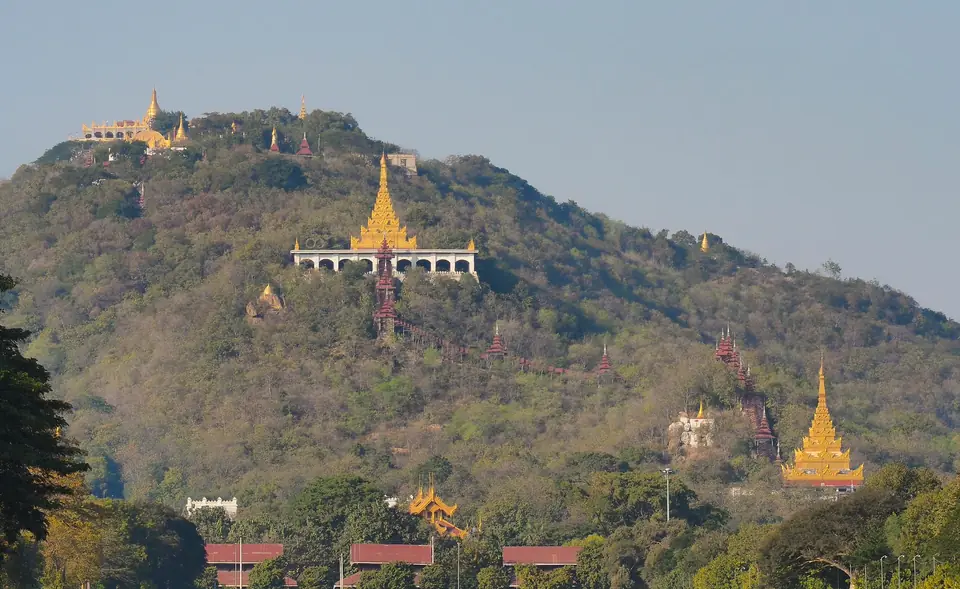
Mandalay Hill rises some 240 metres northeast of the centre and is the hill from which the city took its name. At the foot of this sacred mountain King Mindon built his new capital, moved from Amarapura, which was a capital for only 25 years, from 1860 to 1885. Four covered stairways, the saungdan, climb to the summit from the south, southeast, west and north, and much of that architecture of roofs and pavilions is the work of the hermit U Khanti, who looked after the hill for 40 years.
On the same ridge sit the most devout image and the most brutal episode. Just before the summit, the ogress Sanda Muhki offers her own breasts to the Buddha, and she is considered an earlier incarnation of King Mindon. A few steps away, in March 1945, the Japanese turned the temples into a stronghold linked by tunnels, and the British had to take them one by one, with grenades, because bombing the pagodas was ruled out.
Highlights
- Southern covered stairway — 1,729 steps between two white chinthe, with stalls of flowers and offerings
- Shweyattaw Buddha — A great standing golden Buddha pointing at the city with a gesture unique to Myanmar
- Statue of Sanda Muhki — The kneeling ogress offering her breasts to the Buddha before the summit
- Sutaungpyei Pagoda — A mosaic terrace with views of the plain, the moat, Kuthodaw and the Irrawaddy
- Traces of 1945 — The flat-roofed Pavilion and the plaques of the regiments that took the hill
Northeast of the centre, Mandalay Hill rises above the Irrawaddy plain and explains the whole city: Mandalay took its name from it. Its height changes depending on who measures it, between 224 and 240 metres, and the military account of 1945 spoke of 776 feet. What does not change is its role. At the foot of this sacred hill King Mindon built the kingdom’s new capital, moved from Amarapura; most sources set its foundations in 1857, the year 2400 of the Buddhist era, although some give a later date for the move. Mandalay was the capital of Burma for only 25 years, from 1860 to 1885, before falling into British hands in 1886.
The history of Mandalay Hill is at once that of a prophecy, of a hermit and of a battle. The prophecy announced a great city at the foot of the mountain in the year 2400 of the Buddhist era, and a golden Buddha still points at it with his finger. The hermit, U Khanti (1868-1949), spent 40 years rebuilding ruined pagodas and shrines with donations, and much of the covered stairway is his. The battle came in March 1945, when the temples at the summit became a Japanese stronghold.
The architecture of Mandalay Hill is that of a vertical pilgrimage. Four covered stairways, the saungdan, climb it from the south, southeast, west and north, with landings, brick benches and pavilions (tazaungs) decorated with painted friezes, mostly from the end of the Konbaung dynasty, among them a detailed scene of the Avici hell. At the top waits the Sutaungpyei Pagoda, “the one that fulfils wishes”, covered in mosaics; one encyclopedia attributes it to King Anawrahta of Bagan in the 11th century, while other sources present that authorship as traditional belief and point to renovations by the Konbaung kings. At the end of the access road, escalators and a lift also lead to the summit pagoda; from the base of the complex visitors go barefoot.
To know what to see at Mandalay Hill, the audio guide climbs the southern stairway in five stops and 90 minutes, from the guardian lions to the summit terrace. The thread that binds them: every step supports a prophecy that justified a city, the patience of a hermit who rebuilt it and a war that came close to reducing its pagodas to rubble.
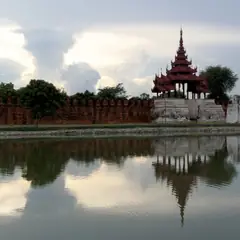
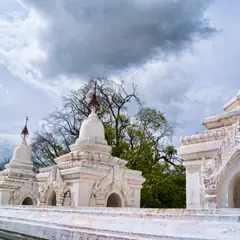
From the summit the moat of the Mandalay Palace can be surveyed, and at the foot of the hill wait the white shrines of the Kuthodaw Pagoda.
Two white lions and 1,729 steps
Chinthe of the south stairway
Summary of this stop
The main climb starts at the south entrance, between two enormous chinthe, the white guardian lions that give this “ascent of the two chinthe” its name. Behind them begins the southern covered stairway: 1,729 steps under a roof, like a tunnel of shade, dotted with brick benches and stalls of flowers, parasols and offerings for pilgrims.
Along the way figures of a rabbit, a rooster or a lizard appear before images of the Buddha. They are not decoration. Legend says the hill had a different name under each Buddha of the past and that, long before his enlightenment, the future Buddha lived in its surroundings as king of the elephants, of the lions, of the deer, of the monitor lizards, of the roosters and of the quails.
One of those lives would have to do with the place’s own name, although it is not the only explanation in circulation: others derive it from mandala or from the refuge of a prince of Bagan. Beside the chinthe, the audio guide tells which of those earlier lives would, according to popular belief, have christened an entire city.
The hermit who roofed the hill
U Khanti's Dazaung
Summary of this stop
The stairway has a name of its own. The hermit U Khanti, born in 1868 and a hermit since 1900, looked after the hill and organised its religious life for four decades. With donations he rebuilt ruined pagodas and shrines, and the covered stairway and many of the pavilions along the climb are his work.
In his dazaung, the pavilion that bears his name, a little-known treasure was kept for years: three bone fragments of the Buddha found in 1908-1909 beneath the Kanishka stupa at Shah-ji-ki-Dheri, in Peshawar. The British sent them to Burma in 1910, they were kept here from 1923 and, after the Second World War, they moved to a building at the foot of the hill, where they are not on display. The pavilion is exited through a tunnel flanked by the 28 Buddhas or by a steep stairway beside it.
The Kanishka reliquary supports that these are remains of the Buddha and yet the temple that kept them receives hardly any local veneration. Sources attribute this to the hands that brought them, in the midst of anti-colonial tension. In the dazaung, the audio guide unpicks why genuine relics arrived at a bad moment and through the wrong door.
The Buddha who points at the city
Shweyattaw Buddha
Summary of this stop
Halfway up, the Shweyettaw pavilion houses a great standing golden Buddha, the Shweyattaw or Byadeippay, “the one who prophesies”. His right arm is extended and his finger points toward the plain, toward the city and the palace compound. It is a non-traditional mudra, a gesture unique to Myanmar.
That finger sums up the logic of Mandalay. It is tied to the prophecy according to which, in the year 2400 of the Buddhist era, a great city would arise at the foot of the hill. King Mindon left Amarapura and moved the capital to this site; the city born of that announcement was a capital for only 25 years, from 1860 to 1885.
In front of the Shweyattaw Buddha, the audio guide reconstructs how a prophecy ended up justifying the move of an entire kingdom, and what became of that capital barely a generation later.
The devout ogress and the tunnel of fire
Statue of Sanda Muhki
Summary of this stop
Just before the summit pagoda, on the south terrace of a small stupa, appears one of the most unusual images on the hill: the ogress Sanda Muhki, kneeling, offering her own breasts to the Buddha, with ogre kings and their miniature armies at the four corners. The prophecy that has her reborn as the founding king is dated to the year 2400 of the Buddhist era, 1857, the year Mindon laid the foundations of Mandalay; that is why she is considered an earlier incarnation of the king.
Eighty-eight years later, this same ridge was a battlefield. In March 1945 the Japanese turned the temples into a garrisoned stronghold, many linked by underground tunnels, and General Thomas Wynford Rees’s 19th Indian Division had to take them one by one. On the night of 8 to 9 March, D Company of the 4th/4th Gurkha Rifles set out at three in the morning for the summit under Subedar Damarsing Pun; counter-attacked that morning, when his colonel asked him by radio whether he needed anything, he replied: “No, only breakfast. Out.” The battalion lost 17 dead and 49 wounded on the hill and its surroundings, and sources disagree on the exact day the hill was declared taken.
The ogress’s shrine, the “Second Pagoda” to the British, was stormed with grenades on 10 March, according to the account of the fighting, and its survivors took refuge in a tunnel that crossed the hill from side to side. What happened down there has been told in more than one version. In front of Sanda Muhki, the audio guide narrates how the darkest side of the battle was fought beside the most devout image on the hill.
The pagodas nobody wanted to bomb
Sutaungpyei Pagoda
Summary of this stop
The climb ends on the terrace of the Sutaungpyei Pagoda, decorated with mosaics. From here opens the view the golden Buddha was pointing to: the plain, the moat and the wall, the Kuthodaw Pagoda and the Irrawaddy. Beside the summit stands the Pavilion, a flat-roofed concrete building of about 23 by 15 metres, the Myatsawnynaung Thein.
Here one of the last Japanese redoubts held out on 11 and 12 March 1945. An air strike against the pagodas was requested and not authorised for fear of damaging the religious buildings, so the 2nd Battalion of the Royal Berkshire took it with grenades, thrown through holes opened in the roof. When the fighting ended, U Khanti’s secretary showed Major Twidle where the Japanese mines on the hill were, and they were removed. In 1986 three plaques were photographed on the hill, of the 19th Indian Division, the 4th/4th Gurkha and the 2nd Royal Berkshire, the latter under the Pavilion, and, on the beams of the covered walkways, bullet and shrapnel impacts.
General Rees had forbidden bombing the sacred sites and, according to Major Hill’s account, the hermit answered that respect with an unexpected gesture toward an English regiment at the height of the colonial era. On the terrace of the Sutaungpyei, the audio guide closes the tour with that gift and with the doubt over whether it was ever celebrated.