Pilgrimage shrine
Mahamuni Pagoda Audio Guide (Mahamuni Buddha Temple)
Mandalay's most venerated shrine was built to hold a spoil of war: a bronze Buddha seized from Arakan in 1784, now deformed by a crust of gold some 15 centimetres thick, whose face a monk washes every dawn as if it were someone alive.
- 60 min of audio
- Gold-covered Buddha
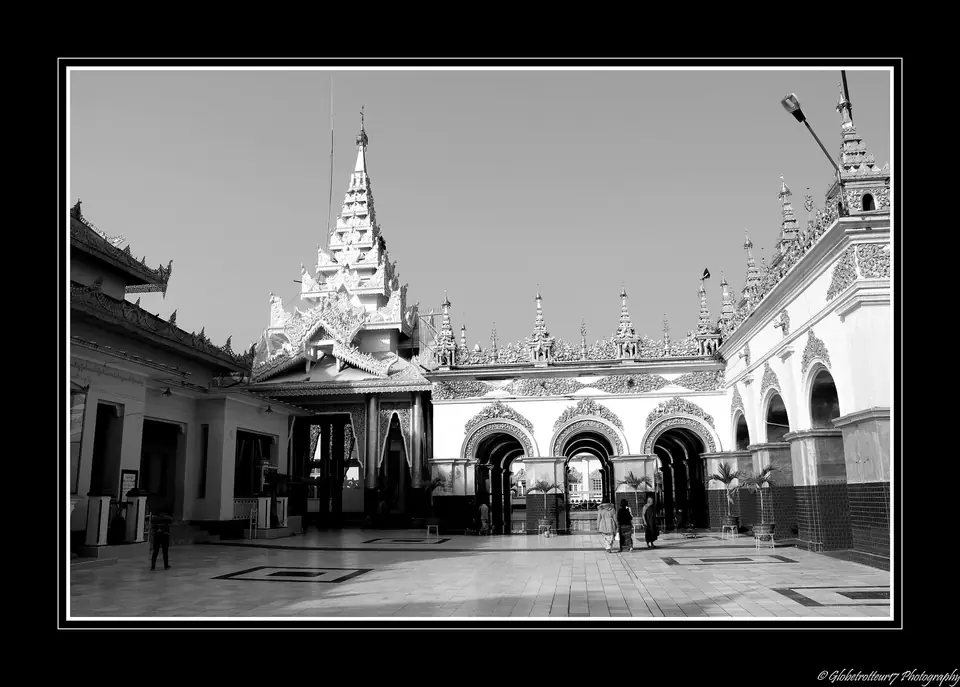
The Mahamuni Pagoda was born in 1784, when King Bodawpaya conquered the kingdom of Arakan and carried off its most sacred image, which he installed in a temple north of his capital, Amarapura. That is why it now lies in the south of Mandalay, a city founded decades later. The Burmese name Rakhine Hpaya-gyi, the Great Pagoda of Rakhine, and the British Arakan Pagoda still preserve that origin. The present brick pavilion, from 1896, wraps the original shrine and is crowned by a seven-tiered golden roof.
The contrast is plain to see: the image's body, of about 6.5 tonnes, is swollen with the gold leaf that male devotees apply, while the face keeps its smooth shape. That face is washed every day around 4 in the morning, for over an hour, and the used towels go back to the faithful, who keep them on their home altars. In the courtyard, six bronzes from Angkor that changed hands as spoils four times gleam where pilgrims rub them to be cured.
Highlights
- Mahamuni image — A bronze Buddha of about 6.5 tonnes and 3.8 metres under a crust of gold some 15 cm thick
- Dawn face washing — Every morning, around 4, a senior monk washes the image's face for over an hour
- Khmer bronzes — Six pieces from Angkor, war spoils four times over, polished by the touch of the faithful
- East access gallery — Arcades of golden columns among stalls of incense, flowers and robes
- Bodawpaya's inscriptions — Steles gathered from across the country, being rebuilt after the 2025 earthquake
In the south of Mandalay, the Mahamuni Pagoda, also called Maha Myat Muni, is the most venerated pilgrimage shrine in the city, and its origin is an act of war. In 1784 King Bodawpaya conquered the kingdom of Arakan and carried off the Mahamuni image, which he installed in a temple built north of his capital, Amarapura. Mandalay was founded decades later and ended up surrounding the shrine. The Burmese also call it Rakhine Hpaya-gyi, the Great Pagoda of Rakhine, and in British times it was known as the Arakan Pagoda: the name has never stopped recalling where the spoil came from.
The history of the Mahamuni Pagoda is made of moves, fires and reconstructions. According to Arakanese tradition, the image was cast in the Buddha’s lifetime; archaeology places it around the 2nd century AD, and some suspect that the present bronze combines pieces from different periods. A fire in 1884, under King Thibaw, reduced the pavilion to ashes but spared the image. In 1896 the minister Kinwun Mingyi U Kaung, with Western architects, built the present brick pavilion wrapping Bodawpaya’s shrine. And the earthquake of 28 March 2025 bent the image’s crown, brought down the diamond finial of the roof and sank the museum and several covered stairways.
The temple also cannot be understood without its devotional life. Beyond the daily face washing, documented tradition says that on Uposatha days an orange stole is placed on the image and it is fanned, and that in the cold season it is wrapped in a robe; in the days of the kings, a procession brought it food every day from the palace under a royal white umbrella. At the full moon of Tabodwe, around February, the great Mahamuni festival fills the courtyard with glutinous-rice bonfires, incense and thanaka stalls. It is even said that in 1942, during the war, thousands of monks with bamboo staves stood up to Kuomintang soldiers who wanted to melt the image down.
To know what to see at the Mahamuni Pagoda, the audio guide walks the compound in five stops and 60 minutes, from the east access gallery to the courtyard of the bronzes and the inscriptions. The thread that binds them is uncomfortable and fascinating: here nothing arrived willingly, neither the image nor its bronzes, and perhaps that is why the faithful tend it every dawn like someone they have no intention of letting go.
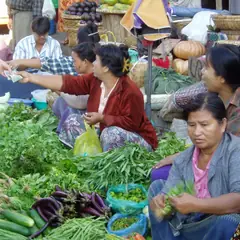
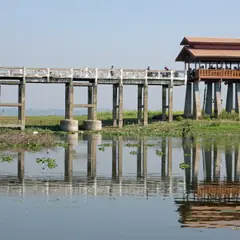
When it was built, the pagoda lay north of Amarapura, the old capital from which the U Bein Bridge starts today; toward the centre, the Zegyo Market completes the portrait of everyday Mandalay.
A market corridor toward a spoil of war
East access gallery
Summary of this stop
The formal entrance to the shrine is the east access gallery, a covered corridor of arcades with golden columns and carvings, flanked by stalls of incense, flowers, robes and souvenirs. Devout commerce accompanies the pilgrim until it opens out in front of the image. In July 2025, with the pagoda damaged after the earthquake, it was the only open door.
That corridor is the last stretch of a much longer journey. The image left Dhanyawadi, in Arakan, on 4 January 1785: it went down on rafts to Taungup, crossed the Yoma range overland, passed 54 stages and 138 mountains and went up the Irrawaddy on two joined golden rafts to the Sagaing landing. It took more than four months, under the command of the crown prince Thado Minsaw, whose bronze statue stands today in the compound. On arrival, Bodawpaya himself went down to the river with the water up to his neck to receive it, escorted by the four corps of his army.
Not everyone sees that journey the same way. For many Arakanese the move of 1784 was a theft, and part of the Rakhine tradition even holds that the Mandalay image is a copy and that the original was hidden or lost on the way; most Burmese and many Arakanese take it to be the original. Under the arcades, the audio guide follows the route of the golden rafts to the gesture with which a king stepped into the river.
Fifteen centimetres of gold and a smooth face
Mahamuni Pagoda
Summary of this stop
In the chamber waits the Mahamuni image: a seated Buddha in the earth-touching gesture, crowned and jewelled, of about 6.5 tonnes and some 3.8 metres on a pedestal of 1.84 metres. It can be seen from the front and from both sides, from the men’s enclosure in front and from the area behind. Its silhouette is no longer the original: the gold leaf applied by male devotees has formed a crust of about 15 centimetres that swells the body, while the face keeps its smooth shape. Women do not apply it directly; they leave their sheets in boxes for others to apply.
The smooth face has an explanation. Every dawn, around 4 or 4:30, a senior monk washes the image’s face and brushes its teeth for over an hour. Since 17 February 1988 the sayadaw Bhaddanta Paññavaṃsa, of the Taung Htilin monastery, has officiated; some sources date the start of the ritual to that day and others trace it back to at least 1886-1887. When it ends, the used towels are returned to the faithful, who keep them on their home altars.
Behind that care lies a legend. According to Arakanese tradition, King Sanda Thuriya asked the Buddha to leave his image, and Sakka, king of the gods, cast it from the gold and jewels donated by the people. What happened next, when the Buddha stood before it, explains why for the devotee this is not a statue. In front of the chamber, the audio guide tells that moment.
The body that was once mutilated
Old photographs of the image
Summary of this stop
Beside the chamber, some old photographs allow the image’s silhouette of a century ago to be compared with the present one, thickened by gold. The comparison invites the question of what lies underneath. In April 1884 a fire reduced the pavilion, its four covered stairways and the neighbouring monasteries to ashes; the crown, the earrings and the gold bands melted, but the image stayed intact. From the molten metal more than 5,450 ticals of gold were gathered, some 91 kilos, which were turned into the gold mantle the figure still wears today.
The Arakanese chronicles hold a darker episode. According to that documented tradition, in the early 12th century soldiers sent by the king of Pagan sacked the shrine looking for treasure and left the image gravely mutilated; for six reigns nobody knew where it was, until it was found deep in the jungle, sunk in the earth. The versions disagree on which parts of the body were lost.
The last shock came in 1997, during the military regime’s works begun a year earlier: a hole appeared in the image’s belly, it was covered with a monastic robe and the monks of Mandalay demanded its removal, in an episode that coincided with that year’s anti-Muslim riots in the city. What caused it, and whether there was anything inside, remains unclear. In front of the photographs, the audio guide dwells on the question all this leaves: how much of the body under the gold is the original.
Angkor bronzes worn down by pain
Hall of the Khmer bronzes
Summary of this stop
At the north end of the courtyard, the hall of the Khmer bronzes holds six pieces that came from Angkor: the three-headed elephant Airavata, three lions with heads remade in Burmese style and two warriors. Today they stand in the centre of the hall, on a platform and behind glass, and show areas that gleam polished.
Their path is that of a trophy that never stays still. They left Angkor for Ayutthaya in 1431; Bayinnaung took them to Bago in 1564, Razagri to Mrauk U in 1599 and Thado Minsaw to Amarapura in 1785, together with the image. Later, King Thibaw melted many down to make cannon: of the original thirty six remain, although one source speaks of five.
The shine has another explanation, and it is not art history. According to local custom, anyone suffering an ailment rubs the afflicted part of their body against the same part of the figure, convinced they will be healed, and it is said that these pieces acquired that power only on arriving at the temple. In front of the platform, the audio guide reveals the gesture proper to those with stomach complaints, the strangest of all.
The king’s steles and a fallen roof
Bodawpaya inscription gallery
Summary of this stop
In the southeast corner of the courtyard stretches the inscription gallery that Bodawpaya gathered from across the country: steles of marble and sandstone, some gilded. It was damaged in 2025, and on 14 February 2026 Nepal handed over at the pagoda itself 300,000 dollars to rebuild it. Very close by, in a large pond, pilgrims feed fish and turtles with rice cakes, and in the courtyard two enormous bronze gongs, cast in the 1960s and 1970s, each occupy a shed of their own.
From here the seven-tiered golden roof that crowns the image’s chamber can be seen. Beneath it, the brick pavilion of 1896 wraps Bodawpaya’s original shrine, whose dates and exact form sources still dispute. The 2025 earthquake damaged that pavilion and threw its diamond finial to the ground; the casualty toll in the compound was also reported contradictorily.
It is the last layer of a temple that has been wrapped and rebuilt again and again, without the pilgrimage ever stopping. Among the king’s steles, the audio guide closes the tour by tying together the threads of that story of spoils, fire and devotion.